Japa Mantra Meditation Workshop
Jack UtermoehlThis page is a reference for the Japa Mantra Meditation workshop at Transcend Yoga Festival presented by Jack Utermoehl. Use it to review the mantras, understand the practice, and continue your own japa meditation at home.
The core teaching is simple: the mind already repeats. Mantra helps us choose what we repeat with attention, devotion, and care.
What Is Japa Mantra Meditation?
Japa is the repetition of a mantra. A mantra is a sacred sound, word, or phrase used to gather and direct the mind. In practice, mantra gives attention a steady place to return.
Japa may be practiced aloud, softly, mentally, or silently. A mala can be used to count repetitions and support rhythm.
"What you repeat, you strengthen. What you strengthen, you begin to live from."
Key Terms
| Term | Meaning | Practice Use |
|---|---|---|
| Mantra | A sacred sound, word, or phrase used to focus the mind. | The object of repetition. |
| Japa | The repetition of mantra. | The method of practice. |
| Mala | A strand of beads used to count mantra repetitions. | The tactile support for rhythm and consistency. |
| Bhakti | Devotion, relationship, love, and offering. | The heart of the practice. |
| Dharana | Concentration, or binding the mind to one object. | The focused attention behind mantra practice. |
The Practice Progression
You can practice mantra in four modes. You can use the same progression at home.
- Audible repetition: Chant the mantra out loud so the body, breath, and voice join the practice.
- Soft repetition: Lower the volume and let the mantra become more internal.
- Mental repetition: Repeat the mantra silently in the mind.
- Silence: Release the repetition and notice what remains.
When the mind wanders, return to the next repetition. The return is the practice.
Opening Invocation
Vande Gurunam
This invocation honors the teachers, the teachings, and the wisdom that guides the practice.
Mantra:
Vande gurunam charanaravinde
Sandarshita svatma sukhava bodhe
Nihshreyase jangalikayamane
Samsara halahala mohashantyai
Abahu purushakaram
Shankha chakrasi dharinam
Sahasra shirasam shvetam
Pranamami Patanjalim
Simple meaning:
I bow to the teachers who reveal the joy of the inner Self. I bow to Patanjali, who is honored as a guide of yoga, wisdom, and liberation.
In this workshop, Vande Gurunam is used as an invocation. You do not need to memorize it to practice japa.
Mantras from the Workshop
| Mantra | Use | Simple Meaning |
|---|---|---|
| Om Gam Ganapataye Namaha | Beginning, clearing obstacles, grounding, entering practice. | I bow to Ganesh, remover of obstacles and guardian of new beginnings. |
| Om Shri Maha Lakshmyai Namaha | Inner wealth, beauty, steadiness, gratitude, nourishment, receptivity. | I bow to Lakshmi, the great presence of abundance, grace, and auspiciousness. |
| Om Namah Shivaya | Release, integration, inner Self, transformation. | I bow to Shiva, the auspicious inner Self. |
| Om Aim Saraswatyai Namaha | Learning, wisdom, creativity, voice, study, teaching. | I bow to Saraswati, source of wisdom, learning, and inspired speech. |
| Om Mani Padme Hum | Compassion, tenderness, universal care, open-hearted presence. | Often rendered as “the jewel in the lotus,” this is a mantra of compassion. |
Pronunciation Guide
Pronunciation matters, but it does not need to become a barrier. Begin with sincerity, listen carefully, and refine over time.
| Mantra | Simple Pronunciation |
|---|---|
| Om Gam Ganapataye Namaha | Ohm gum guh-nuh-puh-tuh-yay nuh-muh-huh |
| Om Shri Maha Lakshmyai Namaha | Ohm shree muh-hah luck-shmee-yai nuh-muh-huh |
| Om Namah Shivaya | Ohm nuh-muh shee-vai-yuh |
| Om Aim Saraswatyai Namaha | Ohm eye-eem suh-ruh-swah-tyai nuh-muh-huh |
| Om Mani Padme Hum | Ohm mah-nee pud-may hoom |
How to Practice Japa at Home
Keep the practice simple. Choose one mantra and stay with it long enough to build a rhythm.
7-Day Japa Practice
- Choose one mantra. Use Ganesh for beginnings, Lakshmi for cultivation, Shiva for release, Saraswati for learning, or Om Mani Padme Hum for compassion.
- Choose one time. Morning and evening are common times.
- Choose one seat. Practice in the same place when possible.
- Practice for one full mala. You may also complete more than one mala of 108 repetitions.
- Pick your comfort level. Audible, soft, mental, silence.
- Write a line after practice. Note what you felt, noticed, resisted, or understood.
A simple practice is easier to repeat. Repetition is the point.
How to Use a Mala
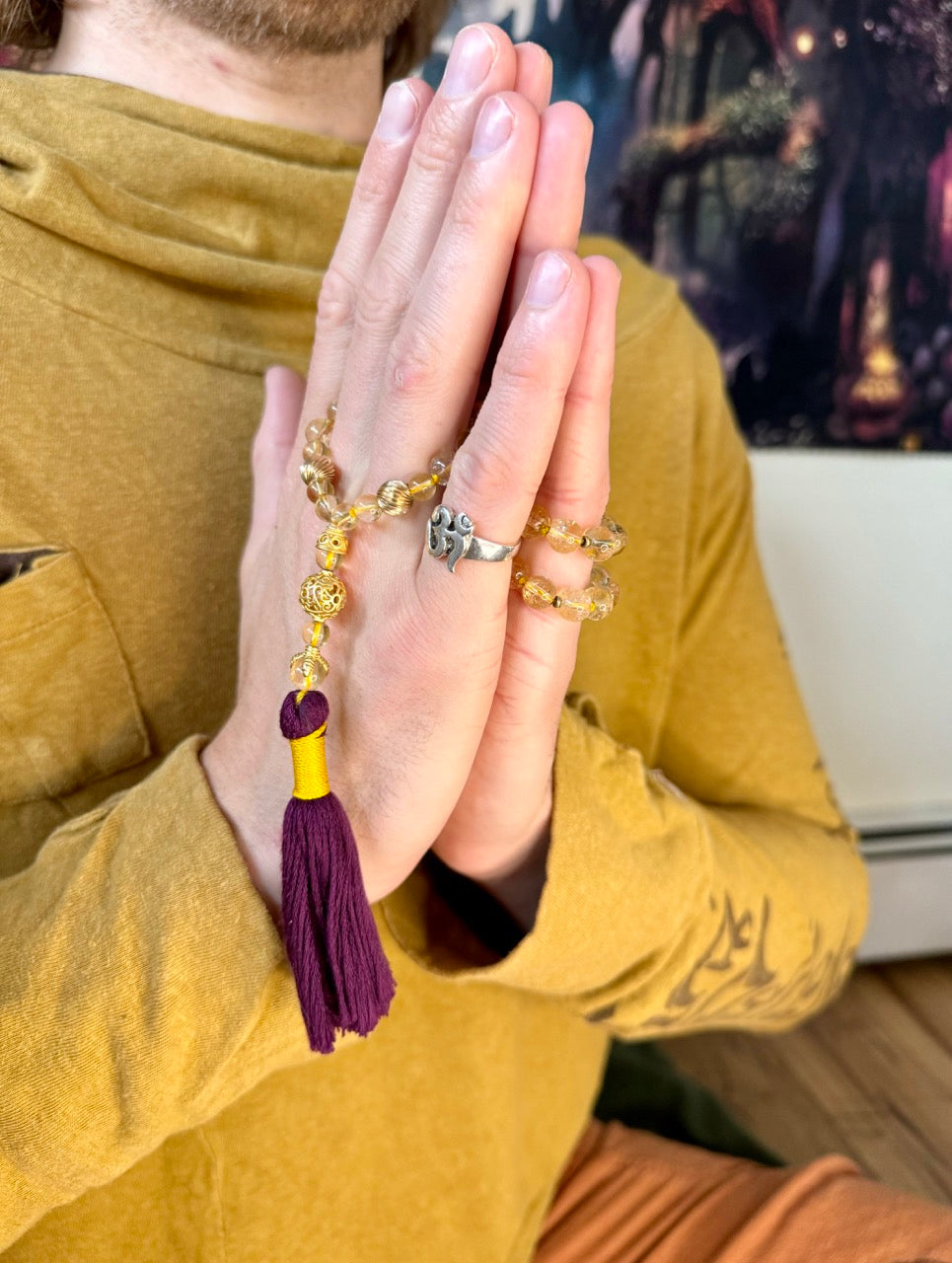
A mala is a strand of beads used to count mantra repetitions. Most traditional malas have 108 beads plus one larger bead called the guru bead or meru bead.
- Hold the mala in one hand with thumb and middle finger.
- Begin on the bead next to the guru bead.
- Repeat the mantra once per bead.
- Move one bead at a time.
- When you return to the guru bead, pause
- To continue, turn the mala around rather than crossing over the guru bead.
The mala is more than just a counter. It gives the mind, body, and mantra a shared rhythm.
Choosing a Mantra
Choose a mantra based on what you are practicing, not only what sounds beautiful.
| If You Are Practicing... | Consider This Mantra |
|---|---|
| Beginning something new | Om Gam Ganapataye Namaha |
| Clearing resistance or obstacles | Om Gam Ganapataye Namaha |
| Gratitude, enoughness, or inner wealth | Om Shri Maha Lakshmyai Namaha |
| Release, transformation, or inner steadiness | Om Namah Shivaya |
| Study, teaching, creativity, or voice | Om Aim Saraswatyai Namaha |
| Compassion and open-hearted presence | Om Mani Padme Hum |
Once you choose, stay with the mantra for at least 7 days. Depth comes through relationship. Long-term benefits come from repeating a mantra 100,000+ times. That's only 1000 full malas.
Reflection Prompts
Use these prompts after practice or at the end of the day.
- What did I notice in my body?
- What happened to my breath?
- What phrase or thought was repeating in my mind before practice?
- What changed after the mantra?
- Did the mantra feel like sound, meaning, prayer, focus, resistance, or relationship?
- What am I strengthening through repetition?
When the Mind Wanders
The mind will wander. This is normal. In japa practice, wandering is not failure. It is the moment you notice that attention has moved away from the mantra.
When you notice the mind wandering, return to the next repetition. You do not need to restart. You do not need to judge the practice. Simply continue.
Frequently Asked Questions
Do I need to believe in the deity to practice the mantra?
No. You can approach the mantra devotionally, symbolically, psychologically, or meditatively. A sincere relationship with the practice is more important than forcing belief.
What if I mispronounce the mantra?
Begin with care and refine over time. Listen to trusted teachers when possible. For home practice, sincerity, attention, and consistency matter.
Can I use an English phrase instead?
Yes, though Sanskrit mantra carries a traditional sound structure and lineage. If Sanskrit feels inaccessible at first, begin with a simple phrase that gathers your mind and supports your practice.
Do I need a mala?
No. A mala is helpful, but not required. You can practice by time, by breath, or not counting repetitions. A mala simply makes the practice more tactile and steady.
How long should I practice?
Start with one full mala of 108 repetitions which is a traditional and useful practice length of 5-10 minutes.
Can I practice more than one mantra?
Yes, but for a beginning home practice, choose one mantra for at least 7 days. Staying with one mantra helps build depth, steadiness, and relationship.
Continue Your Practice
Japa is simple, but it becomes powerful through repetition. Choose one mantra, one seat, one time, and practice for 7 days.
If you would like a mala for your practice, you can explore handcrafted malas from Asivana Yoga.