Asato Ma Sadgamaya: Meaning, Translation, Pronunciation, and How to Chant
Jack UtermoehlPeople chant Asato Ma Sadgamaya as a prayer for guidance, clarity, and movement beyond darkness and mortality. Its familiar meaning is: “Lead me from what is unreal to what is real, from darkness to light, and from death to immortality.” The three-line prayer comes from the Brihadaranyaka Upanishad, a Vedic Sanskrit text. It may be recited quietly, spoken as a prayer, or sung in a group, with a brief pause after each line.
The Mantra
तमसो मा ज्योतिर्गमय ।
मृत्योर्मामृतं गमय ॥
tamaso mā jyotir gamaya
mṛtyor māmṛtaṃ gamaya
tamaso ma jyotirgamaya,
mrityor ma amritam gamaya.
Om asato ma sadgamaya,
tamaso ma jyotirgamaya,
mrityor ma amritam gamaya,
Om shanti shanti shanti.
Performers may repeat individual lines, add melody, or use call and response.
Translation
Lead me from what is unreal to what is real, from darkness to light, and from death to immortality.
From non-being or unreality, lead me to being or reality; from darkness, lead me to light; from death, lead me to the deathless.
“Unreal to real” is a conventional translation, but asat and sat have a wider range of possible senses, including non-being and being, untrue and true, or bad and good. In the Upanishadic passage itself, asat is explained as death and sat as immortality; darkness is likewise equated with death and light with immortality. “Lead us” is a common communal adaptation, but mā is grammatically singular: “me.”
How to Pronounce the Mantra
tuh-muh-soh maa jyoh-teer guh-muh-yuh
mrit-yor maa-mri-tung guh-muh-yuh
| Mantra | Pronunciation | Notes |
|---|---|---|
| asato mā sad gamaya | uh-suh-toh maa sud guh-muh-yuh | The o in asato is long. Hold mā approximately twice as long as a short a. Sad ends with a dental d produced near the upper teeth. |
| tamaso mā jyotir gamaya | tuh-muh-soh maa jyoh-teer guh-muh-yuh | Blend the j and y in jyotir rather than inserting a full extra vowel. Sanskrit o is long. |
| mṛtyor māmṛtaṃ gamaya | mrit-yor maa-mri-tung guh-muh-yuh | English mri is only an approximation of syllabic ṛ. In continuous recitation, mā amṛtam combines as māmṛtam. The final nasal before g is commonly close to the ng in “sing.” |
Pronunciation Notes
- IAST transliteration is more precise than English phonetics, which are only teaching aids.
- Sanskrit does not use English-style heavy lexical stress. Keep syllables relatively even while preserving long vowels, especially mā and the inherently long e and o sounds.
- Short a is a neutral open sound, while long ā is held longer.
- The t and d sounds in these words are dental: place the tongue near the back of the upper teeth.
- The prayer appears in a Vedic textual setting. Formal lineage recitation, ritual timing, and accent should be learned aurally from a qualified teacher.
How to Chant Asato Ma Sadgamaya
For personal practice, you can use the three lines as one complete prayer and reflect on their parallel movement from asat to sat, darkness to light, and death to immortality.
Learn one line at a time. Recite at a steady, unhurried pace, preserving the long vowel in mā and pausing briefly after each line. You may chant aloud, recite softly, or use the words as a meditation prayer. The Sanskrit asks an unstated singular addressee to guide the speaker, so it can be held as a personal request for direction and understanding.
- Spoken prayer
- Meditative recitation
- Group chanting
- Modern liturgical invocation
- Kirtan adaptation
- Ritual japa
Brihadaranyaka Upanishad 1.3.28 instructs that the three formulas be recited but does not give a universal numerical count for modern personal practice. Counts such as 3, 9, 21, or 108 may belong to later teachers’ routines or general japa customs, not to a canonical requirement in this passage.
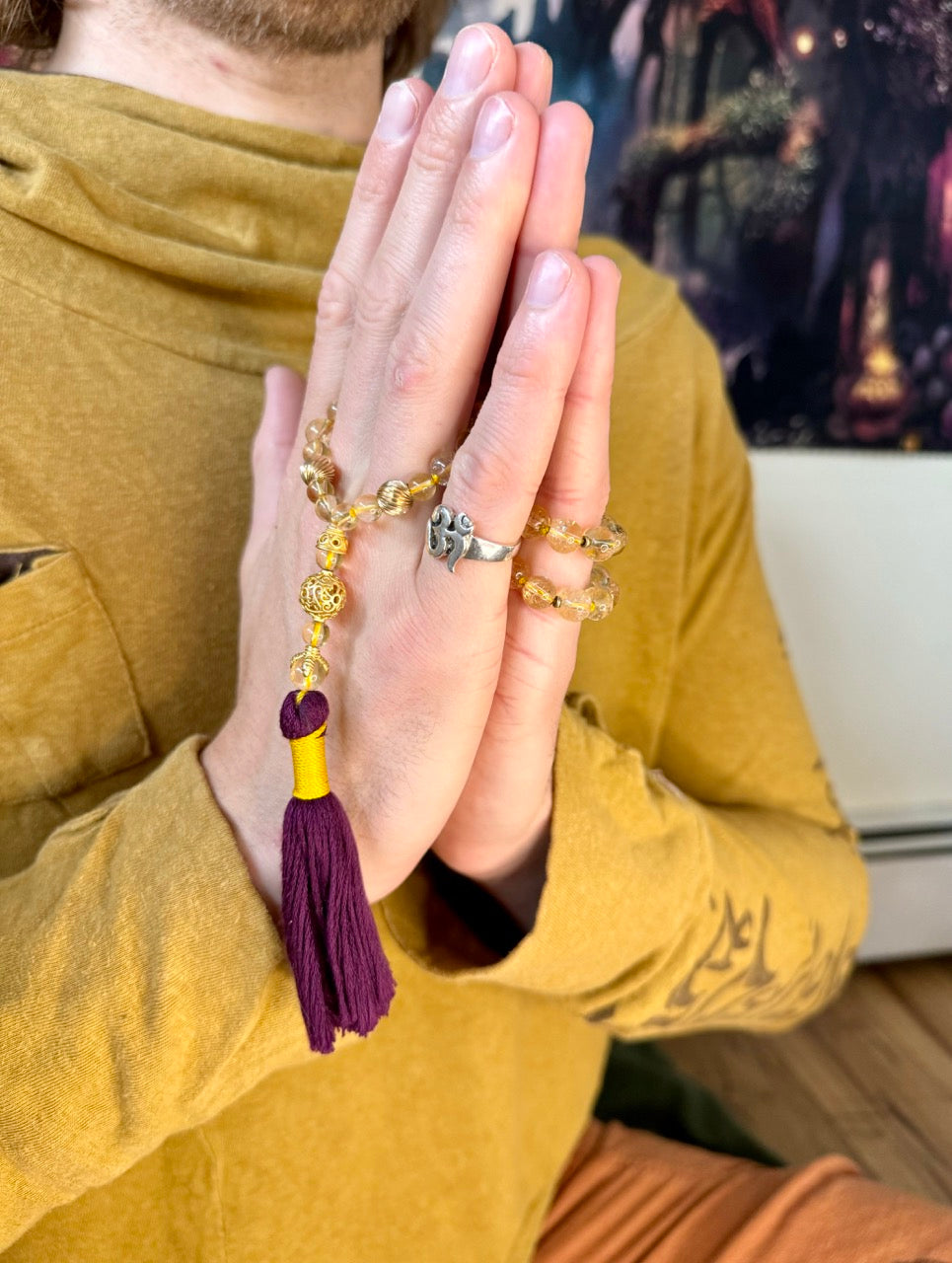
A mala is not mentioned in the source passage and is not intrinsic to the original Pavamana ritual. It may be used as part of a general personal japa practice, but this is an optional later practice rather than a text-specific instruction.
The common three-line prayer is widely taught and recited publicly, with no stated initiation requirement for devotional or contemplative use. Its original setting, however, belongs to a Vedic sacrificial ritual involving trained officiants. Learn formal Vedic ritual performance, timing, and lineage-specific recitation from a qualified teacher.
Mantra at a Glance
| Tradition | Vedic Hinduism; Shukla Yajurveda; Upanishadic and Vedanta traditions |
|---|---|
| Language | Vedic Sanskrit |
| Classification | Three-part Upanishadic prayer and ritual japa formula |
| Primary source | Brihadaranyaka Upanishad 1.3.28 in the Shatapatha Brahmana tradition of the Shukla Yajurveda |
| Traditional context | Pavamana and Saman ritual chanting, with an association to prana |
| Common modern use | Prayer, meditation, group chant, yoga settings, and kirtan |
| Access | Public for common devotional recitation; formal Vedic performance requires traditional training |
Word-by-Word Meaning
| Mantra | Basic Meaning | Grammar / Context |
|---|---|---|
| asato | from asat; from non-being, unreality, what is untrue, or what is not good | Ablative singular of asat. The underlying form asataḥ becomes asato through sandhi. |
| mā | me | An enclitic first-person singular accusative pronoun. Here it names the person whom the unstated addressee is asked to lead, not the prohibitive mā meaning “do not.” |
| sad | being, reality, what is true, or what is good | The underlying word is sat, used as the goal of gamaya. Its final t becomes d before the g of gamaya. |
| gamaya | lead; cause to go; bring | A second-person singular causative imperative from the root gam, “to go.” |
| tamaso | from darkness | Ablative singular of tamas. The underlying form tamasaḥ becomes tamaso through sandhi. |
| jyotir | light | The underlying form jyotiḥ is a neuter accusative singular goal expression. Its final visarga becomes r before g in gamaya. |
| mṛtyor | from death | Ablative singular of mṛtyu. The underlying form mṛtyoḥ becomes mṛtyor in connected recitation. |
| amṛtaṃ | the deathless; immortality | A neuter accusative singular form used as the goal of gamaya. In continuous recitation, mā amṛtam becomes māmṛtam. |
Meaning of Asato Ma Sadgamaya
Asato Ma Sadgamaya is a direct personal prayer for guidance through three linked transitions: from asat to sat, from darkness to light, and from death to immortality. People commonly chant it as a contemplation of truth, understanding, and the hope of moving beyond mortality.
The most familiar translation, “Lead me from the unreal to the real,” is useful but not exhaustive. At the lexical level, asat and sat can suggest non-being and being, unreality and reality, untrue and true, or bad and good. The prayer therefore has room for more than one interpretive emphasis.
The source passage itself gives a specific explanation: asat is death and sat is immortality; darkness is death and light is immortality. From that perspective, all three lines express one central request: to be led beyond death into the deathless.
The person or power being asked to lead is not named in the Sanskrit. In modern devotional practice, practitioners may understand that guide as God, divine grace, a guru, wisdom, or an inward spiritual guide. These are devotional interpretations rather than an explicit named addressee in the three formulas.
Prana and the Movement Beyond Death
The mantra does not name a deity. Its immediate chapter concerns prana, the vital force, which is presented as the successful chanter of the Udgitha and as the power that carries the faculties beyond death.
The prayer concludes a Brihadaranyaka section devoted to the glory and ritual meditation of prana in relation to Saman chanting. Śaṅkara’s commentary connects the ritual context with prana and advancement toward divine status. This contextual association does not mean that the three lines explicitly address Prana as a named deity.
Origin and History of the Mantra
The complete three-line prayer is securely preserved in Brihadaranyaka Upanishad 1.3.28, a Vedic prose text of the Shukla Yajurveda within the Shatapatha Brahmana tradition. The passage is often called the Pavamana Abhyaroha, an ascent associated with Pavamana chants.
The Brihadaranyaka Upanishad is among the earliest Upanishads. It is often placed broadly around the seventh to sixth centuries BCE, give or take a century, but the precise date of this passage and its textual layer cannot be securely fixed.
In its original setting, the formulas are recited by the sacrificer when the Prastotri begins the relevant Saman chant. This ritual instruction belongs to a sacrificial context and should not be reconstructed from a general mantra guide.
Over time, the lines became a widely recognizable freestanding Hindu prayer. The familiar expanded form beginning with Om and ending with Om Shanti Shanti Shanti is common in modern liturgical, temple, Vedanta, yoga, and kirtan use, but those additions are not part of the three formulas in Brihadaranyaka Upanishad 1.3.28.
Traditional Interpretations
The Brihadaranyaka Upanishad’s own explanatory prose identifies asat with death and sat with immortality. It makes the same equation between darkness and death, and between light and immortality. The third line, asking to be led from death to the deathless, states the shared movement most openly.
In Śaṅkara’s commentary, the first line can be read as a movement from evil action, ignorance, and unregulated natural action toward conduct guided by scripture and conducive to divinity. The second is interpreted as movement from ignorance toward knowledge and divine status.
Modern Advaita and Vedanta teaching often reads the prayer philosophically: from transient appearance to enduring reality, from ignorance to Self-knowledge, and from identification with mortality to realization of the deathless Self or Brahman. This is a traditional interpretation, not the only possible literal translation.
Sanskrit and Grammar
Each line follows the same structure: “cause me to go from X to Y.” Gamaya is a second-person singular causative imperative from the Sanskrit root gam, “to go,” and mā means “me.” The grammar is singular and personal, even when the prayer is recited by a group.
The source terms, asato, tamaso, and mṛtyor, are ablative forms that mark the starting point: from unreality, darkness, and death. Sat, jyotir, and amṛtaṃ are goal expressions: to reality, light, and the deathless.
Several familiar spellings reflect Sanskrit sandhi, the sound changes that occur in connected speech. Thus sat gamaya becomes sad gamaya, jyotiḥ gamaya becomes jyotir gamaya, mṛtyoḥ mā becomes mṛtyor mā, and mā amṛtam becomes māmṛtam.
Variations of the Mantra
Underlying Upanishadic form
tamaso mā jyotir gamaya
mṛtyor māmṛtaṃ gamaya
This is the three-line form preserved in Brihadaranyaka Upanishad 1.3.28. It does not include an opening Om or a closing peace refrain.
Expanded peace-invocation form
tamaso mā jyotirgamaya
mṛtyor mā amṛtaṃ gamaya
oṃ śāntiḥ śāntiḥ śāntiḥ
This common modern liturgical form adds Om and a threefold shanti refrain. It should not be quoted as the exact text of the Upanishadic passage.
Sandhi-separated form
tamasaḥ mā jyotiḥ gamaya
mṛtyoḥ mā amṛtam gamaya
This spelling displays underlying word forms for grammar study. It is not the usual connected pronunciation.
Musical and kirtan versions
Performers may repeat phrases, add melody, alternate Om or shanti refrains, or use call and response. These are modern arrangements, not canonical textual lines.
Communal English rendering
This can work as a communal prayer in English, but the Sanskrit mā is grammatically singular, meaning “me.”
How This Mantra Is Used Today
Today, Asato Ma Sadgamaya is used as a spoken or sung prayer before and after yoga classes, meditation, Vedanta talks, puja, educational gatherings, and interfaith events. It also appears in devotional recordings and kirtan.
Modern practice generally separates the prayer from its original Soma-sacrifice setting and uses its three movements as a broad aspiration for truth, understanding, and transcendence of mortality.
Modern musical settings may repeat lines or add Om and Shanti refrains. There is no single standardized contemporary practice, melody, pace, or repetition count.
Related Concepts
Sat and asat · Amrita · Prana · Udgitha and Saman · Pavamana · Japa · Shanti patha
Related Mantras
Purnamadah Purnamidam · Sahana Vavatu · Sarve Bhavantu Sukhinah · Gayatri Mantra
Common Questions About Asato Ma Sadgamaya
What does Asato Ma Sadgamaya mean?
The familiar translation is: “Lead me from what is unreal to what is real, from darkness to light, and from death to immortality.” More literally, asat and sat can mean non-being and being, unreality and reality, or other related contrasts. In the source passage, the first two pairs are specifically explained through death and immortality.
Where does the Asato Ma mantra come from?
It comes from Brihadaranyaka Upanishad 1.3.28, in the Shatapatha Brahmana tradition of the Shukla Yajurveda.
Is Om Shanti Shanti Shanti part of the original mantra?
No. The Upanishadic passage contains the three lines beginning asato mā, tamaso mā, and mṛtyor mā. Om and the threefold shanti refrain are common later or contextual liturgical framing.
Does ma mean “do not” in this mantra?
No. Here mā is the enclitic pronoun “me.” It is not the prohibitive particle mā meaning “do not.”
Should it be sadgamaya or sat gamaya?
Sat is the underlying word. In connected Sanskrit speech, its final t becomes d before the voiced g of gamaya, producing sad gamaya. Both spellings appear depending on whether an edition shows underlying words or connected recitation.
Which deity is Asato Ma addressed to?
The three Sanskrit formulas do not name an addressee. Their ritual context is associated with prana, while later practitioners may understand the guide as God, divine grace, a guru, wisdom, or the Self.
Must Asato Ma be chanted 108 times?
No universal count is prescribed in Brihadaranyaka Upanishad 1.3.28. A chosen count may come from a later teacher’s routine or from general japa practice, but it is not a canonical requirement of this passage.
Do I need initiation to chant Asato Ma?
The common three-line prayer is publicly taught and may be used for devotional or contemplative recitation without a stated initiation requirement. Formal Vedic ritual performance and lineage-specific chanting remain matters for traditional instruction.
Does the mantra say “lead me” or “lead us”?
The Sanskrit says “lead me,” because mā is singular. “Lead us” is a modern communal adaptation.
Is Asato Ma a peace mantra?
It is commonly used as a peace or blessing invocation today. In its original passage, however, it is a Pavamana Abhyaroha in a ritual Saman context, and the familiar threefold shanti is not included in the three-line source text.
Sources and Further Reading
- The Prana: Its Glories and Redeeming Power, Brihadaranyaka Upanishad 1.3.28, Brihadaranyaka Upanishad with the commentary of Shankaracharya; translated by Swami Madhavananda; digital edition hosted by Wisdom Library
- The Early Upanisads: Annotated Text and Translation, Patrick Olivelle; Oxford University Press
- Early Upanishads: Olivelle Edition, Sanskrit at the University of Texas at Austin
- Brihadaranyaka Upanishad with Vedic Accents, Sanskrit Documents; based on editions by Albrecht Weber and Willem Caland and TITUS data
- Brihadaranyakopanishad, Vedic Heritage Portal, Government of India
- Asato Ma Sadgamaya, Hindu Society of North America
- Sri Gayatri Havan Vidhi, Chinmaya Mission
- Anusvara and Visarga, Learn Sanskrit Online
- Visarga Sandhi, Learn Sanskrit Online
- Sadhana and The Divine Life Society, Swami Chidananda; The Divine Life Society