Om Aim Hrim Klim Chamundaye Viche: Meaning, Translation, Pronunciation, and How to Chant
Jack UtermoehlPeople chant this mantra as an invocation of the Goddess, often seeking guidance, protection, and a deeper connection with her fierce and compassionate forms. Its clearest literal meaning is “to or for Chamunda”; the other sounds are sacred mantra syllables rather than ordinary words with direct English equivalents. Known as the Navarna or Navakshari Mantra, it belongs to Shakta Goddess traditions and is used in devotional repetition, worship, and Chandi liturgy. Many lineages treat formal practice as initiation-sensitive.
The Mantra
चामुण्डायै विच्चे॥
cāmuṇḍāyai vicce
Chamundaye Viche
Chamundaye Viche
Translation
Om. Through the seed syllables aim, hrim, and klim, the mantra addresses the Goddess Chamunda; vicce completes the sacred formula.
Oṃ; aiṃ; hrīṃ; klīṃ; to or for Cāmuṇḍā; vicce.
This is not an ordinary Sanskrit sentence. Only cāmuṇḍāyai has a straightforward grammatical translation: “to or for Chamunda.” Om is a sacred syllable, while aim, hrim, and klim are bija, or seed, syllables. Vicce is a terminal mantra element rather than a securely interpretable ordinary Sanskrit word.
How to Pronounce the Mantra
OHM EYE(M) HREEM KLEEM
CHAA-mun-DAA-yai vit-CHAY
| Mantra | Pronunciation | Notes |
|---|---|---|
| oṃ | ohm, with a long closed o and a lightly nasal ending | The final nasal sound may be expressed as resonance rather than as a strongly released English m. |
| aiṃ | eye, lightly nasalized at the end | The vowel ai sounds like the vowel in English eye. |
| hrīṃ | hreem, with both h and r audible and a lightly nasal ending | The ī is long. Avoid dropping the initial h. |
| klīṃ | kleem, with a clear kl cluster and a lightly nasal ending | The ī is long. |
| cāmuṇḍāyai | chaa-mun-daa-yai | C sounds like English ch. The first and third vowels are long. The final yai includes the ai sound heard in eye. |
| vicce | vit-chay or vich-chay, with the ch held slightly longer | The initial i is short, as in bit. The doubled cc represents a doubled ch sound. Viche and vichche are common teaching spellings. |
Pronunciation Notes
- Hreem, kleem, Chamundaye, and viche are practical English spellings, not precise scholarly transliteration.
- The precise Sanskrit form is cāmuṇḍāyai, not Chamundaye.
- The widespread pronunciation vee-chay reflects modern devotional usage, but vicce has a short initial i in the written Sanskrit.
- Lineages may teach the seed syllables with specific nasal resonance, duration, or tonal handling.
How to Chant Om Aim Hrim Klim Chamundaye Viche
For a simple devotional approach, chant the full line slowly and attentively, allowing the sound and your intention to remain the focus. Formal tantric practice can involve additional ritual steps and is often learned from a qualified teacher.
Sit or stand in a comfortable, steady position. Recite the mantra aloud, softly, or mentally at an unforced pace. If you are learning it, begin by following the phrase breaks and prioritizing respectful, consistent pronunciation over speed. You may use the mantra as part of personal devotion, meditation, or a public chant led by a teacher or community.
- Japa, or repeated recitation
- Mala-counted repetition
- Meditation on the Goddess
- Devi or Chandi puja
- Durga Saptashati or Chandi Path liturgy
- Modern musical chanting
- Nyasa and homa in initiated ritual settings
No single repetition count is inherent in the mantra. Different lineages and ritual settings use different counts for daily recitation, vows, formal practice, and liturgy. Counts such as 21, 108, and 1008 in modern recordings are choices of those recordings, not universal rules.
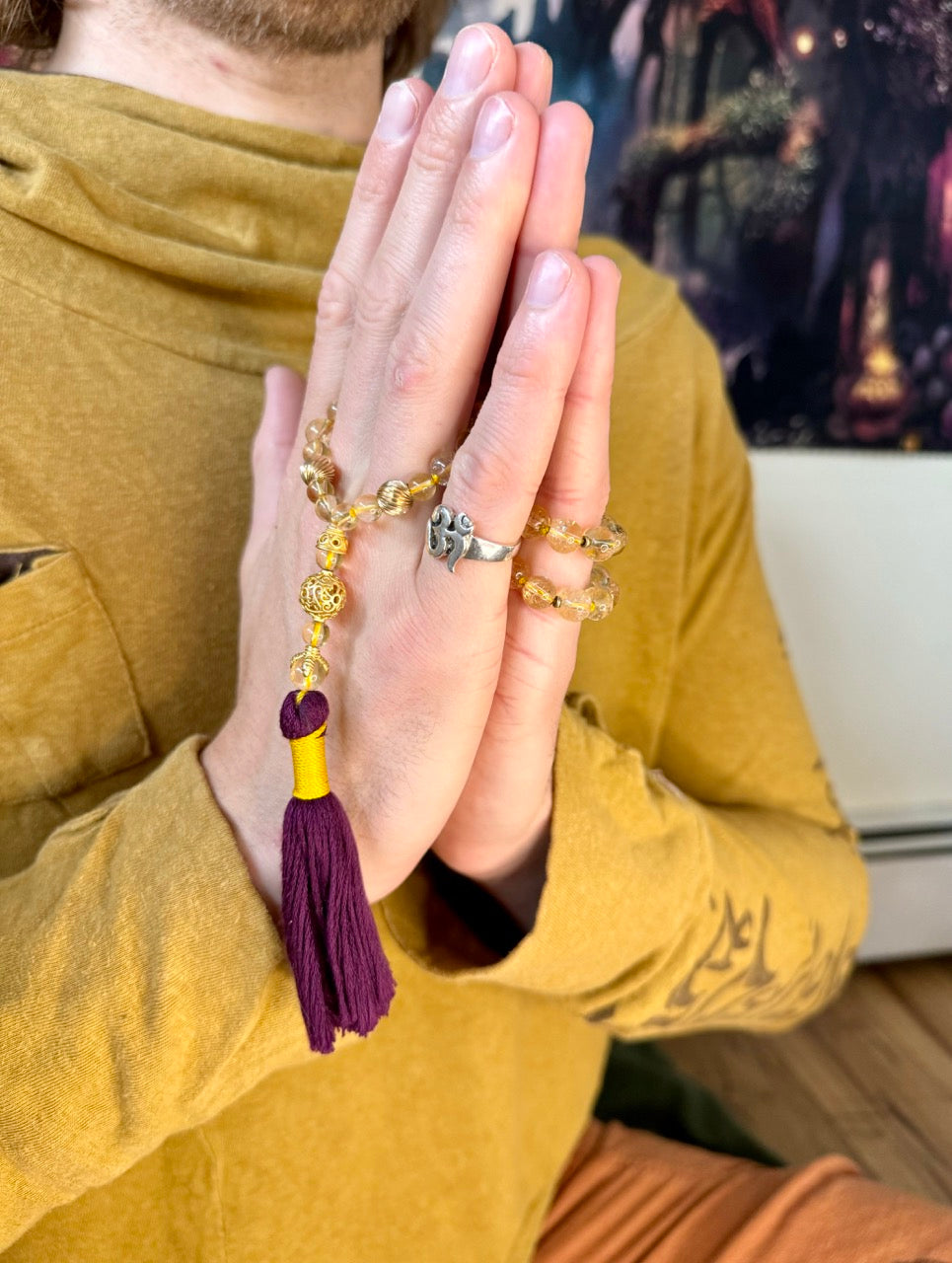
A mala may be used for counted japa. The bead material, daily number of repetitions, and any associated observances vary by lineage and should not be prescribed as universal.
The mantra is publicly printed and widely recited, but many Shakta lineages treat formal bija-mantra practice, nyasa, purashcharana, ritual applications, and siddhi-oriented japa as requiring diksha, or initiation, from a qualified guru. Some communities permit devotional recitation of the publicly available formula. Policies differ, so public availability should not be assumed to authorize every form of tantric practice.
Mantra at a Glance
| Also known as | Navarna Mantra or Chandi Navakshari Mantra |
|---|---|
| Tradition | Shakta and Chandi or Devi Mahatmya worship |
| Language | Sanskrit mantra language |
| Type | Bija-based navakshari and later liturgical mula mantra |
| Associated with | Chamunda, Chandika, and the Mahakali-Mahalakshmi-Mahasarasvati triad |
| Practice contexts | Japa, Devi puja, Chandi Path, nyasa, and initiated ritual |
| Access | Publicly available but initiation-sensitive in many lineages |
Word-by-Word Meaning
| Mantra | Basic Meaning | Grammar / Context |
|---|---|---|
| oṃ | Sacred syllable or pranava | A mantra syllable, not a normal inflected word in this formula. It is a common prefix in later liturgical forms and is absent from the nine-unit extraction in the Devi-Bhagavata Purana. |
| aiṃ | Bija syllable | An uninflected mantra element. It is traditionally associated with speech, knowledge, and Sarasvati or Mahasarasvati, but these are ritual associations rather than dictionary translations. |
| hrīṃ | Bija syllable | An uninflected mantra element. It is widely called the maya or Shakti bija and has differing associations across traditions. |
| klīṃ | Bija syllable | An uninflected mantra element. It is identified as the kama bija and, in this mantra’s liturgical interpretation, is aligned with Mahakali. |
| cāmuṇḍāyai | To or for Chamunda | The feminine dative singular of Cāmuṇḍā. Chamundaye is a common phonetic English spelling that obscures the Sanskrit ending -āyai. |
| vicce | Untranslated terminal mantra element | A mantric element rather than a securely lexical or grammatical Sanskrit word. Traditional analysis counts it as two units, vic and ce. |
Meaning of Om Aim Hrim Klim Chamundaye Viche
This mantra is best understood as a sacred sound formula and invocation of the Goddess rather than as a sentence to translate word for word. People often chant it devotionally in relation to Chamunda or Chandika, seeking to remember, praise, or contemplate the power of the Goddess.
Its clearest grammatical meaning is cāmuṇḍāyai, “to or for Chamunda.” Om, aim, hrim, and klim are sacred seed syllables, known as bija syllables, whose importance lies in their ritual use and traditional associations. Vicce completes the formula but does not have an agreed ordinary Sanskrit translation.
In Shakta practice, the mantra is often understood as a condensed sound-form of the Goddess praised in Chandi or Durga Saptashati worship. The three opening seed syllables are commonly related to three great Goddess forms: Mahakali, Mahalakshmi, and Mahasarasvati. Exact correspondences vary among texts, commentators, and lineages.
Some traditional commentaries interpret the mantra as concerned with removing ignorance and revealing the divine reality represented by Chandika. That is a theological interpretation, not a literal grammatical translation of vicce or the bija syllables.
Chamunda, Chandika, and the Goddess
Chamunda is a fierce form of the Goddess. In chapter 7 of the Devi Mahatmya, Kali emerges from Ambika’s brow, defeats the demons Chanda and Munda, and is told that she will be renowned as Chamunda.
The mantra directly addresses Chamunda through cāmuṇḍāyai, “to or for Chamunda.” In later Navarna liturgy, its presiding divinity is also understood more broadly as Chandika, the supreme Goddess celebrated in the Devi Mahatmya.
Later ritual traditions associate the mantra with Mahakali, Mahalakshmi, and Mahasarasvati. These forms are closely related to the three principal sections and Goddess manifestations of the Devi Mahatmya.
Origin and History of the Mantra
The Navarna Mantra belongs to the medieval tantric and liturgical development of Shakta worship surrounding the older Devi Mahatmya. Its mythic setting and the story of Chamunda come from the Devi Mahatmya, but the complete mantra does not appear as one of that text’s core 700 verses.
Important medieval textual witnesses include the Devi Upanishad and Devi-Bhagavata Purana. Devi-Bhagavata Purana 9.50.57-58 explicitly constructs the core formula as aiṃ hrīṃ klīṃ cāmuṇḍāyai vicce and analyzes it as nine units.
The core nine-unit form begins with aiṃ and does not include om. The om-prefixed form is nevertheless well established in later ritual manuals, printed Durga Saptashati editions, recordings, and contemporary practice. When om is added, the form technically contains an additional syllable.
By the late sixteenth century, Mahidhara’s Mantramahodadhi offered detailed ritual procedures involving the mantra, including nyasa, visualization, and worship. Bhaskararaya’s later interpretive tradition also became influential for theological readings of the formula.
Traditional Interpretations
In the Devi-Bhagavata Purana’s liturgical presentation, the mantra is formed from the vagbhava, Shambhu’s-consort, and kama bijas, followed by cāmuṇḍāyai and vicce. The text associates Mahakali, Mahalakshmi, and Sarasvati with its ritual setting.
Developed Chandi liturgy treats the mantra as a mula mantra, or central formula, of the Goddess praised in the Durga Saptashati. Ritual manuals place its units on the hands and body through forms of nyasa and use the complete formula in japa and worship.
In an interpretation associated with Bhaskararaya’s tradition, the three opening bijas express being, consciousness, and bliss. Chamunda is understood as the divine power that removes ignorance and leads the worshipper toward the transcendent Chandika. This is a theological interpretation rather than a literal translation.
Modern devotional teachings often connect aim, hrim, and klim with Sarasvati, Lakshmi, and Kali, and present the mantra as an invocation for guidance, protection, or the removal of obstacles. These are devotional summaries, not lexical translations of the Sanskrit.
Sanskrit and Grammar
This mantra is not an ordinary Sanskrit sentence. Om, aim, hrim, and klim are mantra syllables, and their significance cannot be reduced to simple English dictionary definitions.
Cāmuṇḍāyai is the feminine dative singular of Cāmuṇḍā, meaning “to or for Chamunda.” The common spelling Chamundaye approximates pronunciation but is not precise transliteration.
Vicce is treated as a terminal mantra element. The traditional ninefold analysis divides it into vic and ce, but there is no agreed ordinary grammatical derivation that establishes translations such as “cut,” “awaken,” or “liberate.” Such meanings belong to commentary and interpretation.
Variations of the Mantra
Core Navakshari form
चामुण्डायै विच्चे
This is the form explicitly constructed as nine mantra-units in Devi-Bhagavata Purana 9.50.57-58. Om is absent.
Om-prefixed liturgical form
चामुण्डायै विच्चे
This widespread later form adds om before the Navakshari. It appears in ritual manuals, printed editions, recordings, and contemporary practice.
Namah extension
चामुण्डायै विच्चे नमः
This adds namah and should be identified as a liturgical or devotional expansion rather than presented as the underlying nine-unit formula.
Popular Roman spellings
Chamundaye Viche
Spellings such as Hreem, Kleem, Chamundaye, Viche, and Vichche approximate pronunciation but do not necessarily indicate different Sanskrit mantras.
How This Mantra Is Used Today
Today, the mantra circulates through temples, prayer books, devotional recordings, yoga communities, meditation sessions, and online instruction. It may be chanted alone, repeated over music, or used within public worship and Chandi recitation.
Modern recordings may repeat the mantra 21, 108, or 1008 times, use melodies and refrains, or add namah and other sounds. These are particular performance or devotional choices, not a single universal format.
Some modern descriptions make claims about chakras, healing, manifestation, psychology, or guaranteed protection. Such claims are not part of the supported historical and grammatical account of the mantra and should be distinguished from specific devotional beliefs.
Related Concepts
Bija · Navakshari · Navarna · Nyasa · Diksha · Devi Mahatmya · Chandi Path
Related Mantras
Om Namas Chandikayai · Siddha Kunjika Stotra mantra sequence · Devi Gayatri · Ya Devi Sarvabhuteshu refrain
Common Questions About Om Aim Hrim Klim Chamundaye Viche
What is the literal meaning of Om Aim Hrim Klim Chamundaye Viche?
The mantra is not a complete ordinary Sanskrit sentence. The directly translatable part is cāmuṇḍāyai, meaning “to or for Chamunda.” Om, aim, hrim, and klim are sacred syllables, while vicce is a terminal mantric element without a secure ordinary Sanskrit translation.
Is the correct ending viche, vichche, or vicce?
The Devanagari spelling विच्चे is academically transliterated as vicce. Vichche is a useful phonetic spelling, while viche simplifies the doubled consonant. These usually represent spellings of the same mantra element.
Is Chamundaye grammatically correct?
Chamundaye is a common English teaching spelling. The precise Sanskrit form is cāmuṇḍāyai, the feminine dative singular of Cāmuṇḍā, meaning “to or for Chamunda.”
Is Om part of the nine-syllabled mantra?
The Devi-Bhagavata Purana’s explicit nine-unit extraction begins with aiṃ and omits om. The om-prefixed version is widespread in later ritual literature and current practice, but adding om technically adds another syllable.
Does vicce literally mean cut through ignorance?
No secure ordinary Sanskrit derivation establishes that as a literal translation. The removal or severing of ignorance is a documented traditional interpretation and should be understood as commentary rather than grammar.
Is this mantra found in the original Devi Mahatmya?
The complete formula is not one of the core 700 verses of the Devi Mahatmya. The text provides the Chamunda narrative and theological setting, while the complete Navarna formula belongs to later medieval Shakta mantra and liturgical traditions surrounding it.
Does the Navarna Mantra require initiation?
Many Shakta lineages require or strongly prefer diksha for formal japa, nyasa, purashcharana, and ritual use. Some communities permit devotional repetition of the publicly printed mantra. There is no single policy across all traditions.
Why is it called the Navarna or Navakshari Mantra?
Navarna and Navakshari refer to nine sound-units. The form without om is traditionally divided as aiṃ, hrīṃ, klīṃ, cā, muṇ, ḍā, yai, vic, and ce.
Is this a Vedic or tantric mantra?
It is Sanskrit and appears in an Atharvaveda-affiliated minor Upanishad, but its structure and practice are characteristically medieval Shakta tantric. It is not a mantra from the ancient Vedic Samhitas.
Sources and Further Reading
- Shri Devyatharvashirsham evam Devyupanishat, Sanskrit Documents; proofread by Ravin Bhalekar, N. A. and P. S. A. Easwaran
- Shrimad Devi Bhagavata Mahapurana, Skandha 9, Chapter 50, verses 57-64, Traditional text; digital edition hosted by Sanskrit Documents
- Mantramahodadhi, Eighteenth Taranga, Mahidhara; digital text hosted by TransLiteral Foundations
- Shri Durga Saptashati, Gita Press tradition; digital mirror hosted by MJFSPM eLibrary
- The Significance of Camunda and the Navakshari Mantra, Bhaskara Prakasha Ashram
- Visions and Revisions of the Hindu Goddess: Sound, Structure, and Artful Ambivalence in the Devi Mahatmya, Raj Balkaran
- In Praise of the Goddess: The Devimahatmya and Its Meaning, Devadatta Kali
- The Chronology of the Works of Mahidhara, P. K. Gode
- Devi Mahatmya, Chapter 7: The Slaying of Chanda and Munda, Swami Krishnananda tradition