Om (Aum): Meaning, Translation, Pronunciation, and How to Chant
Jack UtermoehlPeople commonly chant Om as an invocation, a meditation support, or a way of settling attention before or after yoga practice. It has no single literal English translation, but it is widely understood as a sacred sound for contemplating ultimate reality. Om, also spelled Aum, is a one-syllable Sanskrit mantra with roots in Vedic ritual and major roles in the Upanishads, Vedanta, and Classical Yoga. It may be chanted once, repeated quietly or mentally, or sustained with a group on a comfortable exhalation.
The Mantra
Translation
A sacred syllable used to invoke or contemplate ultimate reality.
Oṃ has no single dictionary-style translation. It is an indeclinable sacred utterance whose uses include ritual assent, invocation, recitational framing, and designation of a contemplated reality.
Teachings such as “Om is Brahman,” “Om is all this,” or “Om is the expression of Ishvara” are interpretations supplied by particular texts, not literal lexical translations of the sound. In some early Vedic settings, forms of Om can function as assent or confirmation, somewhat like “yes,” but that does not exhaust its meanings.
How to Pronounce the Mantra
Some traditions teach a deliberate A-U-M articulation for contemplation. This is an analysis of the sound, not the only valid Sanskrit pronunciation.
| Mantra | Pronunciation | Notes |
|---|---|---|
| oṃ | OHM, with a long, steady o and a gently sustained nasal or m ending | The Sanskrit o is long even though IAST does not use a macron here. The final anusvara may be realized as nasalization, nasal resonance, or an audible m depending on phonetic setting, region, recitation system, and lineage. |
Pronunciation Notes
- IAST oṃ is the scholarly transliteration; English “OHM” is only a teaching approximation.
- Avoid adding a hard glottal onset before the vowel unless it belongs to a received chanting style.
- Do not force maximum volume or breath length. Traditional and modern performances vary greatly in duration.
- Vedic recitation can require specific pitch, duration, accent, and specialized forms that ordinary English spelling cannot show.
- The claim that “Aum” is always more authentic than “Om” oversimplifies a historically varied recitational tradition.
How to Chant Om / Aum
For a general, non-lineage-specific practice, chant one comfortable Om and listen closely to its sound and the quiet that follows.
Sit comfortably and let the breath remain unforced. On an easy exhalation, sound one sustained Om at a comfortable pitch and volume. Let the long o flow into a resonant m or nasal ending. Attend to the sound rather than trying to make it especially loud or long. If you are practicing in the way described in Yoga Sutra 1.28, pair repetition with contemplation of what Om means or refers to in your chosen understanding.
- Japa aloud
- Soft or whispered japa
- Mental japa
- Contemplation of meaning
- Meditation on sound and the quiet that follows
- Opening or closing prayer
- Group chanting
- Kirtan or call and response
- Mala-counted repetition
- Vedic ritual recitation with appropriate instruction
No universal repetition count belongs to standalone Om across all traditions. One Om, three Oms, continuous japa, and mala-based practice all occur in modern or lineage settings, but their conventions depend on context. Counts such as 3, 21, 27, 54, or 108 should not be treated as mandatory for every practice.
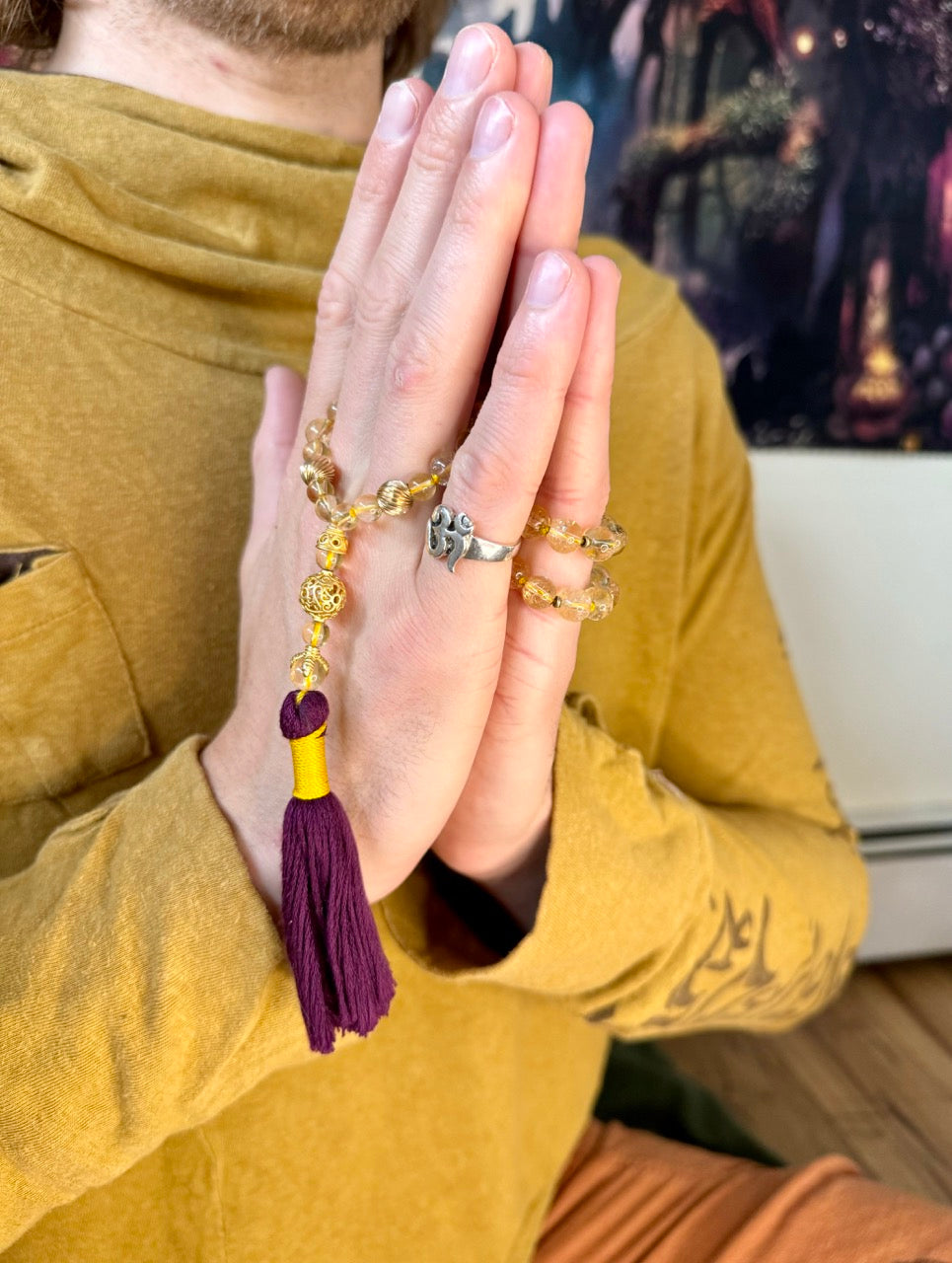
A mala may be used to count Om japa, with one recitation per bead. A 108-bead mala is common in Hindu japa practice, but this does not make 108 the canonical count for every Om practice. Mala handling conventions vary by lineage.
Public group chanting of Om is widespread and generally presented openly. This differs from technical Vedic chanting, initiated mantra practice, or tantric rites, which may require instruction, initiation, ritual eligibility, or lineage-specific pronunciation. When Om appears within a received mantra or ritual, follow that tradition’s guidance.
Mantra at a Glance
| Tradition | Vedic, Upanishadic and Vedantic, and Classical Yoga traditions; later adopted in diverse Hindu, Buddhist, and Jain mantra traditions |
|---|---|
| Language | Vedic and Classical Sanskrit |
| Classification | Sacred syllable, pranava, one-syllable mantra, and ritual utterance |
| Associated with | Brahman, Atman, Ishvara, Vedic chant, and contemplative mappings of consciousness |
| Primary sources | Early Vedic ritual texts; the Chandogya, Taittiriya, and Mandukya Upanishads; Yoga Sutras 1.27 - 1.29 |
| Practice | Ritual utterance, japa with contemplation, meditation, prayer, and group chanting |
| Access | Public in general use; formal restrictions vary by ritual context and lineage |
Word-by-Word Meaning
| Mantra | Basic Meaning | Grammar / Context |
|---|---|---|
| oṃ | A sacred utterance or syllable; not a normally translatable lexical word | Oṃ is generally treated as an indeclinable particle, interjection, or mantric syllable. It does not form an inflected Sanskrit sentence by itself, and its ritual or contemplative function depends on context. |
What Om Means
People use Om as a prayerful invocation, a focus for meditation, or a sound through which to contemplate what is most fundamental in reality and in themselves. Rather than translating it as a single English word, it is more accurate to understand it as a sacred syllable whose meaning changes with its textual and ritual setting.
In early Vedic ritual settings, Om could mark assent, authorization, priestly response, or the beginning and support of recitation. In later philosophical traditions, it became a concentrated symbol for Brahman, the ultimate reality, and Atman, the self.
For practitioners of Classical Yoga, Om has a particularly direct role. Yoga Sutra 1.27 calls pranava, a traditional name for Om, the designator of Ishvara. The following sutra recommends repeating it while contemplating its meaning. This frames the practice as more than making a sound: practitioners are invited to reflect on what the sound designates.
Brahman, Atman, and Ishvara
Om is not exclusively the mantra of one deity. Upanishadic sources connect it especially with Brahman, ultimate reality, and Atman, the self. These are philosophical and contemplative associations rather than simple dictionary definitions.
In Patanjali’s Yoga, Om is connected with Ishvara, described in the Yoga Sutras as a special purusha. The sutra calls pranava the vācaka, or designator, of Ishvara.
Later devotional and sectarian traditions may interpret Om through Shiva, Vishnu, Devi, or another theological framework. These interpretations are tradition-specific and should not be treated as a universal meaning of Om.
Origin and History of the Mantra
Om did not begin as a fixed version of the modern yoga-class chant. Its earliest documented history appears within the varied sounds and ritual practices of Vedic sacrifice, especially in the recitational cultures associated with the Yajurveda and Samaveda.
Early Vedic textual evidence includes an Om element embedded in the priestly response formula śoṃsāvom in the Taittiriya Samhita 3.2.9.5. Relevant Vedic textual layers are often placed approximately around 1200 - 1000 BCE, though dates remain approximate because these works were orally composed and transmitted. The first historical utterance of Om cannot be established.
Early forms were not uniform. Om could be voiced, nasalized, lengthened, sung, used in priestly exchange, or incorporated into other recitations. This history helps explain why no single modern pronunciation represents every ancient or living tradition.
The Upanishads developed Om into a major subject of contemplation. The Chandogya Upanishad associates it with the Udgitha, the elevated sung element of Samavedic practice. The Taittiriya Upanishad identifies Om with Brahman and “all this” while also listing liturgical uses. The Mandukya Upanishad gives the best-known analysis of a, u, and m in relation to waking, dreaming, and deep sleep, with a measureless fourth associated with Atman.
Classical Yoga later linked pranava with Ishvara and prescribed japa together with contemplation. In global modern yoga and meditation settings, Om is commonly chanted at the beginning or end of class. This preserves invocatory and meditative dimensions while often separating the practice from its specific ritual, textual, and lineage contexts.
Traditional Interpretations
In early Vedic ritual, Om is a flexible recitational sound used for assent, priestly response, mantra augmentation, chanting, and ritual coordination. It is not presented there as one fixed philosophical formula.
The Chandogya Upanishad treats Om as the Udgitha, closely associated with the elevated or sung portion of Samavedic performance. It presents Om as an object of upasana, contemplative worship or meditation.
The Taittiriya Upanishad identifies Om with Brahman and “all this,” while also describing practical liturgical functions, including Samavedic singing, priestly response, authorization, and the commencement of Vedic study.
The Mandukya Upanishad teaches that Om encompasses temporal existence and what transcends time. It correlates the measures a, u, and m with waking, dreaming, and deep sleep. The measureless fourth is associated with the nondual fourth state and Atman.
In Patanjali’s Yoga, pranava is the designator of Ishvara. The practice is japa, repeated recitation, together with contemplation of its meaning.
Advaita Vedanta uses Om as a contemplative support for inquiry into Brahman and Atman. Some teachers interpret the quiet beyond or between utterances as symbolizing what is not captured by manifest sound.
Later sectarian and tantric systems may use Om as a seed-like mantric element or prefix it to longer formulas. Theological meanings, methods, and access requirements differ among these traditions.
Sanskrit and Grammar
Oṃ is not an inflected sentence and has no internal noun-and-verb grammar. Sanskrit usage generally treats it as an indeclinable sacred utterance.
The scholarly form oṃ uses the IAST anusvara sign for the final nasal element. The spelling om can represent an audible final m in some contexts or editorial systems. The final sound may also be nasalized or specially realized in Vedic recitation.
Traditional teaching often analyzes Om as a, u, and m. In Sanskrit phonetic and historical analysis, a plus u can produce o, so the resulting sound is normally a single long o rather than three separately pronounced English syllables. The Mandukya Upanishad gives these measures symbolic correspondences, but they are not three ordinary Sanskrit words with separate dictionary translations.
The form oṃkāra can arise through Sanskrit sound combination from oṃ plus kāra, meaning the making or utterance of Om.
Variations of the Mantra
Om
The most readable public spelling and a reasonable representation of the commonly heard long-o-plus-m pronunciation.
Oṃ
The scholarly IAST transliteration, using the anusvara sign to represent the final nasal element.
Aum
An analytical or pedagogical spelling that makes the traditional a-u-m analysis visible. It can support a deliberately unfolding chant, but it is not the only correct or original pronunciation.
Vedic extended forms
om
oṃ
om̐
o3m
Vedic schools and ritual settings may distinguish voicing, nasalization, duration, pitch, and placement. These forms require context-specific instruction.
Sacred sign
A conventional graphic sign for Om. It should not be treated as a simple letter-by-letter spelling in Devanagari.
Om shanti shanti shanti
oṃ śāntiḥ śāntiḥ śāntiḥ
An expanded chant that adds a threefold invocation of peace. It is not the canonical text of standalone Om.
How This Mantra Is Used Today
In contemporary yoga and meditation settings, Om is often chanted once or three times at the beginning or end of a class. It may also be used in guided meditation, devotional music, group chanting, and personal japa.
Group chanting may sustain Om as a shared drone or use it in call-and-response music. These are common modern practices, but call and response is not intrinsic to the one-syllable mantra and should not be confused with the specialized exchanges of Vedic ritual.
Modern uses sometimes present Om as a universal sound. While it is used across several South Asian religious traditions, its documented history is rooted in particular Vedic, Upanishadic, yogic, and later mantra contexts.
Claims that Om has one scientifically established frequency, reproduces the Big Bang, necessarily activates a chakra, or produces universal clinical effects go beyond the traditional sources considered here.
Related Concepts
Pranava · Omkara · Akshara · Udgitha · Japa · Brahman · Atman · Ishvara · Turiya · Bija syllable
Related Mantras
Om Shanti · Om Namah Shivaya · Om Namo Narayanaya · Gayatri Mantra with Om and the Vyahritis · Om Mani Padme Hum
Common Questions About Om / Aum
Is Om or Aum the correct spelling?
Om is the clearest common English spelling, and oṃ is the precise scholarly transliteration. Aum makes the traditional analysis into a, u, and m visible, but it is not the only historically or phonetically valid form.
What does Om literally mean?
Om has no single dictionary-style translation. Depending on context, it can function as ritual assent, invocation, recitational framing, or a sacred designation for a reality contemplated in particular traditions.
Is Om one syllable or three?
Om is traditionally called a single syllable. The Mandukya Upanishad analyzes it into the measures a, u, and m, with a measureless fourth, but this does not require three disconnected English syllables in every recitation.
How should Om be pronounced?
A practical general approximation is a long, steady o followed by a resonant m or nasal ending: OHM. Vedic and lineage forms vary in nasalization, pitch, duration, and accent, while A-U-M articulation can be a deliberate contemplative method.
Can anyone chant Om?
Public chanting is widespread and generally open in contemporary yoga, meditation, and devotional settings. Formal Vedic recitation, initiated mantra practice, and tantric applications may have lineage-specific requirements for instruction, eligibility, or pronunciation.
How many times should Om be chanted?
There is no universal count for standalone Om. One repetition, three repetitions, continuous japa, and mala-based practice can all be appropriate in their particular settings. A count of 108 is common for mala practice but is not mandatory for every Om practice.
What does Patanjali say about Om?
Yoga Sutras 1.27 - 1.28 identify pranava as the designator of Ishvara and recommend its japa together with contemplation of its meaning.
Does the Om symbol depict the four states of consciousness?
The Mandukya Upanishad maps the sound’s measures to waking, dreaming, deep sleep, and a measureless fourth. Popular explanations that assign each curve and dot of the later ॐ sign directly to these states should not be attributed to the Mandukya Upanishad as its literal teaching.
Is Om a bija mantra?
Some later traditions treat Om as a seed-like mantric element. Its earliest documented identity, however, is a multiform Vedic ritual and recitational utterance, and it should not be described exclusively through later tantric bija theory.
Sources and Further Reading
- Mandukyopanishad, Vedic Heritage Portal, Indira Gandhi National Centre for the Arts and Ministry of Culture, Government of India
- Chandogya Upanishad, Verse 1.1.1, Swami Lokeswarananda; Wisdomlib digital edition
- This Whole World Is OM: Song, Soteriology, and the Emergence of the Sacred Syllable, Finnian McKean Moore Gerety, Harvard University
- Between Sound and Silence in Early Yoga: Meditation on Om at Death, Finnian M. M. Gerety, History of Religions, University of Chicago Press
- Yoga Sutra 1.27 with Vyasa Bhashya and Bhoja Vritti, Gita Supersite, Indian Institute of Technology Kanpur
- Patanjali Yoga Sutra, Chapter 1: Sutras 1.27 - 1.29, Sanskrit Documents and compiled translation study
- Taittiriya Upanishad, Shiksha Valli: Pranava Om Upasana, Anuvaka 1.8, Chinmaya International Foundation
- Meditation: A Journey of Exploration, Swami Tadatmananda, Arsha Bodha Center
- Anusvara and Visarga, Learn Sanskrit Online
- Writing the Sacred Syllable: The History of OM in Script and Image, Finnian M. M. Gerety; SOAS Centre of Yoga Studies