Vande Gurunam: Meaning, Translation, Pronunciation, and How to Chant
Jack UtermoehlPeople chant Vande Gurunam to begin yoga practice with gratitude, humility, and remembrance of the teachers who transmit yoga. The verse praises the gurus' guidance as revealing the happiness of the deeper Self and calming delusion. It is a Sanskrit opening verse from the medieval Yogataravali and is especially familiar as the first part of the modern Ashtanga Vinyasa opening invocation. Practitioners commonly chant it once together before asana practice, often with hands at the heart.
The Mantra
सन्दर्शितस्वात्मसुखावबोधे ।
निःश्रेयसे जाङ्गलिकायमाने
संसारहालाहलमोहशान्त्यै ॥
sandarśitasvātmasukhāvabodhe ।
niḥśreyase jāṅgalikāyamāne
saṃsārahālāhalamohaśāntyai ॥
sandarshita svatma sukhavabodhe
nihshreyase jangalikayamane
samsara halahala mohashantyai
Om
vande gurunam charanaravinde
sandarshita svatma sukhavabodhe
nihshreyase jangalikayamane
samsara halahala mohashantyai
abahu purushakaram
shankha chakrasi dharinam
sahasra shirasam shvetam
pranamami Patanjalim
Om
Translation
I bow to the lotus feet of the gurus, which reveal awakening to the happiness of one's own Self. Unsurpassed, they act like healers of poison, pacifying the delusion that is the deadly poison of cyclic existence.
I honor the two lotus-feet of the gurus: the feet in which awakening to the happiness of one's own self has been revealed, unsurpassed and acting like poison specialists, for the pacification of the delusion that is the hālāhala poison of saṃsāra.
The grammatical object of vande is caraṇāravinde, literally the two lotus-like feet. Gurūṇām is plural, meaning “of the gurus,” not “of the guru.” The image of poison specialists is metaphorical and concerns liberation from delusion, not medical treatment. “Self” renders ātman, a philosophically significant term rather than the ordinary modern sense of personality.
How to Pronounce the Mantra
sun-DUR-shi-tuh SVAAT-muh soo-khaa-vuh-BOH-dhay
nih-SHRAY-yuh-say JAANG-guh-li-kaa-yuh-MAA-nay
sum-SAA-ruh haa-LAA-huh-luh MOH-huh-SHAAN-tyai
| Mantra | Pronunciation | Notes |
|---|---|---|
| vande gurūṇāṃ caraṇāravinde | vun-DAY goo-ROO-naam chuh-ruh-NAA-ruh-VIN-day | The e in vande and aravinde is a long, pure vowel, approximately “ay” without a strong English glide. Both ū vowels in gurūṇām are long. The ṇ is retroflex, made with the tongue slightly curled back. |
| sandarśitasvātmasukhāvabodhe | sun-DUR-shi-tuh SVAAT-muh soo-khaa-vuh-BOH-dhay | Ś sounds like English “sh.” Keep the consonant cluster svātm together as far as practical. The kh in sukha is an aspirated k, not the sound in Scottish “loch.” |
| niḥśreyase jāṅgalikāyamāne | nih-SHRAY-yuh-say JAANG-guh-li-kaa-yuh-MAA-nay | The visarga ḥ before ś may be lightly released or assimilated according to chanting tradition. Ṅ before g is the “ng” sound in “sing.” |
| saṃsārahālāhalamohaśāntyai | sum-SAA-ruh haa-LAA-huh-luh MOH-huh-SHAAN-tyai | The anusvāra in saṃsāra may sound nasalized or m-like in practical recitation. The ending tyai is approximately “ty-eye,” kept as one compact unit. |
Pronunciation Notes
- IAST transliteration is authoritative; the English phonetic guide is an approximation.
- Sanskrit vowel length is meaningful. Long ā and ū receive approximately twice the duration of short vowels.
- Short a is normally a brief neutral-to-open vowel, not always a broad English “ah.”
- Melody, pitch, and the treatment of final visarga or anusvāra vary among Ashtanga teachers and other yoga lineages.
How to Chant Vande Gurunam
Vande Gurunam is usually chanted as an opening invocation rather than as a count-based mantra practice. In modern Ashtanga Vinyasa Yoga, it is commonly recited before asana practice.
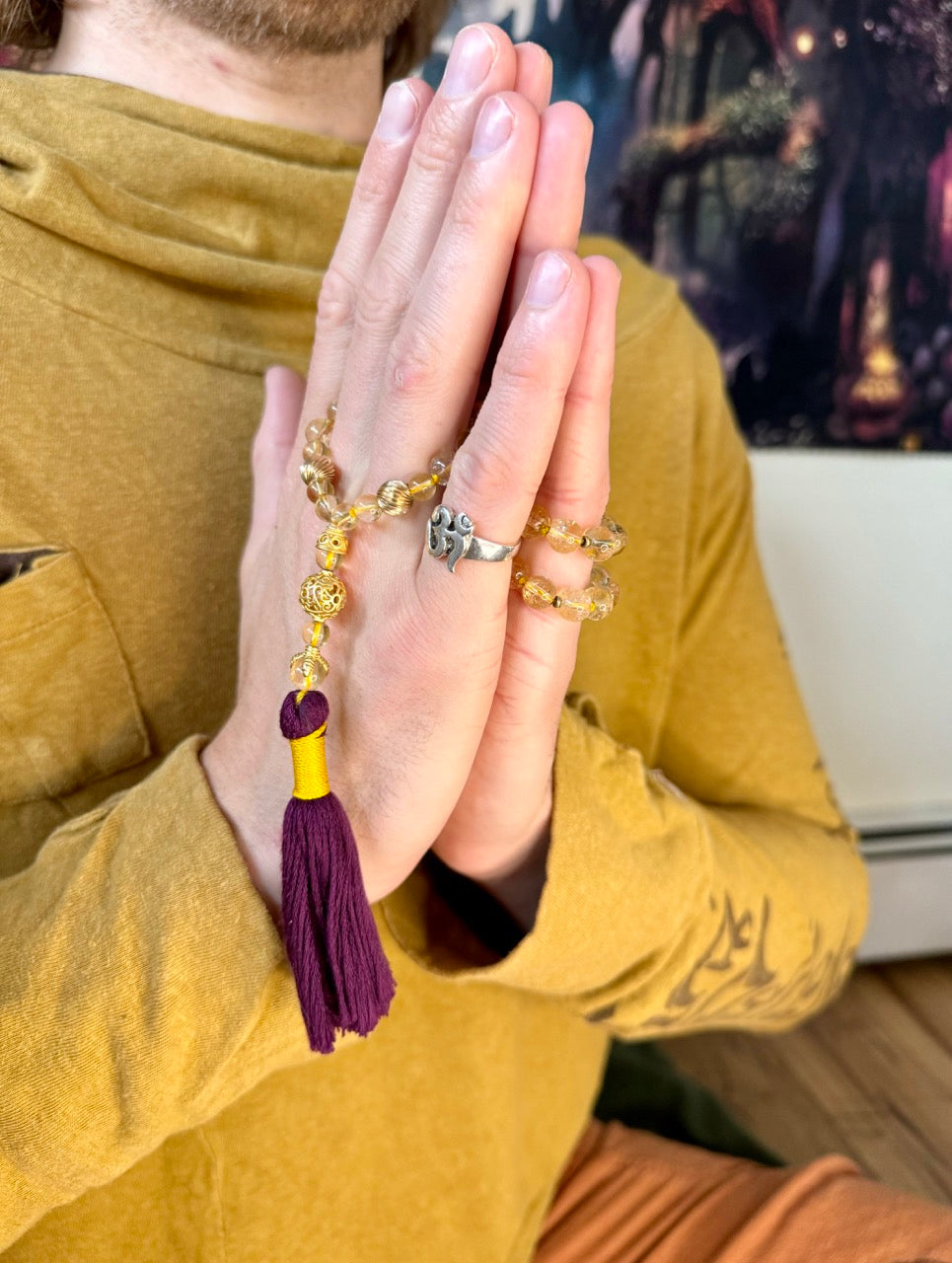
Sit or stand comfortably. In contemporary Ashtanga practice, practitioners often bring the hands together at the heart in añjali mudrā and chant the verse in unison. Follow an established teacher’s melody when practicing within a lineage. If chanting independently, move steadily through the four lines and give care to vowel length and consonants rather than trying to imitate an English pronunciation exactly.
- Opening invocation before asana practice
- Group chanting in unison
- Private recitation before yoga practice or study
- Contemplation of gratitude for the teacher lineage
The Yogatārāvalī does not prescribe a japa count for this verse. In Ashtanga practice, the expanded opening invocation is commonly recited once. Some teachers add Om, a threefold śānti refrain, or lineage-specific repetitions, but these are later liturgical conventions rather than an intrinsic fixed count.
Mala japa is not a standard documented use of this verse. It functions primarily as an invocation or verse of homage rather than a count-based japa formula.
This is an open public chant, and no initiation or formal access requirement is documented. Participation in group chanting may be optional depending on the teacher or studio. Students may follow the pronunciation and liturgical conventions of their own teacher or lineage.
Mantra at a Glance
| Tradition | Medieval Haṭha-Rājayoga source; modern Ashtanga Vinyasa opening chant |
|---|---|
| Language | Sanskrit |
| Classification | Guru-vandana and invocatory śloka, commonly called a mantra |
| Primary source | Yogatārāvalī, verse 1 |
| Associated with | The gurus' lotus feet, knowledge of the Self, and the pacification of delusion |
| Common use | Recited before yoga practice, especially in Ashtanga Vinyasa Yoga |
| Access | Open public recitation; no initiation requirement documented |
Word-by-Word Meaning
| Mantra | Basic Meaning | Grammar / Context |
|---|---|---|
| vande | I praise, honor, or bow to | First-person singular present form of the verbal root vand. It governs the dual object caraṇāravinde. |
| gurūṇām | of the gurus; of the teachers | Genitive plural of guru. The verse grammatically honors multiple gurus or a lineage of teachers. |
| caraṇa | foot | First member of the compound caraṇāravinde. In devotional language, a teacher’s feet signify the place at which a student bows and receives teaching. |
| aravinde | two lotuses; lotus-like pair | Accusative dual within caraṇāravinde, meaning the two lotus-like feet. The dual corresponds to two feet. |
| sandarśita | shown, revealed, caused to be seen | Past passive participial element within a compound qualifying caraṇāravinde. |
| svātma | one's own self | Compound of sva, “one’s own,” and ātman, “self.” Traditional readings generally understand this as the true or inner Self, not simply everyday personality. |
| sukha | happiness, ease, bliss | Member of the compound svātmasukhāvabodhe. “Bliss” is a stronger philosophical interpretation, while “happiness” or “ease” is more lexically restrained. |
| avabodhe | awakening, understanding, realization | Final member of a compound ending in the accusative dual form that agrees with caraṇāravinde. |
| niḥśreyase | unsurpassed, most excellent, connected with the highest good | In the common Ashtanga reading, an accusative dual adjective agreeing with caraṇāravinde. Several textual witnesses instead read janasya ye. |
| jāṅgalikāyamāne | acting like poison specialists | Dual present middle participial form agreeing with caraṇāravinde. In this context, jāṅgalika is a poison or snakebite specialist. |
| saṃsāra | cyclic existence, transmigration | Member of the final compound. It frames delusion as part of conditioned and recurring existence. |
| hālāhala | a deadly or exceptionally powerful poison | Metaphorical member of the final compound. It intensifies the comparison between delusion and poison. |
| moha | delusion, confusion, bewilderment | Member of the final compound and the condition compared to poison. The exact compound relationship permits more than one defensible translation. |
| śāntyai | for pacification, calming, or cessation | Dative singular of śānti, expressing purpose. It means “for the pacification of,” rather than simply the abstract noun “peace.” |
Meaning of Vande Gurunam
Vande Gurunam is an act of reverence toward yoga teachers. Practitioners may use it to remember that yoga is received through instruction, practice, and a lineage of teachers rather than treated only as an individual accomplishment.
The verse praises the gurus’ lotus-like feet as revealing awakening to the happiness of one’s own Self. In devotional language, bowing at a teacher’s feet expresses humility, gratitude, and receptivity to teaching. It is not simply a literal statement about feet.
Its final image compares the gurus to specialists who counteract poison. Here, poison is a metaphor for moha, or delusion, within saṃsāra, the cycle of conditioned existence. The verse presents teaching as a means of pacifying that delusion, not as a medical treatment.
The Sanskrit is addressed to gurus in the plural. This makes the chant appropriate for honoring a succession or community of teachers, often called a teacher lineage, rather than only one individual guru.
The Guru and the Teacher Lineage
The central object of reverence is not a named deity. The verse honors the lotus feet of the gurus, expressed in the plural as gurūṇām, “of the gurus.”
The gurus are portrayed as transmitters of knowledge that reveals awakening to the happiness of the Self. Their role is compared metaphorically to that of poison specialists who neutralize the poison of delusion.
Patanjali is not named in the Yogatārāvalī verse itself. He becomes associated with the chant in modern Ashtanga practice because a separate stanza honoring Patanjali is commonly appended after Vande Gurunam.
Origin and History of the Mantra
Vande Gurunam is the opening stanza of the Yogatārāvalī, a short Sanskrit work on Haṭhayoga and Rājayoga. Within that text, the verse serves as an opening homage to the gurus before teachings on yogic absorption, breath retention, bandhas, nāda, and Rājayoga.
The earliest secure literary location for the verse is Yogatārāvalī 1. Scholarship places the work after the older Amanaska and before the fifteenth-century Haṭhapradīpikā, broadly locating it in the medieval period, probably between the twelfth and fifteenth centuries. Its exact date and author are not securely known.
Printed editions often attribute the Yogatārāvalī to Śaṅkarācārya, but manuscript colophons vary. They include attributions to Śaṅkara, Govindabhagavatpūjyapāda, Nandīśvara, Sadāśiva, and Gorakṣanātha, while several important older palm-leaf witnesses do not name Śaṅkara. Traditional attribution to Adi Shankara should therefore not be stated as established fact.
In modern yoga, the verse is best known as the first part of the Ashtanga Vinyasa opening invocation. Jason Birch records that K. Pattabhi Jois chanted the first Yogatārāvalī verse at the beginning of morning classes. The common Ashtanga form adds Om and a separate stanza saluting Patanjali, but those additions are not part of Yogatārāvalī 1.
Traditional Interpretations
In the Yogatārāvalī’s medieval yoga context, the verse offers homage to the gurus before a teaching system in which Haṭhayoga practices support the attainment of Rājayoga or samādhi.
Because the text has long been attributed to Śaṅkara in some traditions, svātman is often interpreted as the nondual Self, and svātmasukha as the bliss of that Self. This is part of the text’s traditional Advaita reception, not proof that Śaṅkara wrote the work.
In Ashtanga Vinyasa Yoga, the chant is commonly understood as an expression of gratitude for the lineage of teachers and as a way of placing physical practice within a wider transmission of yoga knowledge. The appended second stanza then explicitly honors Patanjali.
In modern trans-lineage yoga settings, teachers may use Vande Gurunam independently before asana, meditation, or study. Some add Om or a threefold śānti refrain, which are modern liturgical forms rather than elements of the source verse.
Sanskrit and Grammar
Vande is a first-person singular verb meaning “I honor” or “I bow to.” Its object is caraṇāravinde, an accusative dual compound meaning “the two lotus-like feet.” Gurūṇām is genitive plural, meaning “of the gurus.”
In the common niḥśreyase reading, the extended compounds through the third line are most coherently read as accusative dual expressions agreeing with caraṇāravinde. This grammatical pattern continues the description of the two feet.
Śāntyai is a dative singular that expresses purpose: “for the pacification of.” Sanskrit compound structure allows more than one defensible nuance in the relation among saṃsāra, hālāhala, moha, and śānti, so a translation should not present one interpretation as mechanically inevitable.
Variations of the Mantra
Yogatārāvalī janasya ye reading
sandarśitasvātmasukhāvabodhe
janasya ye jāṅgalikāyamāne
saṃsārahālāhalamohaśāntyai
Several manuscripts and printed editions read janasya ye, approximately “which for people,” where the common Ashtanga chant reads niḥśreyase, “unsurpassed” or “connected with the highest good.” Scholarship has not established one reading as unquestionably original.
Ashtanga opening invocation
vande gurūṇāṃ caraṇāravinde
sandarśitasvātmasukhāvabodhe
niḥśreyase jāṅgalikāyamāne
saṃsārahālāhalamohaśāntyai
ābāhupuruṣākāraṃ
śaṅkhacakrāsidhāriṇam
sahasraśirasaṃ śvetaṃ
praṇamāmi patañjalim
oṃ
This later liturgical expansion adds opening and closing Om and a separate iconographic salutation to Patanjali. The Patanjali stanza is not part of Yogatārāvalī 1.
Independent guru invocation with śānti refrain
vande gurūṇāṃ caraṇāravinde
sandarśitasvātmasukhāvabodhe
niḥśreyase jāṅgalikāyamāne
saṃsārahālāhalamohaśāntyai
oṃ śāntiḥ śāntiḥ śāntiḥ oṃ
This modern form adds Om and a threefold peace invocation while omitting the Patanjali stanza. It is not the source text of Yogatārāvalī 1.
How This Mantra Is Used Today
Vande Gurunam is widely recognized as the opening of Ashtanga Vinyasa practice. It is generally recited before asana, often as the first stanza of a longer invocation that continues with a separate salute to Patanjali.
The verse also circulates independently among teachers in other modern yoga communities. It may be used before asana, meditation, yoga study, or a class opening as a gesture of gratitude toward the teacher lineage.
Studio handouts, recordings, and classes may differ in melody, word division, transliteration, and added material. Common differences include niḥśreyase versus janasya ye, as well as the addition of Om, the Patanjali stanza, or a śānti refrain. These forms should be recognized as textual variants or later liturgical adaptations rather than treated as one unchanged canonical version.
Related Concepts
Guru-paramparā · Ātman · Saṃsāra · Moha · Hālāhala · Haṭhayoga and Rājayoga
Related Mantras
Abahu Purushakaram · Yogena Chittasya · Gurur Brahma
Common Questions About Vande Gurunam
What does Vande Gurunam mean?
Vande means “I honor” or “I bow to,” and gurūṇām means “of the gurus.” The full verse honors the gurus’ lotus feet as revealers of knowledge of the Self and as metaphorical healers of saṃsāric delusion.
Is Vande Gurunam a Sanskrit mantra?
It is a Sanskrit invocatory śloka from Yogatārāvalī 1. Calling it a mantra is standard in modern yoga, although it is structurally a metrical verse rather than a bīja mantra or short Vedic mantra.
Was Vande Gurunam written by Adi Shankara?
Traditional printed editions frequently attribute the Yogatārāvalī to Śaṅkara, but manuscript evidence does not securely confirm that attribution. The author remains uncertain.
Is Vande Gurunam a prayer to Patanjali?
The source verse honors the gurus generally and does not name Patanjali. It became associated with Patanjali because modern Ashtanga practice commonly appends a separate stanza that salutes him.
Why are there different versions of the chant?
The source verse has manuscript variants, especially niḥśreyase versus janasya ye. Modern yoga lineages may also add Om, the separate Patanjali stanza, or a threefold śānti refrain.
What does “jungle physician” mean in Vande Gurunam?
“Jungle physician” is a familiar translation of jāṅgalika, but it can be misleading. In this context, the term is better understood as a poison or snakebite specialist, which supports the verse’s metaphor of gurus countering the poison of delusion.
How many times should Vande Gurunam be chanted?
The Yogatārāvalī gives no repetition count for this verse. In Ashtanga practice, the expanded opening invocation is commonly recited once.
Can Vande Gurunam be practiced with a mala?
Mala japa is not its standard documented use. The verse functions primarily as an opening invocation and verse of homage rather than as a count-based japa formula.
Sources and Further Reading
- The Yogatārāvalī and the Hidden History of Yoga, Jason Birch
- The Quest for Liberation-in-Life: A Survey of Early Works on Haṭha- and Rājayoga, Jason Birch
- Notices of Sanskrit Manuscripts, No. 1675: Yoga-taravali, Rajendralala Mitra
- The Ashtanga Yoga Mantra Opening the Practice, Dr. Ronald Steiner, AshtangaYoga.info
- Vande Gurūṇām, Kofi Busia
- Yogatārāvalī, Dharmamitra Sanskrit corpus