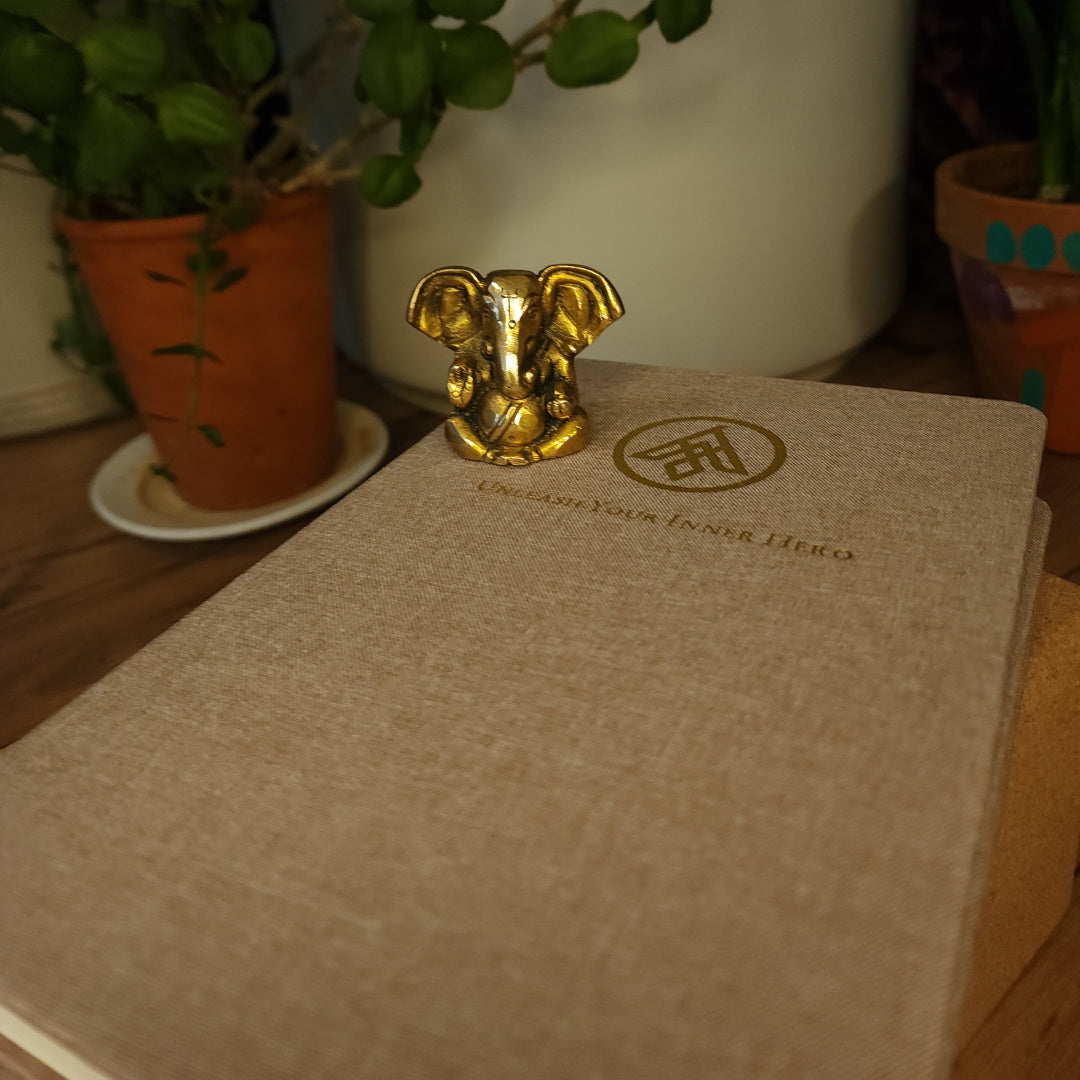
Aham Brahmasmi (I am Brahman): Meaning and Definition
Jack UtermoehlShare
Aham Brahmasmi (i am Brahman)
- Devanagari: अहं ब्रह्मास्मि
- IAST: ahaṃ brahmāsmi
- Pronunciation: uh-hum bruh-maahs-mee. The aa sound in maahs is held longer than the other vowels. Before the following b, the final nasal in aham may sound close to m.
- Alternate spellings: Aham Brahma Asmi, Aham Brahmaasmi, Ahambrahmasmi
Definition
Aham Brahmasmi means “I am Brahman.” In yoga philosophy, especially Advaita Vedanta, Aham Brahmasmi expresses the realization that the deepest Self, or Atman, is identical with Brahman, the fundamental reality underlying all existence. The statement comes from the Brihadaranyaka Upanishad 1.4.10. Here, “I” refers to the Self recognized beyond limited identification with the body, personality, and ahamkara, or ego-making function.
Aham Brahmasmi is one of the best-known mahavakyas, or “great statements,” of the Upanishads. Its meaning becomes clearer when the Sanskrit grammar, original passage, and Vedantic interpretations are considered together. In contemporary yoga settings, it may be repeated as a mantra or affirmation, although its original setting is an Upanishadic prose teaching about knowledge of the Self.
What does Aham Brahmasmi mean word by word?
Aham Brahmasmi is a complete Sanskrit sentence composed of three grammatical elements. Aham means “I.” Brahma is the neuter nominative singular form of Brahman, the ultimate reality discussed in the Upanishads. Asmi is the first-person singular form of the Sanskrit verb meaning “to be,” so it means “I am.”
When brahma and asmi occur together, vowel sandhi joins them as brahmasmi. The resulting sentence literally means “I am Brahman.” English translations sometimes render it as “I am the Absolute” or “I am ultimate reality” to clarify the philosophical meaning of Brahman.
- aham: I
- brahma: Brahman, ultimate reality
- asmi: I am
- aham brahmasmi: I am Brahman
Where does Aham Brahmasmi appear in the Upanishads?
Aham Brahmasmi appears in the Brihadaranyaka Upanishad 1.4.10, an early Upanishadic text associated with the Shukla Yajur Veda. The passage describes Brahman knowing itself through the recognition “I am Brahman.” It then applies this insight to gods, seers, and human beings who awaken to the same knowledge.
The surrounding passage matters because Aham Brahmasmi is part of a broader teaching about transformative self-knowledge. It is not originally presented as an isolated slogan. The passage connects knowing Brahman with becoming or recognizing the whole, meaning that the knower no longer understands the Self as an entirely separate, limited being.
The Upanishad itself does not introduce Aham Brahmasmi with the later technical label mahavakya. Vedanta traditions, especially Advaita Vedanta, came to honor it as one of the principal great statements summarizing Upanishadic teaching.
What does Aham Brahmasmi mean in Advaita Vedanta?
In Advaita Vedanta, Aham Brahmasmi teaches the identity of Atman and Brahman. Atman is the innermost Self or witnessing consciousness. Brahman is the limitless reality in which all experiences and forms appear. Advaita interprets the sentence as revealing that these are not two independently existing realities.
The “I” in this teaching is therefore examined carefully. It does not refer to a person’s social identity, opinions, memories, accomplishments, or ahamkara. Ahamkara is the mental function that constructs the sense of being a separate individual and claims experience as “mine.” Aham Brahmasmi points toward the underlying awareness in which that changing sense of identity is known.
From this perspective, the statement is not intended to make the personality feel cosmically important. It is a teaching used to loosen identification with the limited personality. Knowledge replaces avidya, or ignorance of the Self, and this knowledge is regarded in Advaita as central to moksha, liberation.
How do other Vedanta traditions understand the teaching?
Vedanta schools agree that Brahman is central to the Upanishads, but they do not all accept Advaita’s interpretation of complete identity between the individual self and Brahman. This difference affects how statements such as Aham Brahmasmi are explained.
Vishishtadvaita teaches a qualified nonduality in which individual selves and the universe are real and exist in complete dependence upon Brahman. The individual participates in Brahman and belongs inseparably to Brahman while retaining a real identity. Dvaita teaches an enduring distinction between the individual self and Brahman, even in liberation.
For this reason, “I am Brahman” should not be presented as having one universally accepted metaphysical interpretation throughout Hindu philosophy. The direct identity reading is most characteristic of Advaita Vedanta. Devotional and theistic Vedanta traditions interpret Upanishadic language within frameworks that preserve a meaningful relationship between the soul and the supreme reality.
Is Brahman the same as the deity Brahma?
Brahman and Brahma are related Sanskrit terms but have different meanings in most yoga and Hindu philosophical contexts. Brahman is the ultimate or foundational reality described in the Upanishads. Brahma is a personal deity associated with creation and is commonly represented as part of the Trimurti with Vishnu and Shiva.
Aham Brahmasmi refers to Brahman, not to the deity Brahma. The translation “I am Brahma” can therefore mislead English readers. “I am Brahman” is the clearer and more accurate translation.
How is Aham Brahmasmi used in yoga practice?
In traditional Advaita study, Aham Brahmasmi may be contemplated through Shravana, listening to the teaching; Manana, reflecting on its meaning; and nididhyasana, sustained contemplation that allows the teaching to become firmly understood. Guidance from a qualified teacher helps the student distinguish philosophical inquiry from self-enhancing interpretation.
In modern yoga, Aham Brahmasmi is also used as a meditation phrase, mantra, or affirmation. A practitioner may repeat it quietly and observe which identities are being treated as the “I.” The practice can direct attention from changing thoughts and roles toward the awareness that knows them.
Repetition alone does not communicate the full Upanishadic teaching. Teachers using Aham Brahmasmi in class can explain Brahman, Atman, and ahamkara before introducing the phrase. This context helps students understand why “I am Brahman” concerns self-knowledge rather than personal power or superiority.
- Repeat the phrase slowly while maintaining relaxed attention.
- Notice the difference between awareness and the thoughts appearing within awareness.
- Study the original Upanishadic context alongside meditation practice.
- Avoid using the statement to dismiss ordinary responsibilities, ethical conduct, or the lived experiences of others.
How does Aham Brahmasmi relate to the other mahavakyas?
Aham Brahmasmi belongs to a group of Upanishadic statements that Advaita teaching commonly uses to illuminate the relationship between Atman and Brahman. Each statement approaches the teaching from a different grammatical perspective.
Tat Tvam Asi, “You are That,” presents the teaching from teacher to student. Ayam Atma Brahma, “This Self is Brahman,” identifies the Self with Brahman. Prajnanam Brahma, often translated as “Consciousness is Brahman,” describes Brahman in terms of consciousness. Aham Brahmasmi expresses the recognition in the first person: “I am Brahman.”
Taken together, these statements support inquiry into the identity of the knower. Their traditional purpose is philosophical and liberating rather than merely inspirational.
Related Sanskrit Terms
- Brahman
- Atman
- Advaita
- Advaita Vedanta
- Mahavakya
- Upanishad
- Vedanta
- Ahamkara
- Avidya
- Jnana
- Moksha
- Tat Tvam Asi
- Ayam Atma Brahma
- Prajnanam Brahma
- Shravana
- Manana
- Nididhyasana