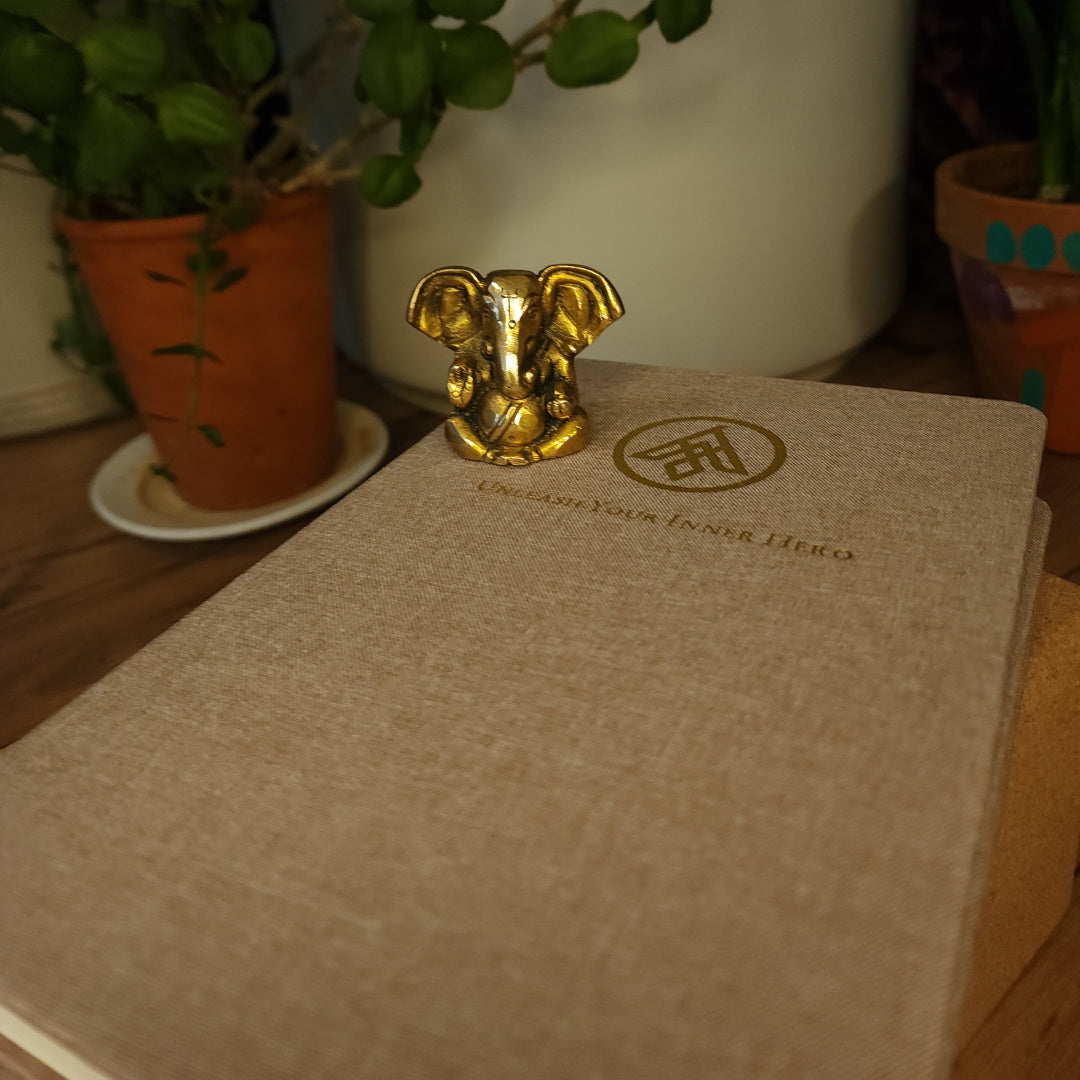
Deva (God; deity; divine or celestial being): Meaning and Definition
Jack UtermoehlShare
Deva (god; deity; divine or celestial being)
- Devanagari: देव
- IAST: deva
- Pronunciation: Approximately DAY-vuh, with a pure, sustained e vowel rather than a strongly gliding English “day.” The v is soft and may sound between an English v and w. IPA: /d̪eːʋɐ/.
- Alternate spellings: Dev (a common modern spelling in names and some Indian languages)
Definition
Deva means “god,” “deity,” or “divine or celestial being.” In yoga and related Hindu traditions, deva usually refers to a male deity or divine being honored through mantra, puja, devotion, or sacred stories. The English word “god” is useful but incomplete because deva can name a particular deity, a class of heavenly beings, or something described as divine or celestial. It does not always mean an all-powerful creator God.
Deva is one of the oldest and most widely used Sanskrit words for a divine being. Yoga practitioners may encounter it in Vedic hymns, devotional practices, philosophical teachings, deity names, and compounds such as Ishta Devata. Its meaning should be determined from the tradition and text in which it appears.
What does deva literally mean?
As a noun, deva commonly means a god, deity, or celestial being. As an adjective, related forms can mean divine, heavenly, sacred, or excellent. Sanskrit dictionaries connect deva with the root div, associated with shining, brightness, and the luminous sky. This connection explains the familiar interpretive gloss “shining one,” although “deity” is usually the clearer translation in an actual sentence.
Deva is the masculine dictionary stem. The corresponding feminine noun is Devi, meaning goddess. As a masculine a-stem noun, deva changes its ending according to grammatical case and number. For example, the nominative singular is देवः, written as devah without diacritics, while deva remains the standard dictionary and English-language form.
- Primary noun meanings: god, deity, divine being, or celestial being
- Related adjectival meanings: divine, heavenly, sacred, or excellent
- Grammatical gender as a noun: masculine
- Corresponding feminine term: Devi
What does deva mean in yoga?
In yoga, deva refers most often to a deity or divine being approached through devotion, contemplation, mantra, ritual, or sacred narrative. A practitioner might recite a mantra associated with a particular deva, meditate on the deity’s qualities, or honor the deity through puja and offerings.
The most useful English translation for yoga teaching is often “deity.” The translation “god” is also valid, but it may suggest a single creator who exists outside creation. That implication does not fit every Hindu philosophical or devotional context. “Demigod” appears in some English translations, especially when devas are understood as subordinate celestial beings, but it is a tradition-specific choice rather than a neutral definition.
Deva can refer to a divine figure with a distinct name and form, such as Agni, Indra, Surya, Shiva, Vishnu, or Ganesh. In devotional traditions, a particular deva may be worshiped as the supreme expression of reality rather than as one limited deity among many. The theological status of a deva therefore depends on the school, scripture, and community.
- Use “deity” as a broadly applicable translation.
- Use “god” when the surrounding context makes its meaning clear.
- Avoid assuming that every deva is a creator God, an angel, or a demigod.
- When teaching, identify the specific tradition’s understanding of the deity.
Deva in Vedic literature
In the Vedas, devas are divine powers addressed through hymns, offerings, praise, and ritual. Prominent Vedic devas include Agni, Indra, Surya, Soma, and Vayu. Their hymns associate them with fire, storms, sunlight, sacred drink, wind, moral order, protection, insight, and other dimensions of life and the cosmos.
Calling the Vedic devas “nature gods” can be helpful as an introduction, but it is incomplete. A Vedic deva may be connected with a natural phenomenon while also embodying ritual power, intelligence, social order, or a cosmic function. The same deva can carry different qualities across hymns and historical periods.
The etymological association with brightness is especially relevant in the Vedic setting, where light, radiance, and the luminous heavens frequently characterize divine presence. Still, readers should treat “shining one” as an explanatory gloss rather than as the only possible translation.
- Agni is associated with fire, sacrifice, and communication between worshipers and the devas.
- Indra is a powerful Vedic deva associated with storms, strength, and victory.
- Surya is the solar deity and a visible expression of light.
- Soma can refer to a deity, a sacred offering, and the power associated with that offering.
Deva, Brahman, and Ishvara are not exact synonyms
Deva generally names a deity or celestial being, while Brahman in Vedanta refers to ultimate reality. Ishvara usually refers to the Lord or supreme governing consciousness. These distinctions are useful, but their application varies among Vedanta schools and devotional traditions.
A deva may be understood as a distinct divine being with particular powers and functions. In another tradition, the same deity may be worshiped as Ishvara or as the fullest personal revelation of Brahman. The word deva alone does not settle the theological question.
The Bhagavad Gita discusses worship directed toward devas while distinguishing it from devotion directed toward Krishna as the supreme Lord. Interpretations of this distinction vary among commentators. Some treat devas as limited celestial beings, while others understand the many divine forms as expressions within a single ultimate reality.
- Brahman: ultimate reality in Vedanta
- Ishvara: the Lord or supreme governing consciousness
- Deva: a deity, divine power, or celestial being
- Ishta Devata: the chosen or personally cherished form of deity
Deva in devotional practice
In Bhakti traditions, relationship with a deva may be cultivated through mantra, kirtan, prayer, puja, visualization, pilgrimage, and service. The deity is commonly approached as a living divine presence rather than only as a literary symbol.
Ishta Devata means a chosen or cherished deity. The practice allows devotion to take a particular name and form, such as Shiva, Krishna, Rama, or Ganesh. Different traditions explain the relationship between the chosen deity and ultimate reality in different ways.
A murti is a consecrated or ritually honored form through which the presence of a deva or Devi may be approached. Translating murti simply as “idol” can miss its devotional role. Practitioners may understand the form as a focus of divine presence, relationship, and worship.
- Mahadeva means “Great God” and is a well-known title of Shiva.
- Kuladeva refers to a deity associated with a family, clan, or lineage.
- Ishta Devata refers to a personally chosen or cherished deity.
- Puja is a form of ritual honoring that may be directed toward a deva or Devi.
How is deva used in Buddhism and Jainism?
In Buddhist traditions, devas are celestial beings who inhabit heavenly realms and may possess long lives, refined pleasure, radiance, and extraordinary abilities. They remain within samsara and are subject to change, death, and rebirth. A Buddhist deva is therefore not an eternal creator and is not equivalent to a Buddha.
In Jain traditions, devas are also celestial beings within the inhabited universe. They possess remarkable powers and may receive ritual attention, but they remain within the cycle of rebirth. Jain teachings distinguish such gods and goddesses from the liberated Jinas, who have passed beyond karmic bondage.
These Buddhist and Jain meanings show why “celestial being” can sometimes be more accurate than “god.” The best translation depends on whether the passage emphasizes worship, cosmological status, divine qualities, or a particular named deity.
- Buddhist devas remain within samsara and have not necessarily attained liberation.
- Jain devas remain subject to karma and rebirth.
- Neither Buddhist nor Jain usage ordinarily makes deva an eternal creator God.
How should yoga teachers explain deva?
Yoga teachers can define deva first as “a deity or divine being” and then explain how the specific tradition understands that being. This approach gives students a direct meaning without imposing a single theology on every Sanskrit text.
When a deva appears in an asana story, mantra, or philosophical discussion, name the source tradition when possible. A devotional account of Shiva, a Vedic hymn to Agni, and a Buddhist description of celestial beings use related vocabulary within different religious frameworks.
Pronunciation also deserves care. The Sanskrit e is inherently long, so the first syllable should be sustained. The final a remains audible in careful Sanskrit pronunciation, producing approximately DAY-vuh rather than the one-syllable English form “Dev.”
- Concise teaching definition: “Deva means a deity or divine being.”
- Add context before describing a deva as supreme, subordinate, symbolic, or celestial.
- Retain the final vowel when pronouncing the Sanskrit headword.
- Explain that Devi is the corresponding feminine term.
Related Sanskrit Terms
- Devi (Goddess)
- Ishvara (Supreme Being)
- Ishta Devata
- Brahman
- Bhakti
- Puja (Devotional Worship)
- Mantra
- Murti (Sacred Image)
- Agni
- Indra (King of the Devas)
- Surya (Sun)
- Mahadeva
- Kuladeva
- Loka (World or Realm)
- Samsara