Om Sri Maha Lakshmiyei Namah: Meaning, Translation, Pronunciation, and How to Chant
People chant Om Sri Maha Lakshmiyei Namah as a prayer of reverence for Mahalakshmi and for the auspicious flourishing associated with her worship. Its basic meaning is “Om. Salutations to the revered Mahalakshmi.” This short Sanskrit mantra is used in Hindu Lakshmi worship, personal prayer, meditation, and repeated recitation. It may be spoken aloud, softly, or mentally, including as part of a formal offering ritual.
The Mantra
Translation
Om. Salutations to the revered Mahalakshmi.
Oṃ; śrī, a reverential or auspicious honorific; to Mahalakshmi; homage.
An idiomatic rendering may say, “I bow to the great Goddess Lakshmi,” but the Sanskrit does not contain an explicit first-person verb meaning “I bow.” Namaḥ is a formula of homage used with mahālakṣmyai, meaning “to Mahalakshmi.”
How to Pronounce the Mantra
muh-HAA-luksh-my-eye
nuh-muh(h)
| Mantra | Pronunciation | Notes |
|---|---|---|
| oṃ | ohm | Use a long, steady o followed by nasal resonance. The scholarly form is oṃ rather than a forced sequence of three separate sounds. |
| śrī | shree | The ś is like English sh, and ī is a long ee. If possible, use a light tap or roll for r rather than a strongly American r. |
| mahālakṣmyai | muh-HAA-luksh-my-eye | The ā in mahā is long. Kṣ is approximately ksh for English-speaking learners. The final ai is approximately the vowel in eye in careful Classical Sanskrit pronunciation. |
| namaḥ | nuh-muh(h) | Both a vowels are short. The final ḥ is visarga, a light breath or echo after the preceding vowel. Musical and regional recitations may make an audible “nama-ha.” |
Pronunciation Notes
- IAST transliteration is more precise than English phonetic spellings, which are only teaching aids.
- Regional and lineage pronunciation may realize ai closer to English eye, ay, or a sound between them.
- The common spelling Lakshmiyei is a phonetic approximation. Mahalakshmyai more closely represents the Sanskrit mahālakṣmyai.
- This form uses śrī, not the distinct nasalized bīja śrīṃ, often written Shrim.
How to Chant Om Sri Maha Lakshmiyei Namah
This mantra can be used as a simple devotional prayer, as repeated japa practice, or during Lakshmi puja. Its central gesture is offering homage to Mahalakshmi.
Sit or stand respectfully and chant at an unhurried pace. You may repeat it aloud, softly, or mentally while keeping attention on Mahalakshmi and the act of reverence. In a formal puja, follow the procedure of a family, temple, or teacher. The mantra may accompany offerings such as a seat, water, sandal paste, flowers, incense, a lamp, or food.
- Silent or audible japa
- Personal devotional prayer
- Meditation
- Lakshmi puja and individual offerings
- Home or temple worship
- Modern musical chanting or kirtan
No universally binding repetition count or ancient prescription was established for this exact short form. It can be spoken once with each puja offering or repeated as japa. One mala or 108 repetitions is a common broader japa convention, but it is not a universally required count for this mantra.
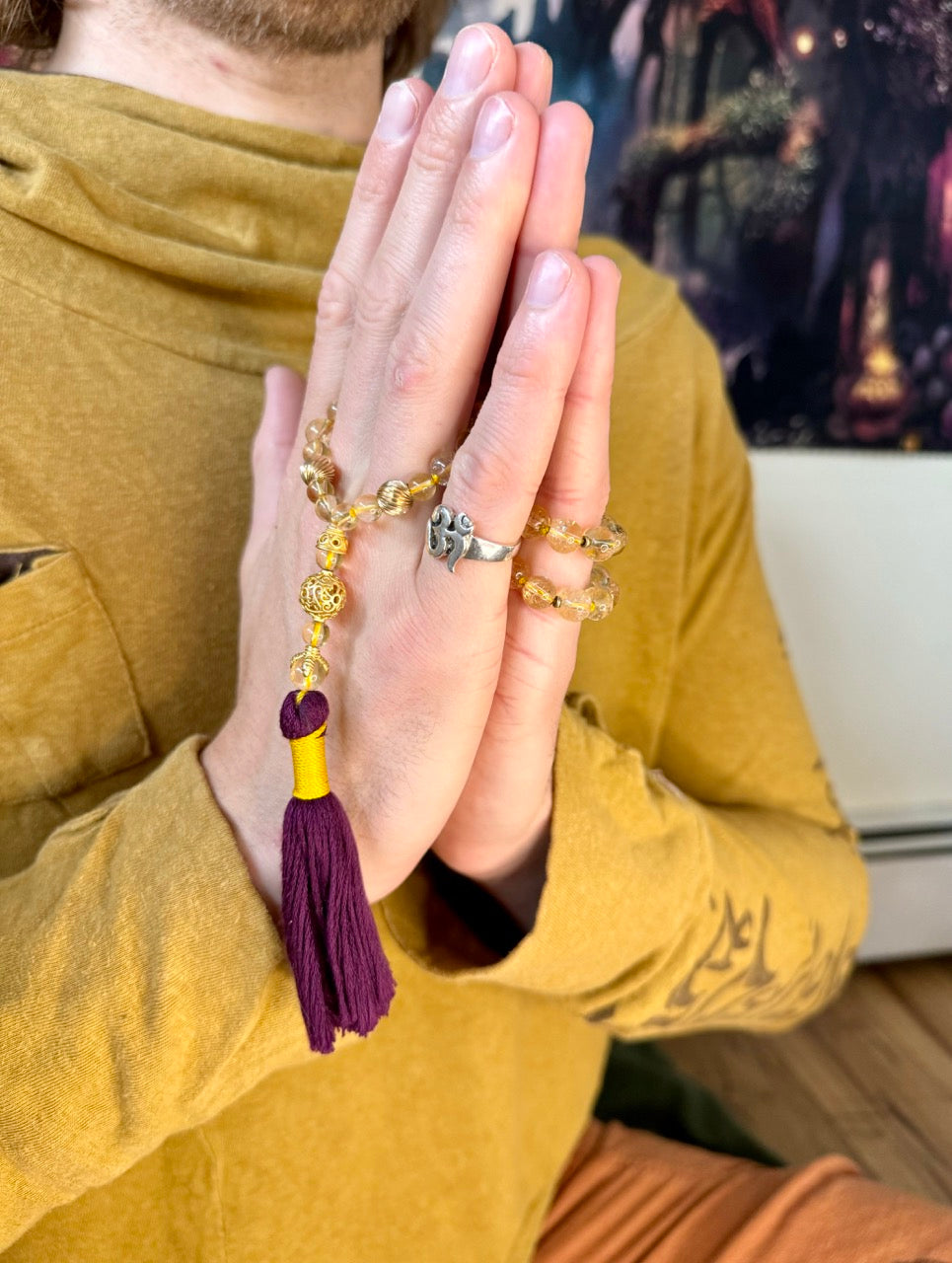
A mala can be useful during japa to track repetitions and support sustained attention. It is optional for simple prayer and is not required when the mantra accompanies individual puja offerings.
The simple salutation is publicly taught in Lakshmi puja manuals and is generally open in this devotional form. More complex Lakshmi practices involving multiple bīja syllables, ritual nyāsa, homa, or claims of mantra-siddhi may have lineage-specific prerequisites or require instruction.
Mantra at a Glance
| Language | Sanskrit |
|---|---|
| Tradition | Hindu Lakshmi worship in Vaishnava, Shakta, Smarta, temple, and domestic contexts |
| Type | Short deity-salutation or namaḥ mantra |
| Addressed to | Mahalakshmi, also closely associated with Sri and Lakshmi |
| Common uses | Japa, prayer, meditation, Lakshmi puja, offerings, and modern kirtan |
| Access | Generally open as a simple public devotional formula |
Word-by-Word Meaning
| Mantra | Basic Meaning | Grammar / Context |
|---|---|---|
| Om, oṃ | A sacred syllable conventionally placed at the beginning of mantras and ritual formulas | An indeclinable sacred utterance, traditionally called the praṇava. It introduces and sacralizes the salutation. |
| Sri, śrī | Splendor, auspiciousness, prosperity, or a revered honorific | Used here as an honorific or as part of an honorific compound. Śrī is also a name of Lakshmi. |
| Mahalakshmyai, mahālakṣmyai | To or for Mahalakshmi | The feminine dative singular form of Mahālakṣmī. The ending -yai expresses “to” or “for”; it is not a separate word. |
| Namah, namaḥ | Homage, reverence, salutation | An indeclinable ritual expression commonly used with a deity's name in the dative case. |
Meaning of Om Sri Maha Lakshmiyei Namah
Om Sri Maha Lakshmiyei Namah is a concise act of reverence addressed to Mahalakshmi. Rather than making a specific request, its grammar offers homage: “Om. Salutations to the revered Mahalakshmi.”
People may chant it as a prayer for Mahalakshmi's presence or favor, and as a way of contemplating the auspiciousness, well-being, and flourishing associated with her tradition. In Lakshmi worship, prosperity has a broad scope that can include food, fertility, household stability, reputation, royal fortune, beauty, and auspicious flourishing, rather than money alone.
The mantra itself does not literally promise to attract wealth or guarantee prosperity. Those ideas belong to traditional and modern interpretations of Lakshmi, not to an explicit promise in the Sanskrit wording.
In puja, the formula identifies Mahalakshmi as the recipient of an offering. In japa, the same short formula functions as a complete repeated salutation.
Mahalakshmi and Sri
Lakshmi, also called Sri, is a major Hindu goddess associated with auspiciousness, plenitude, prosperity, fertility, domestic stability, royal fortune, and beauty. Mahalakshmi means “great Lakshmi.”
In Vaishnava traditions, Sri-Lakshmi is understood as Vishnu's divine consort. In Goddess-centered traditions, she may be understood as a manifestation of Devi or divine shakti, a term for sacred power. These are theological frameworks that give devotional depth to the mantra, rather than literal translations of its four words.
The word śrī before Mahalakshmi can function as an honorific, conveying reverence and auspiciousness. It also recalls Sri as Lakshmi's ancient name and the wider principle of auspicious flourishing.
Origin and History of the Mantra
The exact history of oṃ śrī mahālakṣmyai namaḥ is not securely established. It follows a widespread Sanskrit pattern: oṃ, a deity's name in the form meaning “to,” and namaḥ, meaning homage.
The Sri Sukta is an early and foundational hymn to Sri-Lakshmi, but it does not contain this exact short mantra. It is historically important for Sri-Lakshmi worship and should not be treated as the direct textual source of this formula.
A closely related Mahalakshmi mantra appears in the Garuda Purana, in a chapter on Lakshmi worship: śrīṃ hrīṃ mahālakṣmyai namaḥ. Another related sequence ends in śrīmahālakṣmyai namaḥ. These forms support the history of the Mahalakshmi salutation pattern, but they are not exact witnesses to the requested non-bīja wording.
The Garuda Purana is a layered text transmitted in differing recensions, and the date of this individual chapter cannot be fixed securely. Later puja manuals clearly document the exact short salutation in living Lakshmi worship.
Traditional Interpretations
In general Hindu devotional practice, the mantra is understood as a direct salutation to Mahalakshmi, who is associated with auspicious flourishing and well-being.
In Vaishnava and Sri Vaishnava settings, Sri-Lakshmi is understood in inseparable relation to Vishnu. Sri Vaishnava theology especially describes her as gracious mediator or intercessor. This theological meaning is not stated explicitly in the short mantra's grammar.
In Shakta traditions, Mahalakshmi may be honored as Devi or divine shakti. From this perspective, prosperity can be understood as one dimension of sovereign divine power.
In domestic and festival puja, the salutation may accompany offerings made with intentions of household auspiciousness, stability, food, prosperity, and family welfare.
Sanskrit and Grammar
The core grammatical construction is mahālakṣmyai namaḥ: “homage to Mahalakshmi.” Mahālakṣmyai is feminine dative singular, the Sanskrit form used for the recipient of homage. Namaḥ is an indeclinable expression of reverence that conventionally takes the dative.
Mahālakṣmī is a compound name made from mahā, meaning “great,” and Lakṣmī, the goddess's name. The popular division “Maha Lakshmiyei” is helpful for English-speaking pronunciation but does not precisely represent Sanskrit morphology.
The requested mantra contains śrī, written श्री. It is not śrīṃ, written श्रीं, a distinct bīja syllable traditionally associated with Sri-Lakshmi. A bīja is a ritual seed syllable and should not be treated as an ordinary dictionary word.
Variations of the Mantra
Requested short salutation
oṃ śrī mahālakṣmyai namaḥ
The form discussed here. It contains śrī as an honorific, not the nasalized Lakshmi bīja śrīṃ.
Short form without Sri
oṃ mahālakṣmyai namaḥ
This form omits the separate honorific śrī while retaining the same grammatical salutation to Mahalakshmi.
Modern Shrim variant
oṃ śrīṃ mahālakṣmyai namaḥ
This distinct variant uses śrīṃ, often written Shrim, in place of śrī. Śrīṃ is a bīja syllable and does not have an ordinary lexical translation.
Garuda Purana related form
śrīṃ hrīṃ mahālakṣmyai namaḥ
A closely related Puranic ritual formula with two bīja syllables. It is not the exact source of the requested short, non-bīja wording.
Expanded Lakshmi puja mantra
oṃ śrīṃ hrīṃ śrīṃ kamale kamalālaye prasīda prasīda śrīṃ hrīṃ śrīṃ oṃ mahālakṣmyai namaḥ
This longer liturgical formula adds bījas, direct address to the lotus goddess, and the request “be gracious.” It is a distinct expansion, not simply the short mantra sung for longer.
How This Mantra Is Used Today
Today, Om Sri Maha Lakshmiyei Namah is used in home and temple puja, personal japa, yoga and meditation settings, devotional recordings, and kirtan-inspired music.
Western yoga presentations sometimes call it an “abundance mantra.” This can describe a modern devotional intention, but the literal Sanskrit is a salutation to Mahalakshmi. It does not state that chanting will mechanically attract money, manifest wealth, heal conditions, or guarantee prosperity.
When used musically, the mantra may be repeated in a cycle or offered through call-and-response. These are contemporary performance methods rather than intrinsic or textually prescribed features of the mantra.
Related Concepts
Sri · Mahalakshmi · Namah · Japa · Puja · Shrim
Related Mantras
Om Shrim Mahalakshmyai Namah · Sri Sukta · Mahalakshmi Gayatri · Mahalakshmi Ashtakam · Om Shrim Hrim Shrim Kamale Kamalalaye
Common Questions About Om Sri Maha Lakshmiyei Namah
Does the mantra say Sri or Shrim?
The requested form says śrī, written श्री. Śrīṃ, written श्रीं and often spelled Shrim, is a distinct nasalized bīja syllable that creates a different mantra variant.
What is the correct Sanskrit spelling?
The corrected Devanagari spelling is ॐ श्री महालक्ष्म्यै नमः. It includes the dative form महालक्ष्म्यै and the final visarga in नमः.
What does Mahalakshmyai mean?
Mahālakṣmyai is the feminine dative singular form of Mahālakṣmī. It means “to Mahalakshmi” or “for Mahalakshmi.”
Is Lakshmiyei an accurate transliteration?
Lakshmiyei is a common English phonetic spelling, but it is not precise transliteration. The academic IAST form is mahālakṣmyai, and Mahalakshmyai is a closer plain-Latin spelling.
Does this mantra literally mean that it attracts wealth?
No. Its literal content is a salutation to Mahalakshmi. Prosperity and wealth are traditional associations of Lakshmi, but the grammar does not make a promise of financial results.
Does this mantra require initiation?
The simple salutation is publicly taught in Lakshmi puja manuals, and no initiation requirement was located for this use. More complex tantric or bīja-based practices may have lineage-specific requirements.
How many times should I chant it?
No universal canonical count was verified for this exact short form. It may be spoken with individual offerings or repeated as japa. A count of 108 is a common broader japa convention, not a universal requirement for this mantra.
Is this mantra from the Sri Sukta?
No exact occurrence of this short mantra was found in the Sri Sukta. The Sri Sukta is historically important for Sri-Lakshmi worship, but it should not be identified as the source of this exact formula.
Sources and Further Reading
- Garuda-Purana, Part 1, Purvakhanda 1.10: Lakshmyarcananirupana, GRETIL, University of Göttingen
- The Garuda Purana, Chapter X: The Mode of Worshipping the Goddess Lakshmi, Manmatha Nath Dutt; hosted by Wisdom Library
- Diwali Pooja Vidhi, Chinmaya Mission
- Puja to Mahalakshmi, Sri Venkateswara Temple
- Sri/Lakshmi: Goddess of Plenitude and Ideal of Womanhood, Mandakranta Bose
- History of the Worship of Sri in North India to circa A.D. 550, Bandana Saraswati, SOAS University of London
- Sri Sukta (Rigveda Khila tradition), Traditional Sanskrit text; Sanskrit Documents
- A Sanskrit Grammar for Students, Arthur Anthony Macdonell
- Sanskrit-English Dictionary Entry for Namas, Monier-Williams lexicon data hosted by SanskritDictionary.com
- Sanskrit Manual, Roderick S. Bucknell
- How Japa Leads to Meditation, Pandit Rajmani Tigunait, Himalayan Institute
- Guide to Sanskrit Pronunciation, SYDA Foundation, Siddha Yoga