Om Namo Bhagavate Vasudevaya: Meaning, Translation, Pronunciation, and How to Chant
Jack UtermoehlPeople chant Om Namo Bhagavate Vasudevaya as a prayer of reverence and devotion toward Krishna or Vishnu. In plain English, it means, “Om. I bow to Bhagavan Vasudeva.” It is a Sanskrit mantra strongly associated with Vaishnava devotional traditions and with the story of Dhruva in the Bhagavata Purana. It may be repeated aloud, softly, or mentally during personal meditation, worship, or group chanting. Formal ritual practice and initiation expectations vary by lineage.
The Mantra
Translation
Om. I bow to Bhagavan Vasudeva.
Oṃ; homage or reverence to the Blessed Lord, to Vāsudeva.
“I bow” supplies a natural English subject and verb. The Sanskrit directly expresses homage to Bhagavat, identified as Vāsudeva. Interpretations such as “the Lord who dwells in all beings” are theological explanations of Vāsudeva, not a word-for-word translation.
How to Pronounce the Mantra
bhuh-guh-vuh-TAY
VAA-soo-day-VAA-yuh
| Mantra | Pronunciation | Notes |
|---|---|---|
| oṃ | OHM | Use a long o followed by a gentle nasal resonance or closed m. The exact realization varies by recitation tradition. |
| namo | nuh-MOH | The first vowel is short. Keep the final o long and relatively pure, without a strongly English-style glide. |
| bhagavate | bhuh-guh-vuh-TAY | Bh is pronounced as b with an audible breath release. The three a vowels are short, while Sanskrit e is long. |
| vāsudevāya | VAA-soo-day-VAA-yuh | The first and fourth vowels are long ā. The u is short, e is long, and the final a in ya is short. Sanskrit v may sound softer than English v and can sound somewhat between v and w in some traditions. |
Pronunciation Notes
- The IAST transliteration is more precise than English phonetic spelling.
- Preserve the long vowels in vā, de, and vā.
- Keep the rhythm relatively even rather than using heavy English-style stress.
- Avoid pronouncing bhagavate as “bug-a-vate” or ending Vasudevaya like the English word “vaya.”
How to Chant Om Namo Bhagavate Vasudevaya
For general devotional practice, chant the complete mantra clearly and evenly while holding an intention of homage toward Vāsudeva.
Sit or stand in a comfortable, attentive position. Recite the full mantra at a steady pace:
Om Namo Bhagavate Vasudevaya
You may chant it aloud, softly, or mentally. Traditional sources connect repetition with contemplation and worship, so practitioners may reflect on Vāsudeva as Krishna, Vishnu, or the supreme Lord according to their Vaishnava teaching. More elaborate practices involving ritual procedures, formal vows, deity installation, nyasa, fire offerings, or breath regulation are best learned within an appropriate lineage.
- Audible japa, or repeated recitation aloud
- Soft or whispered japa
- Mental japa
- Devotional meditation
- Puja and arcana, or ritual worship
- Congregational chanting
- Invocation associated with Bhagavata recitation
No single repetition count is intrinsic to the mantra or universally prescribed. A traditional account connects continuous repetition with Dhruva’s particular ascetic and ritual setting, but that narrative should not be treated as a general promise or required schedule.
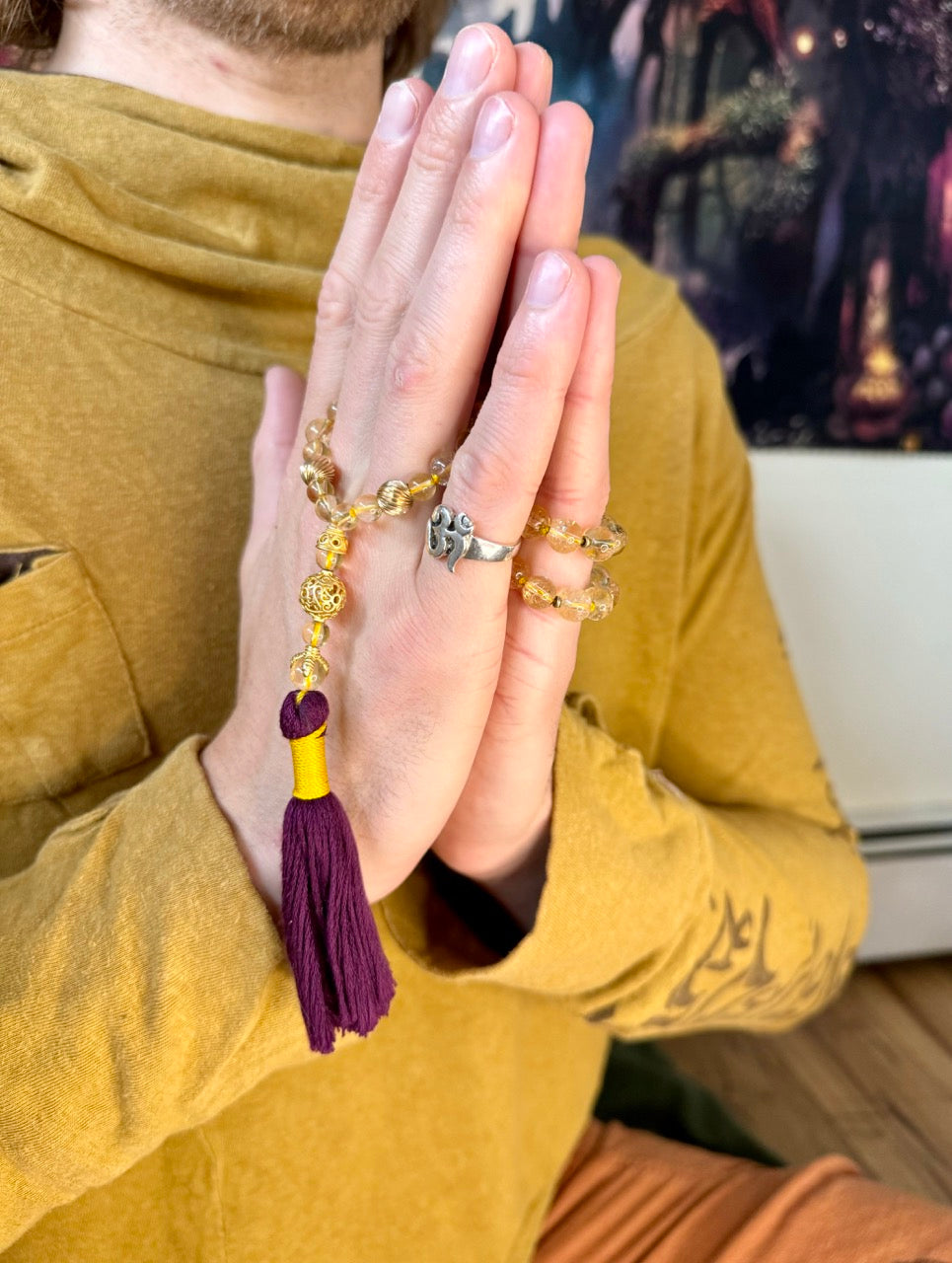
A mala can support a chosen personal japa discipline. A standard mala commonly has 108 counting beads, making 108 a common practice count, but it is a convention rather than a universal requirement of this mantra. Lineage-specific instructions may differ.
The mantra is publicly printed and widely used in devotional and congregational settings. Some lineages nevertheless expect instruction from a qualified teacher for formal mantra practice, especially when it includes ritual procedures, intensive practice, or a committed vow. Casual devotional chanting and formally initiated mantra practice are not identical contexts.
Mantra at a Glance
| Tradition | Vaishnava, especially Bhagavata and Krishna devotional traditions |
|---|---|
| Language | Sanskrit |
| Classification | Vāsudeva twelve-syllable mantra; devotional and ritual japa mantra |
| Associated with | Vāsudeva as Krishna or Vishnu; traditionally connected with Dhruva |
| Primary source | Bhagavata Purana 4.8.53-54 |
| Practice | Japa, meditation, worship, and modern congregational chanting |
| Access | Publicly recited; formal initiation requirements vary by lineage and practice level |
Word-by-Word Meaning
| Mantra | Basic Meaning | Grammar / Context |
|---|---|---|
| Om, oṃ | the sacred syllable oṃ | An indeclinable sacred utterance, traditionally called praṇava. It is not adequately translated by a single English dictionary word. |
| Namo, namo | homage; reverence; salutation | The sandhi form of namaḥ, used with a dative recipient. English commonly renders it as “I bow to” or “salutations to.” |
| Bhagavate, bhagavate | to the blessed, venerable, or divine Lord | Dative singular of bhagavat or bhagavant. In Vaishnava usage, Bhagavat functions as a divine title. |
| Vasudevaya, vāsudevāya | to Vāsudeva | Dative singular of the masculine proper name Vāsudeva. The Sanskrit name Vāsudeva, a name of Krishna or the deity addressed, differs from Vasudeva, the name of Krishna’s father. |
Meaning of Om Namo Bhagavate Vasudevaya
This mantra is a concise act of reverence directed to Bhagavan Vāsudeva. Its central meaning is homage, while its devotional orientation is toward Krishna or Vishnu.
A readable translation is, “Om. I bow to Bhagavan Vasudeva.” The more literal sense is, “Oṃ; homage to the Blessed Lord, to Vāsudeva.”
Vaishnava teachers often understand the mantra as an expression of reverence, self-offering, or surrender to Krishna or Vishnu. Surrender is a devotional interpretation of the practice, rather than a separate verb stated in the Sanskrit.
Some Vedantic and modern teachings use Vāsudeva as a contemplation of the omnipresent or indwelling Lord. This can be a meaningful theological interpretation within broader Vaishnava thought, but it is not the direct grammatical translation of the name.
Vāsudeva: Krishna and the Supreme Lord
Vāsudeva is a major name of Krishna and a divine designation in Vaishnava traditions. Historically and grammatically, the name may identify Krishna as the son of Vasudeva.
In developed Vaishnava theology, Vāsudeva is also identified with Vishnu, Bhagavan, and the supreme reality. In this mantra, Vāsudeva is the direct recipient of homage.
Descriptions such as the all-pervading Lord, the indwelling Self, or the source of the universe belong to particular theological interpretations. They should not be confused with the mantra’s bare grammatical wording.
Origin and History of the Mantra
Om Namo Bhagavate Vasudevaya is conventionally known as the Dvādaśākṣara, meaning the twelve-syllable mantra. The traditional count is oṃ-na-mo-bha-ga-va-te-vā-su-de-vā-ya.
The earliest exact primary-text attestation securely located for this research is Bhagavata Purana 4.8.54. In that narrative, the sage Narada teaches the mantra to the child devotee Dhruva for repetition, meditation, and worship of Hari.
The Vishnu Purana also refers to contemplation of a twelve-syllable mantra that its translation and commentarial tradition identify as this formula. It includes a related Vāsudeva prayer in its account of Dhruva, although that longer formulation should not automatically be equated with the bare twelve-syllable mantra.
The historical dates and textual development of the Puranas remain disputed. For that reason, the Bhagavata Purana passage is best described as the earliest exact attestation securely located here, not as proof of when the mantra was first composed or orally transmitted.
Later Vaishnava ritual sources treat the formula as a developed mantra for japa, meditation, worship, and ritual procedures. Modern Hindu institutions also publish and recite it openly in personal practice, public chanting, recordings, and devotional settings.
Traditional Interpretations
In the Bhagavata Purana narrative, Narada gives Dhruva the mantra as a secret teaching for continuous repetition, meditation on Hari, and ritual worship.
In Krishna-centered Vaishnavism, the mantra is commonly understood as homage and devotional surrender to Krishna as Vāsudeva, Bhagavan, and the son of Vasudeva.
In broader Vaishnava traditions, Vāsudeva may be understood as Vishnu or the supreme Lord.
Some modern Vedantic and institutional teachings present the mantra as meditation on the omnipresent or indwelling Lord. This is a theological contemplation attached to the mantra, not its literal grammatical translation.
Sanskrit and Grammar
Oṃ is an indeclinable sacred syllable. Namo is the sandhi form of namaḥ and introduces an expression of homage.
Bhagavate and vāsudevāya are both masculine dative singular forms and stand in apposition. Together, they identify the recipient of homage as Bhagavat Vāsudeva.
The Sanskrit is a compact nominal formula rather than a complete English-style sentence. The translation “I bow to Bhagavan Vasudeva” naturally supplies an English subject and verb.
Variations of the Mantra
Canonical twelve-syllable form
This is the complete standard formula documented in Bhagavata Purana 4.8.54.
Form with final namah
This popular expansion adds a second expression of homage. It is no longer the canonical twelve-syllable mantra.
Repeated musical form
repeated with melodic elongation
The mantra itself remains unchanged, while repetitions, melody, pauses, and added refrains depend on the performer or group.
Vishnu Purana Vāsudeva prayer
This related prayer includes descriptive material about Vāsudeva and should not be silently reduced to the exact twelve-syllable formula.
How This Mantra Is Used Today
Today, this mantra appears in yoga communities, ashrams, temples, devotional recordings, personal meditation, and public group chanting.
It may be practiced as japa, devotional meditation, worship, or an invocation before Krishna-centered scriptural teaching. In group settings, a leader may sing the mantra and others may repeat it, although call-and-response is a performance method rather than part of the canonical Sanskrit text.
Public devotional chanting is widely documented, but some lineages continue to emphasize teacher-guided transmission for formal mantra-sadhana, ritual worship, or intensive practice.
The Sanskrit text itself does not establish claims about chakras, manifestation, neurological effects, healing, guaranteed peace, or specific life outcomes.
Related Concepts
Dvadashakshara · Pranava · Namas · Bhagavan · Japa · Bhakti · Dhruva
Related Mantras
Om Namo Narayanaya · Hare Krishna Mahamantra
Common Questions About Om Namo Bhagavate Vasudevaya
What is the literal meaning of Om Namo Bhagavate Vasudevaya?
The grammatical meaning is “Oṃ; homage to Bhagavat Vāsudeva.” In natural English, it may be rendered as “Om. I bow to Bhagavan Vasudeva.”
Is Vasudevaya the name of Krishna or Vishnu?
Vāsudeva directly names Krishna in many contexts. In broader Vaishnava theology, Vāsudeva is also identified with Vishnu or the supreme Lord.
Does Vasudevaya literally mean the indwelling divine?
No. Vāsudevāya is grammatically the dative form of the proper name Vāsudeva. Indwelling or all-pervading meanings are theological interpretations, not the direct translation.
Why is it called a twelve-syllable mantra?
Its traditional syllable count is oṃ-na-mo-bha-ga-va-te-vā-su-de-vā-ya, giving twelve syllables.
Is this mantra found in the Bhagavad Gita?
No. It is not a verse from the Bhagavad Gita. The complete formula is explicitly given in Bhagavata Purana 4.8.54, though later practice may use it as an invocation around Gita or Bhagavata teaching.
Did Narada give this mantra to Dhruva?
Yes, in the Bhagavata Purana account, Narada gives the mantra to Dhruva. The Vishnu Purana version instead has the Seven Sages instruct Dhruva with a related Vāsudeva prayer.
Must the mantra be repeated 108 times?
No universal count is intrinsic to the mantra. A 108-bead mala is a common japa convention, but individual and lineage instructions vary.
Does chanting require initiation?
The mantra is publicly recited today, but some traditional mantra-sadhana systems emphasize instruction from a qualified teacher, especially for formal ritual practice or committed vows. Requirements depend on the lineage and practice level.
Is Om a bija syllable in this mantra?
Oṃ is more precisely identified here as praṇava, a sacred syllable. It should not be assigned an invented dictionary translation.
Sources and Further Reading
- Bhagavata Purana 4.8.54: Sanskrit Text, Bhagavata Purana; digital presentation by Wisdomlib
- Story of Dhruva, Bhagavata Purana Book 4 Chapter 8, Translated under the editorial project of J. L. Shastri and G. P. Bhatt; Motilal Banarsidass edition presented by Wisdomlib
- The Vishnu Purana: Ancient Annals of the God with Lotus Eyes, McComas Taylor; ANU Press
- Gayatri: Mantra and Mother of the Vedas, Dominik A. Haas; Austrian Academy of Sciences Press
- The Date and Provenance of the Bhagavata Purana and the Vaikuntha Perumal Temple, Edwin F. Bryant
- The Significance of Mantra Japa Sadhana, Swami Krishnananda
- Jnana Yajna 16, Chinmaya Mission Archives
- The Bhagavad Gita: Gita-Anushthana Instructions, Swami Sivananda; The Divine Life Society
- Cologne Digital Sanskrit Dictionaries, Institute of Indology and Tamil Studies, University of Cologne