Mala: Meaning and Definition
Jack UtermoehlShare
Mala (garland; wreath; necklace; string of prayer beads)
- Devanagari: माला
- IAST: mālā
- Pronunciation: MAA-laa. Hold both a sounds slightly longer than the a in the English word about.
- Alternate spellings: Maala, mala beads
Definition
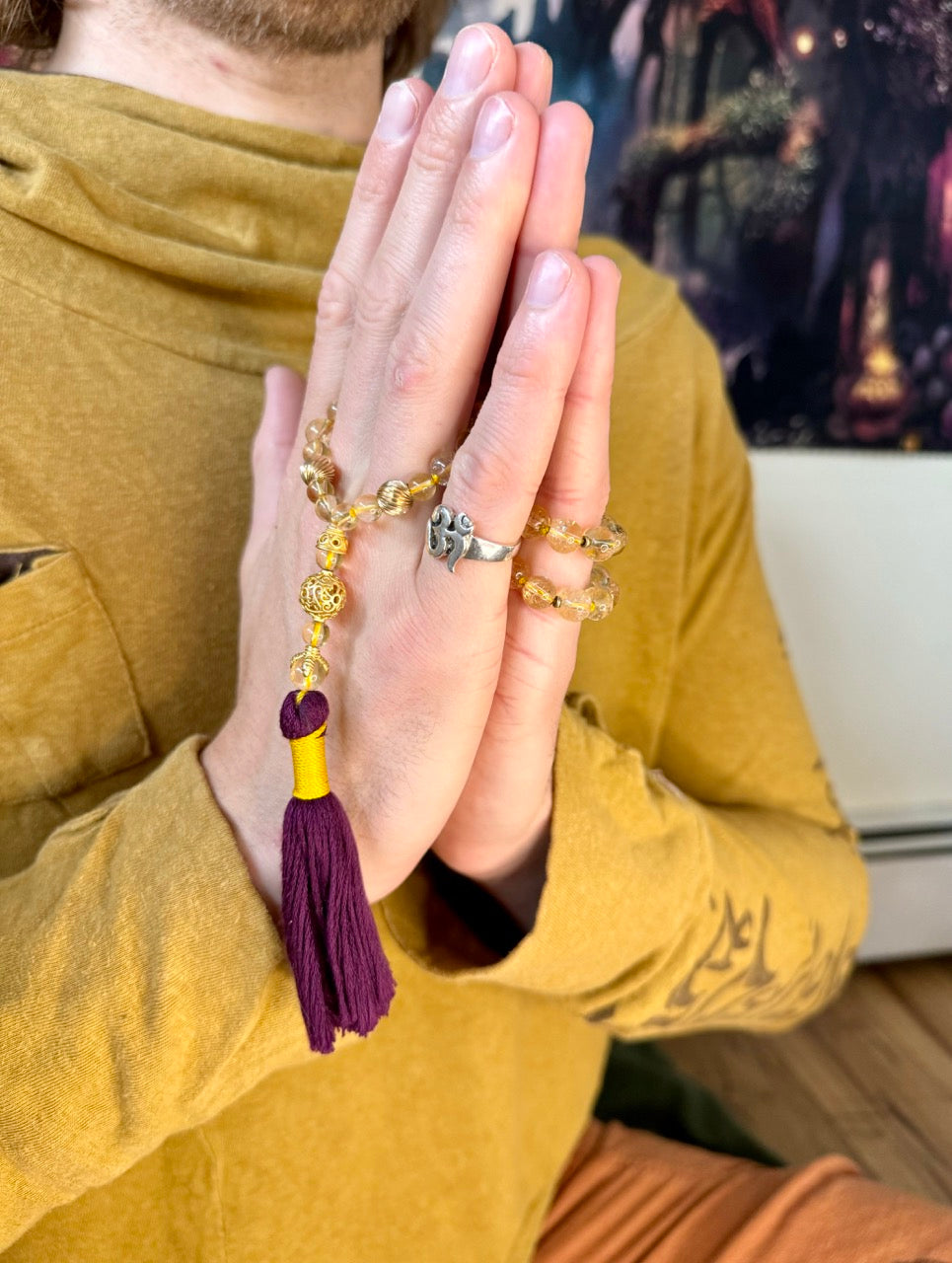
Mala means “garland,” “wreath,” “necklace,” or a series of objects arranged on a string. In yoga, Mala most often refers to a loop of prayer beads used to count repetitions during japa, such as the recitation of a mantra or divine name. A full mala commonly has 108 counting beads, although bead counts, materials, and methods of use vary among traditions. The Sanskrit word defined here is माला, a feminine noun with two long a vowels.
The meaning of Mala begins with the image of a garland. Flowers, beads, words, names, or other elements can be understood as individual parts joined into an ordered series. In devotional and meditative practice, this image becomes a string of beads that supports repetition, attention, and remembrance.
What does Mala literally mean?
Mala is a feminine Sanskrit noun meaning a garland, wreath, chaplet, necklace, row, string, or ordered series. The word can describe a literal flower garland as well as a collection whose parts are linked together. Sanskrit titles sometimes use Mala figuratively for a connected collection of names, verses, teachings, or other material.
When Mala refers to prayer beads, “rosary” is a functional English translation because the beads help count recitations. “String of prayer beads” is usually clearer for yoga students because a Mala belongs to Indian religious and contemplative contexts rather than specifically Christian rosary practice.
How is a Mala used in yoga and meditation?
In yoga and Hindu devotional practice, a Mala is commonly used during japa, the repeated recitation of a mantra, sacred name, or prayer. The practitioner moves through the beads one repetition at a time, allowing the hands to keep count while attention remains with the sound, meaning, or presence invoked by the practice. Museum and reference sources describe malas as aids for counting mantra and prayer repetitions.
A full japa Mala commonly contains 108 counting beads. Shorter strands and other counts are also used, and many malas include a distinct joining or marker bead. The significance assigned to the bead count, the direction in which the beads are moved, which fingers are used, and whether the marker bead is crossed depends on the practitioner’s lineage or instructions. These details should not be presented as universal rules.
The material may also reflect a devotional association. Rudraksha seeds are widely used for prayer beads and are especially associated with Shiva traditions. Tulasi wood is commonly used in Vaishnava devotional contexts. A teacher should describe such associations as tradition-specific rather than treating the material itself as having one fixed meaning.
- Each counting bead generally corresponds to one repetition.
- The beads provide a tactile rhythm that can support steady attention.
- A Mala can be used with spoken, whispered, or mental japa, depending on the practice.
- Handling instructions and devotional etiquette vary by lineage.
Does Mala always mean prayer beads?
Mala does not always mean prayer beads. Its broader Sanskrit meaning is a garland or connected series, and this meaning remains active in ritual, poetry, religious titles, and everyday devotional language. A flower garland offered during puja is also a Mala.
The prayer-bead meaning is found across several Indian religious traditions. Hindu practitioners may use a Mala for mantra or divine-name repetition. Buddhist traditions use related forms of prayer beads for mantras, dharanis, Buddha names, prostrations, and other counted practices. Sikh traditions also have forms of Mala used in remembrance of the divine name. Bead counts, materials, symbolism, and methods are not identical across these traditions.
How does Mala appear in yoga pose names?
In modern yoga, Mala appears in the name Malasana, commonly translated as Garland Pose. The compound joins Mala, “garland,” with Asana, “seat” or “posture.” The physical form called Malasana differs among yoga systems. Some sources apply the name to a compact squat with the arms arranged around the legs, while many contemporary classes use it for a wider squat with the palms together.
Because common English spelling omits Sanskrit vowel length, Malasana is sometimes connected with the separate word मल, meaning waste or excrement. The established Garland Pose explanation derives the name from माला, “garland,” but teachers should recognize that modern discussions of the name are not always consistent.
Mala meaning impurity is a different Sanskrit word
The headword on this page is माला, meaning garland or string of beads. A separate Sanskrit word, मल, means dirt, stain, impurity, bodily secretion, or waste. The two words look identical when written simply as “mala” in English, but their Devanagari spelling and vowel length are different.
The word मल has specialized meanings in Ayurveda and several philosophical traditions. In Ayurveda, it can refer to waste products or bodily excretions. In some Shaiva systems, it refers to forms of limitation or impurity that obscure the full nature of consciousness. These meanings belong to a separate dictionary entry and should not be applied to a japa Mala or flower garland.
- माला: garland, necklace, series, or prayer beads
- मल: dirt, impurity, bodily waste, or a tradition-specific spiritual limitation
Related Sanskrit Terms
- Japa (Mantra Repetition)
- Japa Mala
- Mantra
- Rudraksha Mala
- Tulasi Mala
- Bhakti
- Puja (Devotional Worship)
- Malasana
- Sauca