Maha Mrityunjaya Mantra: Meaning, Translation, Pronunciation, and How to Chant
People chant the Maha Mrityunjaya Mantra as a prayer for nourishment, release from mortality, and continued connection with deathlessness. Its central image asks for release as naturally as a gourd separates from its stem. The mantra is an early Vedic verse addressed to Rudra, later understood in Shaiva tradition as Shiva in his Mrityunjaya, or death-conquering, form. It may be chanted slowly as prayer, meditation, or repeated recitation, with or without a mala.
The Mantra
उ॒र्वा॒रु॒कमि॑व॒ बन्ध॑नान्मृ॒त्योर्मु॑क्षीय॒ मामृता॑त् ॥
urvārukám iva bándhanān mṛtyór mukṣīya mā́mṛtāt
Urvarukam Iva Bandhanan Mrityor Mukshiya Maamritat
Urvarukam Iva Bandhanan Mrityor Mukshiya Maamritat
Modern musical settings commonly add Om before the verse and may repeat the full verse or end a cycle with another Om.
Translation
We worship Tryambaka, the fragrant one who increases nourishment. As a gourd is released from its stem, may I be released from death, not from immortality.
Tryambaka we sacrifice to or worship, fragrant, increasing nourishment; like an urvaruka from its bond, from death may I be released, not from immortality.
The opening verb, yajāmahe, is plural: “we worship” or “we sacrifice to.” The request mukṣīya is singular: “may I be released.” Urvāruka is a cucurbit, often translated as cucumber, gourd, or pumpkin, though its exact botanical identification is uncertain. The final phrase, mā amṛtāt, literally means “not from immortality” or “not from amrita.”
How to Pronounce the Mantra
try-UM-ba-kum ya-JAA-ma-heh
su-GUN-dhim push-ti-VAR-dha-num
ur-VAA-ru-kum i-va BUN-dha-naan
MRIT-yor muk-SHEE-ya maa-mri-TAAT
Keep long vowels clearly longer than short vowels. This guide does not represent the Rigvedic pitch accents.
| Mantra | Pronunciation | Notes |
|---|---|---|
| tryambakaṃ yajāmahe | try-UM-ba-kum ya-JAA-ma-heh | Tryambakam has three audible syllabic units: tryam-ba-kam. The final e of yajāmahe is a long, pure vowel, closer to a slightly lengthened “heh” than English “hay.” |
| sugandhiṃ puṣṭivardhanam | su-GUN-dhim push-ti-VAR-dha-num | Dh is an aspirated d. The ṣ and ṭ in puṣṭi are retroflex consonants. Do not insert an extra vowel between puṣṭi and vardhanam. |
| urvārukam iva bandhanān | ur-VAA-ru-kum i-va BUN-dha-naan | The ā in urvā- and the final ā of bandhanān are long. The underlying word division is bandhanāt mṛtyoḥ, which becomes bandhanān mṛtyor in connected recitation. |
| mṛtyor mukṣīya mā’mṛtāt | MRIT-yor muk-SHEE-ya maa-mri-TAAT | English “mrit” is only an approximation for vocalic ṛ. The u in mukṣīya is short, while ī is long. The apostrophe marks the word boundary between mā and amṛtāt. |
Pronunciation Notes
- IAST and the accent-bearing Vedic text are more precise than English phonetic spelling, which is approximate.
- Formal Vedic recitation includes a pitch-accent system called svara, which should be learned orally from a qualified teacher.
- Common recordings may pronounce the initial vowel of mukṣīya too long; the Sanskrit u is short.
- Om may be pronounced oṃ or auṃ according to lineage, but it is a customary prefix rather than part of Rigveda 7.59.12.
- Musical settings may obscure vowel length, connected pronunciation, or Vedic accents.
How to Chant Maha Mrityunjaya
You can begin by learning the complete verse slowly and treating it as a prayer rather than dividing it into unrelated affirmations. The plain verse is widely taught publicly, while formal Vedic recitation and expanded tantric practices may have additional lineage requirements.
Read one phrase at a time, paying attention to long vowels and consonant clusters. Then join the four phrases into the complete verse. You may chant aloud, softly, or silently as japa, the practice of repeated recitation. In many modern devotional and yoga settings, Om is placed before the verse, but it is helpful to know that the original Rigvedic stanza begins with tryambakam.
- Slow recitation while learning pronunciation
- Silent or softly voiced japa
- Mala-based repetition
- Meditative prayer
- Group chanting
- Puja or abhisheka recitation
- Formal Vedic recitation with svara
- Modern musical chanting
The Rigvedic verse does not give a standalone repetition count. Repeating it 108 times is a widespread later japa and ritual convention, but it is not intrinsic to the Vedic text. Other counts vary by teacher, observance, and ritual setting.
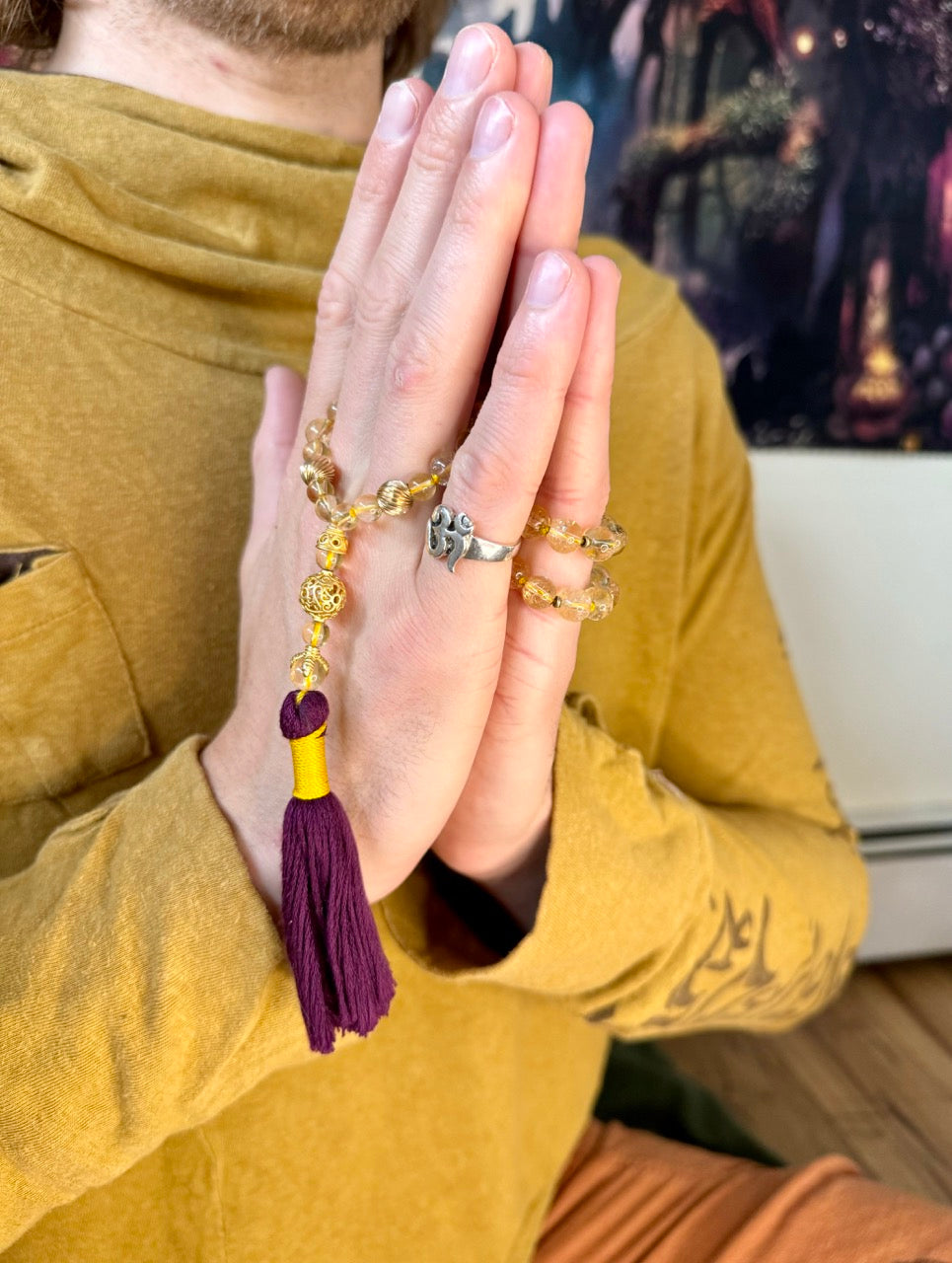
A 108-bead mala is commonly used for later japa practice and can help track repetitions, but it is not required. Specific ways of handling a mala are lineage conventions.
The unexpanded verse is publicly transmitted in several recognized yoga lineages. Exact Vedic recitation with pitch accents is traditionally learned from a trained teacher. Do not assume that public access to the basic verse also applies to bija-expanded, nyasa-based, tantric, or intensive ritual forms.
Mantra at a Glance
| Tradition | Vedic prayer to Rudra, later central to Shaiva devotional and mantra practice |
|---|---|
| Language | Vedic Sanskrit |
| Primary source | Rigveda 7.59.12 |
| Also found in | Yajurvedic sources including Vajasaneyi Samhita 3.60 and Taittiriya Samhita 1.8.6 |
| Associated with | Rudra Tryambaka, later identified with Shiva as Mrityunjaya |
| Traditional orientation | Release from death while remaining connected with amrita, or deathlessness |
| Common modern practice | Japa, puja, homa, meditation, group chanting, and musical settings |
| Om | A common devotional prefix, not part of the Rigvedic verse |
Word-by-Word Meaning
| Mantra | Basic Meaning | Grammar / Context |
|---|---|---|
| Tryambakam | Tryambaka, traditionally understood as the three-eyed one | Masculine accusative singular and the direct object of yajāmahe. The Vedic deity is Rudra; later Shaiva tradition identifies Tryambaka with Shiva. “Three-eyed” is the standard traditional meaning, though the historical etymology is disputed. |
| Yajamahe | we worship, honor, or sacrifice to | First-person plural present middle form of the root yaj. It does not literally mean “we meditate,” although meditation is one later way of practicing the verse. |
| Sugandhim | fragrant or sweet-scented | Masculine accusative singular, describing Tryambaka. Traditional commentators may interpret fragrance as divine presence, virtue, or auspicious influence, but the word itself is a sensory adjective. |
| Pushtivardhanam | increasing nourishment, flourishing, or fullness | Masculine accusative singular compound describing Tryambaka. Puṣṭi can include thriving, prosperity, fullness, and well-being, not physical nutrition alone. |
| Urvarukam | a cucumber, gourd, pumpkin, or related cucurbit | Accusative singular in a comparison with iva. The exact plant is uncertain; the important image is a fruit separating from its attachment. |
| Iva | like or as | An indeclinable particle introducing the fruit-and-stem comparison. |
| Bandhanat | from the bond, attachment, fastening, or stem | Neuter ablative singular. In connected recitation before mṛtyoḥ, bandhanāt appears as bandhanān. |
| Mrityoh | from death | Ablative or genitive singular of mṛtyu. With the request for release, it is naturally understood as “from death.” In continuous recitation it appears as mṛtyor. |
| Mukshiya | may I be released or set free | First-person singular aorist optative middle form of the root muc. Its singular form contrasts with the plural yajāmahe, “we worship.” |
| Ma | not | A negative particle. Here it negates separation from amrita. |
| Amritat | from amrita, deathlessness, or immortality | Neuter ablative singular. Together, mā amṛtāt means “not from immortality” or “not from amrita.” |
Meaning of the Maha Mrityunjaya Mantra
The Maha Mrityunjaya Mantra is a prayer that holds nourishment and mortality together. It begins by honoring Tryambaka as fragrant and life-sustaining, then asks for release from death without losing amrita, a term that can mean deathlessness or immortality.
Its most memorable image is a cucurbit, such as a gourd or cucumber, separating from its attachment. The verse asks for a release that is natural rather than violent: freedom from death while remaining connected to amrita.
At the word level, the mantra speaks of worship, fragrance, nourishment, a fruit’s release from a bond, death, and amrita. It does not explicitly mention healing, chakras, karma, rebirth, fear, or prevention of accidents.
Later Shaiva and Vedantic traditions broaden the prayer’s meaning. They may understand death as mortal bondage, ignorance, or samsara, and amrita as liberation or realization of deathless reality. These are influential theological interpretations rather than a strict word-for-word translation of the Vedic verse.
Rudra Tryambaka and Shiva Mrityunjaya
The deity named in the Vedic verse is Rudra under the name Tryambaka. Tryambakam is the object of the opening act of worship.
In later Shaiva tradition, Rudra is identified with Shiva, and the verse is known as the Maha Mrityunjaya Mantra. Mrityunjaya means conqueror or victor over death, a title emphasizing the mantra’s request for release from death.
The standard Shaiva understanding of Tryambaka is “the three-eyed one.” Some scholars and dictionaries have proposed other older etymologies, including a connection with three mothers or mother-goddesses, so the name’s historical derivation is not fully settled.
Origin and History of the Mantra
The Maha Mrityunjaya Mantra is an early Vedic stanza, not originally a standalone yoga mantra. Its standard primary citation is Rigveda 7.59.12, where it appears at the end of a hymn otherwise addressed to the Maruts, while the verse itself is assigned to Rudra.
The same formula also appears in Yajurvedic contexts, including Vajasaneyi Samhita 3.60 and Taittiriya Samhita 1.8.6. Because of its distinctive position in the Rigveda and its parallel Vedic witnesses, it is more accurate to speak of early Vedic transmission than to assign a precise date based only on its current Rigvedic placement.
In its early ritual setting, the verse belonged to the Tryambaka episode of the Sakamedha seasonal sacrifice. Sources describe an offering to Rudra Tryambaka, a fire at a crossroads, and circumambulation.
Over time, the stanza was extracted from this ritual context and used as an independent Shaiva prayer. The Shiva Purana clearly attests the later name Mahamrityunjaya and gives the verse an expanded Shaiva interpretation involving japa, homa, meditation, nyasa, and consecrated water.
Today, the verse is common in temples, yoga communities, recordings, group prayer, and personal practice. Its use in prayers during illness, danger, grief, or approaching death belongs to living devotional tradition, but it should not be presented as a guarantee of medical healing, protection, or physical immortality.
Traditional Interpretations
In an early Vedic ritual interpretation, the verse is a prayer to Rudra Tryambaka for release from death while remaining connected with amrita, or the continuity of life and deathlessness.
Later Shaiva and Puranic traditions identify Tryambaka with Shiva. They interpret his fragrance as a pervasive divine essence and describe him as the nourisher of beings and cosmic principles. In this reading, Shiva releases devotees from death’s noose and from bondage.
Moksha-oriented interpretations understand death more broadly as samsaric bondage or spiritual ignorance. Amrita then signifies liberation or realization of a deathless reality. This interpretation is theological and philosophical, rather than the literal surface grammar alone.
In modern Himalayan yoga teaching, the publicly taught verse may be used for daily japa and contemplation of fear, attachment, mortality, and inner nourishment. In that lineage, formal initiation is not considered mandatory for the plain verse.
Sanskrit and Grammar
The first half of the mantra centers on yajāmahe, “we worship” or “we sacrifice to.” It governs Tryambaka and the descriptive words sugandhim, “fragrant,” and puṣṭivardhanam, “increasing nourishment or flourishing.”
The second half shifts to mukṣīya, “may I be released.” This is why a grammatically close translation preserves the movement from “we worship” to “may I be released,” even though some devotional translations smooth the entire verse into the plural.
The phrase urvārukam iva introduces a simile: “like an urvaruka.” Bandhanāt, “from the bond,” and mṛtyoḥ, “from death,” express separation. Mā amṛtāt means “not from amrita” or “not from immortality.”
In connected recitation, Sanskrit sound combination, called sandhi, changes bandhanāt mṛtyoḥ into bandhanān mṛtyor and mā amṛtāt into māmṛtāt. These are connected forms, not different mantra texts.
Variations of the Mantra
Rigvedic source verse
urvārukam iva bandhanān mṛtyor mukṣīya mā’mṛtāt
This is the underlying Vedic verse of Rigveda 7.59.12. It does not begin with Om.
Common devotional form
urvārukam iva bandhanān mṛtyor mukṣīya mā’mṛtāt
This widely used standalone form adds Om before the Vedic stanza. It is common in contemporary devotional and yoga settings.
Vajasaneyi companion formula
urvārukam iva bandhanād ito mukṣīya mā’mutaḥ
Vajasaneyi Samhita 3.60 includes this related companion verse. It concerns release from one’s present family but not from the husband’s family, and it is not an alternative translation of the Maha Mrityunjaya verse.
Bija-expanded Mahamrityunjaya forms
There is no single universal expanded text. These forms should not be confused with Rigveda 7.59.12, and some lineages require initiation for them.
Modern musical arrangements
Added repetitions, melody, phrase looping, and extra Om syllables are performance choices rather than canonical textual variants.
How This Mantra Is Used Today
Contemporary practitioners chant the Maha Mrityunjaya Mantra in personal japa, yoga classes, temple worship, group prayer, recordings, and meditative practice. It may also be included in puja, abhisheka, homa, and observances connected with illness, danger, grief, longevity, death, or liberation.
Many people use a 108-bead mala and chant 108 repetitions. This is a common later japa convention, not a number prescribed by the Rigvedic source.
The mantra is often called a healing or protection mantra in modern settings. Those descriptions reflect devotional and lineage-based applications. They should not be understood as medical claims, guarantees of safety, or substitutes for professional care.
Related Concepts
Rudra · Shiva · Mrityunjaya · Amrita · Moksha · Japa · Vedic svara · Urvāruka
Related Mantras
Om Namah Shivaya · Sri Rudram · Tryayusha Mantra · Gayatri Mantra
Common Questions About Maha Mrityunjaya
Is Om part of the original Maha Mrityunjaya Mantra?
No. Rigveda 7.59.12 begins with tryambakam. Om is a customary later prefix in standalone devotional recitation.
Does the mantra literally say “we meditate”?
No. Yajāmahe means “we sacrifice to,” “we worship,” or “we honor.” Meditation is a possible later practice method, not the literal meaning of the verb.
Does the mantra ask for physical immortality?
The grammar asks for release from death while not being separated from amrita. Traditional interpretations range from continued participation in life to spiritual liberation, but the verse is not a promise that the body will never die.
Why do translations say cucumber, gourd, or pumpkin?
Urvāruka is a term for a cucurbit, but its exact botanical identification is uncertain. Cucumber, gourd, and pumpkin are approximate translations. The central image is a fruit separating from its attachment or stem.
Does the mantra say “may we be liberated” or “may I be liberated”?
The opening verb is plural, “we worship,” while mukṣīya is singular, “may I be released.” Some devotional translations smooth this grammatical shift into the plural.
Is Tryambaka definitely “the three-eyed one”?
“Three-eyed” is the standard traditional Shaiva interpretation. However, scholars and dictionaries have also proposed an older connection with three mothers or mother-goddesses, so the historical etymology remains uncertain.
Does chanting require initiation?
The plain verse is publicly taught without formal initiation in some recognized lineages. Formal Vedic recitation with pitch accents, intensive observances, and tantric or bija-expanded forms may require oral instruction or diksha from a teacher.
How many times should the mantra be repeated?
The Rigvedic verse gives no standalone repetition count. One hundred eight repetitions is a common later japa convention, often counted with a mala. Other counts depend on a teacher, ritual, or lineage.
Is the Maha Mrityunjaya Mantra scientifically proven to heal illness?
Healing and protection are traditional devotional applications, but the sources reviewed do not establish the mantra as a medical treatment. It should not be presented as a substitute for professional care or as a guaranteed cure.
Sources and Further Reading
- Rigveda - Shakala Samhita - Mandala 07 Sukta 059, Vedic Heritage Portal, Indira Gandhi National Centre for the Arts and Government of India
- Vajasaneyi Madhyandina Samhita, Adhyaya 3, Vedic Heritage Portal, Indira Gandhi National Centre for the Arts and Government of India
- Ṛgveda 7, 59, Jan Gonda
- A Dictionary of the Vedic Rituals, Chitrabhanu Sen
- The Dialogue between Kshuva and Dadhicha, Shiva Purana 2.2 Chapter 38, J. L. Shastri translation hosted by Wisdom Library
- Shiva Purana Book 2.2 Chapter 38, Sanskrit Text, Wisdom Library digital edition based on published Sanskrit editions
- The Maha Mrityunjaya Mantra: Heal Yourself, Heal the World, Himalayan Institute
- Learning Support for Chanting the Mrityunjaya Mantra - Om Tryambakam, Paul Harvey, Centre for Yoga Studies
- Monier-Williams Sanskrit-English Dictionary: Tryambaka, Monier Monier-Williams; Cologne Digital Sanskrit Dictionaries
- A Message to New Initiates, Swami Sivananda, The Divine Life Society