Ong Namo Guru Dev Namo: Meaning, Translation, Pronunciation, and How to Chant
People chant Ong Namo Guru Dev Namo to begin Kundalini Yoga practice with reverence, guidance, and a receptive frame of mind. Its basic meaning is homage to a creative sacred source and to the divine or revered teacher. Known as the Adi Mantra, it is the opening invocation of Kundalini Yoga as taught by Yogi Bhajan in the 3HO tradition. It is generally sung together three times before a class or personal practice.
The Mantra
Translation
I bow to the creative source; I bow to the divine teacher.
Ong is a lineage-specific sacred syllable associated with manifested creative consciousness; namo expresses homage or reverence; guru-dev means divine or revered teacher; namo again expresses homage.
Kundalini Research Institute commonly translates the mantra as “I bow to the Creative Wisdom; I bow to the Divine Teacher within.” “Within,” “higher self,” and “creative wisdom” are traditional 3HO interpretations rather than strictly grammatical translations. Ong is a sacred sound with lineage associations, not an ordinary dictionary word.
How to Pronounce the Mantra
| Mantra | Pronunciation | Notes |
|---|---|---|
| Ong | ohng | End with the nasal sound heard at the end of “sing,” without a strongly released hard g. KRI teaching explicitly distinguishes Ong from Om. |
| Namo | naa-MOH | KRI teaching materials commonly use “NAAMO” as an English pronunciation guide. The final syllable is sustained in chant. |
| Guru | goo-ROO | Use two audible syllables. Avoid compressing it into “groo.” |
| Dev | dayv | The established KRI teaching pronunciation is “DAYV.” In the traditional melody, this word rises approximately a minor third. |
| Namo | naa-MOH | Complete the phrase without rushing the final syllable. |
Pronunciation Notes
- The living lineage pronunciation is more relevant here than normalized Sanskrit pronunciation because no canonical Sanskrit or Gurmukhi source text has been established.
- KRI instructs practitioners to chant the full phrase on one exhalation. If needed, take a brief breath after “Ong Namo.”
- English phonetic spellings are approximate teaching aids, not authoritative transliteration.
- Within KRI practice, Om and Ong are not interchangeable.
How to Chant Om Namo Gurudev Namo
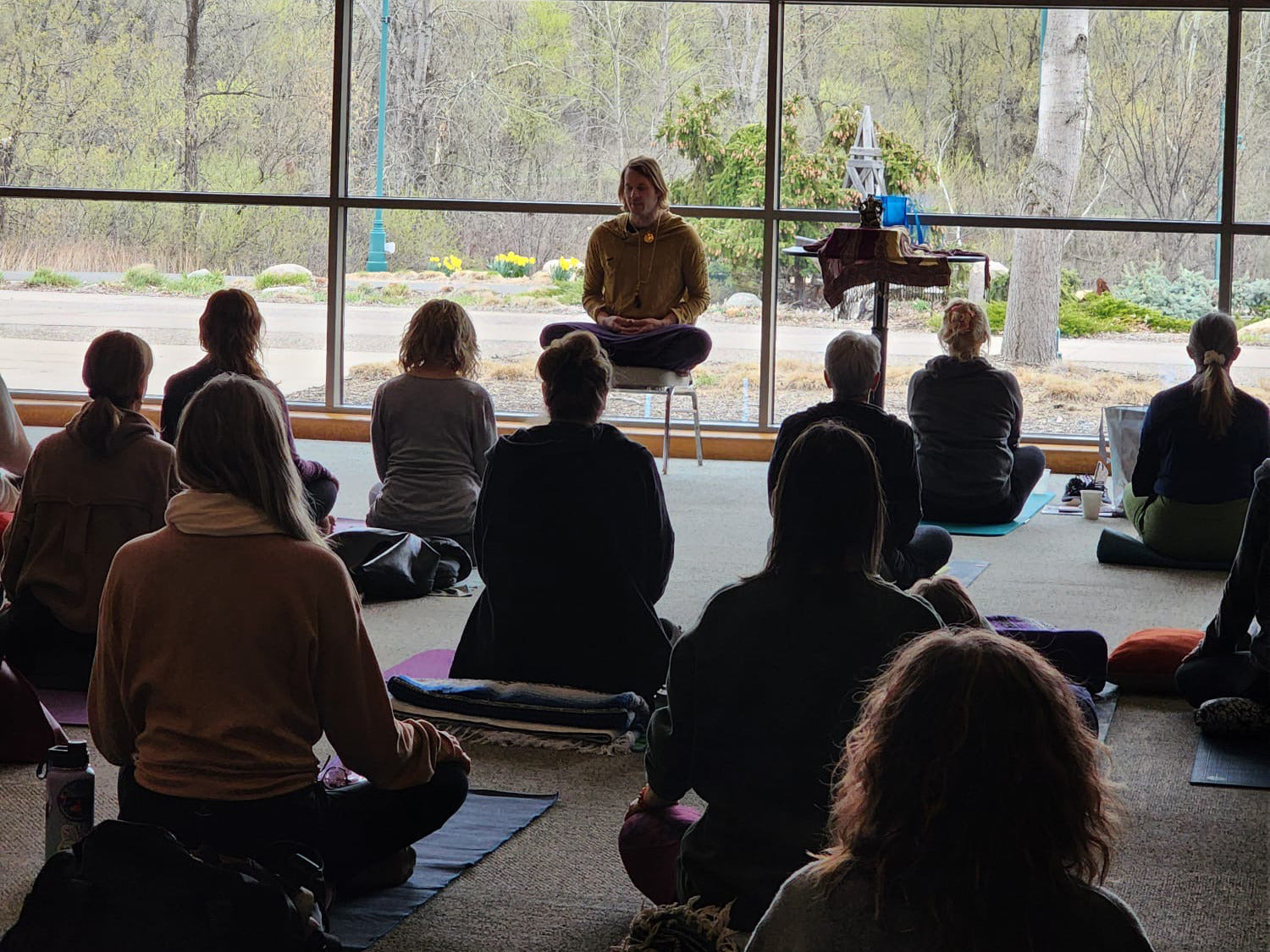
In Kundalini Yoga as taught by Yogi Bhajan, this mantra is used to tune in before class or personal practice.
Sit cross-legged or in a chair with the spine upright. Bring the palms together at the chest, with the thumb joints at the sternum. Close the eyes and place attention toward the brow point. Inhale, then chant the complete mantra on one exhalation. If one breath is not enough, take a brief additional breath after “Ong Namo.” In the traditional melody, raise “Dev” slightly above the surrounding notes.
- Opening invocation before a Kundalini Yoga class
- Opening invocation before personal Kundalini Yoga practice
- Sung meditation
- Group unison chanting
- Lineage remembrance
Three repetitions are the most consistently documented opening practice. Current KRI materials also describe chanting it three to five times. The short opening mantra is not customarily prescribed as a 108-repetition practice.
Mala use is not part of the documented standard tuning-in procedure. Reliable lineage instructions for the short form do not establish 108-count mala japa as customary practice.
The mantra is publicly taught to beginners, and no initiation requirement is stated in the located KRI or 3HO instructions. Its role as a required opening practice is specific to Kundalini Yoga as taught by Yogi Bhajan and should not be generalized to all kundalini-oriented yoga.
Mantra at a Glance
| Tradition | Kundalini Yoga as taught by Yogi Bhajan / 3HO |
|---|---|
| Also called | Adi Mantra |
| Type | Opening invocation and lineage-attunement mantra |
| Language | Modern Sanskritic liturgical formula in a Sikh-influenced 3HO setting |
| Associated with | Creative consciousness, the divine teacher, higher consciousness, and the 3HO Golden Chain |
| Usual practice | Chanted in unison three times, or sometimes three to five times, before Kundalini Yoga practice |
| Access | Open and publicly taught |
Word-by-Word Meaning
| Mantra | Basic Meaning | Grammar / Context |
|---|---|---|
| Ong (Oṅ) | A sacred sound associated in KRI teaching with creative, manifested consciousness | A lineage-specific sacred syllable rather than an ordinary dictionary word in this formula. |
| Namo | Homage, reverence, salutation | Related to Sanskrit namas, meaning obeisance or salutation. “I bow” is an idiomatic English rendering. |
| Guru | Teacher, preceptor, venerable one | A Sanskrit noun and adjective widely adopted into Punjabi, Hindi, and other South Asian languages. |
| Dev | Divine, heavenly, deity, or revered | The transmitted chant uses dev, a shortened or vernacularized form related to Sanskrit deva. Together, guru dev can be understood as divine or revered teacher. |
| Namo | Homage, reverence, salutation | The repeated reverential formula is directed, in lineage interpretation, toward guru-dev. |
Meaning of Ong Namo Guru Dev Namo
Ong Namo Guru Dev Namo is an invocation of guidance that marks the transition into Kundalini Yoga practice. Practitioners commonly use it to set aside ego-centered authority, cultivate humility, and become receptive to wisdom as they begin.
Its basic movement is twofold: reverence toward a sacred creative source, then reverence toward the divine or revered teacher. A concise, defensible rendering is: “Homage to the creative source; homage to the divine teacher.”
In KRI and 3HO teaching, the mantra is interpreted as a way of orienting the practitioner toward creative consciousness and the teacher principle. The familiar language of the “teacher within” or “higher self” expresses this lineage interpretation; it is not explicitly contained as a grammatical phrase in the chant itself.
The practice has a ritual dimension as well as a verbal meaning. Its conventional posture, melody, breath pattern, and repetitions are part of how the mantra functions as the opening of a Kundalini Yoga session.
The Divine Teacher and the Golden Chain
This mantra is not primarily an invocation of a named deity. It addresses guru-dev, the divine or revered teacher.
In Kundalini Research Institute and 3HO teaching, guru-dev is understood both as higher consciousness within the practitioner and as wisdom transmitted through a lineage of teachers. Chanting the mantra is said to connect the practitioner with the “Golden Chain,” the lineage through which this wisdom is understood to be transmitted.
The Golden Chain is a central belief within the Yogi Bhajan-derived Kundalini Yoga system. Academic scholarship disputes the historical claim that the complete system represents an unchanged ancient lineage, so this connection is best described as a lineage belief rather than established history.
Origin and History of the Mantra
The exact formula is securely associated with the modern Kundalini Yoga system developed and transmitted by Yogi Bhajan and 3HO beginning in the late 1960s. Although its vocabulary draws on wider Sanskritic and Sikh religious language, an ancient source for the complete fixed formula has not been demonstrated.
Early 3HO teacher Shakti Parwha Kaur Khalsa later reported using the mantra while teaching in 1969, and subsequent manuals describe it as part of Yogi Bhajan’s early instruction. However, no securely documented pre-1969 manuscript, scripture, yoga manual, or independent lineage source containing the exact phrase was located.
Yogi Bhajan’s organization standardized the chant as the Adi Mantra and made it the customary opening for its Kundalini Yoga classes. KRI materials provide a fixed posture, melody, breath pattern, translation, and Golden Chain interpretation.
Sikh Dharma International states that the mantra does not originate in the Guru Granth Sahib. It should therefore not be presented as a verse from Sikh scripture.
Traditional Interpretations
Kundalini Research Institute and 3HO describe the mantra as a call to infinite creative consciousness and divine wisdom. In this interpretation, it helps the practitioner begin practice from humility and receptivity rather than personal ego.
Sikh Dharma International, in its 3HO-related teaching context, describes the chant as a bow to Creative Wisdom and the Divine Teacher within. This reading adds an inward, contemplative dimension to the words guru-dev.
In contemporary yoga settings, guru is often explained as intuition, inner wisdom, or the higher self. This is a common modern interpretation and is compatible with KRI language, but it is not the literal translation of guru-dev.
Sanskrit and Grammar
Most of the mantra’s lexical elements are Sanskrit-derived. Namas denotes homage, guru denotes a teacher or venerable person, and deva denotes something divine, heavenly, or a deity.
Namo before guru can be explained as a form related to Sanskrit namaḥ. However, the complete formula is not securely attested as a normalized classical Sanskrit sentence. The standalone sacred syllable Ong, the form dev, and the final namo reflect the living transmitted chant rather than a standard classical construction.
A more conventional Sanskrit formula for “homage to the divine guru” would typically use a form such as gurudevāya namaḥ. For that reason, Ong Namo Guru Dev Namo should be represented according to its 3HO lineage form rather than silently corrected into classical Sanskrit.
Some Kundalini Yoga materials call the mantra’s language “Gurmukhi.” Gurmukhi is properly the name of a script used especially for Punjabi and Sikh texts, not the name of a language.
Variations of the Mantra
Standard Adi Mantra
This is the standard KRI and 3HO opening mantra.
Complete Adi Mantra
Guru Dev Namo, Guru Deva
This expanded form is taught for individual meditation. It should be distinguished from the short class-opening formula.
Om Namo Gurudev Namo
This modern normalization or substitution replaces the lineage-specific Ong with Om and often combines Guru Dev into Gurudev. It is not the standard KRI form.
Extended musical form
Guru Dev, Guru Dev Namo
Kirtan and recording arrangements may repeat or rearrange parts of the mantra for musical development, sometimes with added English devotional lyrics.
English teaching transliteration
This spelling appears in KRI-related materials as an English pronunciation aid, not as scholarly transliteration.
How This Mantra Is Used Today
Ong Namo Guru Dev Namo remains a recognizable opening marker of Kundalini Yoga as taught by Yogi Bhajan. It is commonly sung at the beginning of public classes, personal practices, trainings, and group gatherings in the 3HO-related setting.
The mantra also appears in yoga-studio music and devotional recordings, where artists may repeat phrases, use echoing voices, add harmony, or include English verses. These are musical adaptations rather than replacements for the short opening formula.
Modern presentations sometimes describe the chant as an ancient Sanskrit or Sikh mantra without naming its specific 3HO history. The available record supports a more careful description: a modern Sanskritic liturgical formula transmitted in the Yogi Bhajan-derived Kundalini Yoga tradition.
Related Concepts
Guru · Namas · Golden Chain · Ik Oankar · Gurmukhi
Related Mantras
Complete Adi Mantra · Aad Guray Nameh · Sat Nam · Om Namo Gurudevaya
Common Questions About Om Namo Gurudev Namo
Is it Om Namo Gurudev Namo or Ong Namo Guru Dev Namo?
KRI and Sikh Dharma International transmit the opening mantra as “Ong Namo Guru Dev Namo” and explicitly distinguish Ong from Om. “Om Namo Gurudev Namo” is a common modern substitution or normalization, not the standard KRI form.
Is Ong Namo Guru Dev Namo Sanskrit?
Its vocabulary is largely Sanskrit-derived, but the complete fixed phrase is best described as a modern Sanskritic liturgical chant in the 3HO Kundalini Yoga tradition. It is not securely established as a normalized classical Sanskrit sentence.
Does this mantra come from the Guru Granth Sahib?
No. Sikh Dharma International states that Ong Namo Guru Dev Namo does not originate in the Guru Granth Sahib.
What does the mantra literally mean?
Its basic lexical sense is homage to a sacred creative source and homage to a divine or revered teacher. “I bow to the Divine Teacher within” is a traditional 3HO interpretation, not a strictly literal translation.
How many times should I chant it?
Three repetitions are the most consistently documented opening convention. Current KRI materials also describe three to five repetitions. A standard 108-repetition requirement was not located for the short Adi Mantra.
Can I chant it without a guru or initiation?
The mantra is publicly taught to beginners, and no initiation requirement was located in KRI or 3HO instructions. Its Golden Chain interpretation, however, belongs specifically to the Yogi Bhajan-derived Kundalini Yoga lineage.
Is this mantra usually chanted with a mala?
No. The documented opening practice uses three, or sometimes three to five, sung repetitions rather than mala-counted japa.
Sources and Further Reading
- The Adi Mantra & the Golden Chain of Kundalini Yoga, Kundalini Research Institute / 3HO International
- Complete Adi Mantra, 3HO International
- Ong Namo Guru Dev Namo, Kundalini Research Institute and Sikh Dharma International
- Tool Kit for Teaching Beginners, Shakti Parwha Kaur Khalsa
- From Maharaj to Mahan Tantric: The Construction of Yogi Bhajan's Kundalini Yoga, Philip Deslippe
- A Sanskrit-English Dictionary: namas, Sir Monier Monier-Williams
- A Sanskrit-English Dictionary: deva, Sir Monier Monier-Williams via Gandhari.org
- Kundalini Yoga for Youth and Joy, Yogi Bhajan