Om Namah Shivaya Gurave: Meaning, Translation, Pronunciation, and How to Chant
People chant Om Namah Shivaya Gurave as a prayer of reverence for the teacher, Shiva, and the wisdom they represent. The verse honors a reality described as peaceful, radiant, independent, and beyond the changing world. It is a Classical Sanskrit guru-praise verse used in Vedantic and Shaiva traditions and is widely known today as the Anusara Invocation. It is often sung together at the opening of a yoga class, sometimes in call and response.
The Mantra
निष्प्रपञ्चाय शान्ताय निरालम्बाय तेजसे ॥
niṣprapañcāya śāntāya nirālambāya tejase
Saccidananda Murtaye
Nishprapanchaya Shantaya
Niralambaya Tejase
Namah Shivaya Gurave
Saccidananda Murtaye
Nisprapancaya Shantaya
Niralambaya Tejase
Om
Translation
Om. Reverence to Shiva, the Guru, the embodiment of being, consciousness, and bliss; beyond manifold manifestation, peaceful, independent of all support, and radiant.
Om. Homage to Shiva; to the guru; to the embodiment of being, consciousness, and bliss; to the one free from manifold manifestation; to the peaceful one; to the unsupported or independent one; to radiance or splendor.
The words following namah are all forms that identify the recipient of homage. Traditional readings commonly understand Shiva and guru together as “the guru who is Shiva.” Om is a sacred syllable and is not given a simple dictionary translation. Modern interpretations such as “the teacher within” or “lighting the way to transformation” are interpretations, not literal translations.
How to Pronounce the Mantra
na-mah shi-vaa-ya gu-ra-vay
sat-chid-aa-nan-da moor-ta-yay
nish-pra-pan-chaa-ya shaan-taa-ya
ni-raal-am-baa-ya tay-ja-say
| Mantra | Pronunciation | Notes |
|---|---|---|
| oṃ | ohm, ending with light nasal resonance | Do not add a strongly separated final m. The exact realization of the nasal can vary by recitation tradition. |
| namaḥ śivāya gurave | na-mah shi-vaa-ya gu-ra-vay | The ḥ is a light breath after the preceding vowel. Ś sounds approximately like English sh. Hold ā about twice as long as short a. |
| saccidānandamūrtaye | sat-chid-aa-nan-da moor-ta-yay | The written cc is pronounced as a lengthened or doubled ch sound. The ū in mūrti is long. |
| niṣprapañcāya śāntāya | nish-pra-pan-chaa-ya shaan-taa-ya | Ṣ is a retroflex sh sound, made with the tongue slightly curled back. Ñ before c has a palatal nasal sound, followed by ch. |
| nirālambāya tejase | ni-raal-am-baa-ya tay-ja-say | Keep both long ā vowels distinct in nirālambāya. Tejase has three syllables: te-ja-se. |
Pronunciation Notes
- IAST transliteration is the most precise guide; English phonetics are approximate teaching aids.
- Sanskrit does not use English-style lexical stress.
- Long vowels marked ā and ū are held approximately twice as long as short vowels.
- Lineage and regional pronunciation can differ, especially for visarga and the two sh sounds.
How to Chant Shiva Mantra
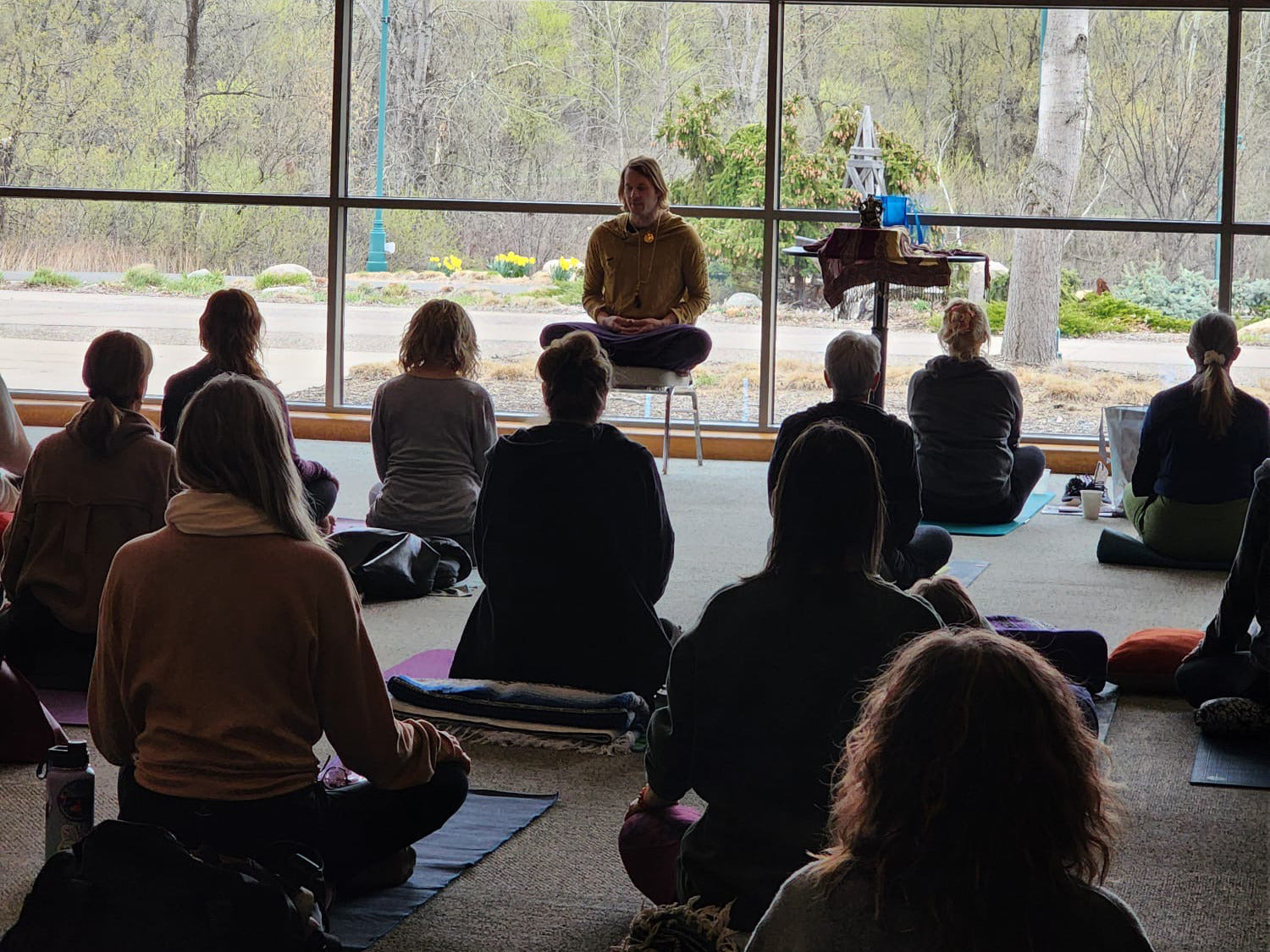
This verse is commonly chanted or sung as a shared opening invocation, especially in Anusara Yoga classes and gatherings.
Follow the teacher or lead chanter for pitch, pace, melody, and repetitions. Recite or sing the verse in its four natural phrases, allowing a brief pause between each phrase. In a group setting, it may be sung collectively or through call and response.
- Group chanting at the beginning of a yoga class
- Opening invocation
- Prayer
- Guru-puja or guru-pada-puja
- Devotional recitation
- Call and response
- Musical chanting
No universal repetition count is documented for this complete verse. It may be sung once in a class or repeated according to an established ritual or musical arrangement. Repetition counts associated with the separate mantra Om Namah Shivaya should not automatically be applied to this longer verse.
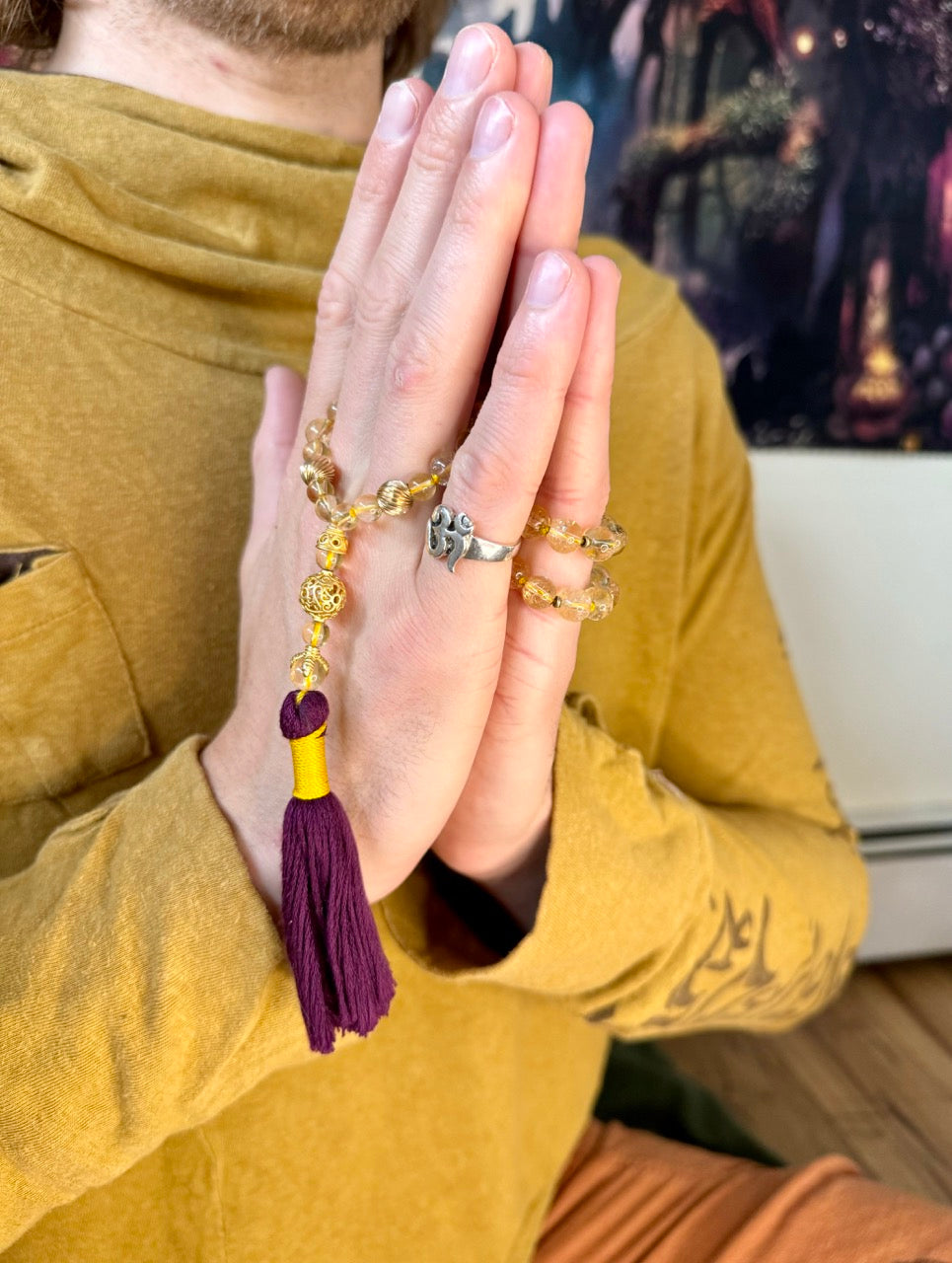
No reliable source reviewed prescribes mala counting for this complete invocation. Mala use may be optional for personal devotional repetition, but it should not be treated as a required or canonical practice for this verse.
The verse is publicly taught and chanted, and no general initiation requirement was documented for the complete verse. Practitioners in a particular guru lineage should follow that lineage's guidance about melody, ritual placement, or formal practice.
Mantra at a Glance
| Tradition | Vedantic and Shaiva guru devotion; modern transmission through Divine Life Society, Svaroopa Yoga, and Anusara Yoga |
|---|---|
| Language | Classical Sanskrit |
| Classification | Guru-praise verse and Shiva invocation |
| Associated with | Shiva as guru, being-consciousness-bliss, peace, independence, and radiance |
| Common modern use | Opening invocation for yoga classes, workshops, gatherings, and devotional singing |
| Related short mantra | Namah Shivaya, the Panchakshara mantra |
| Access | Publicly taught; no general initiation requirement documented for the complete verse |
Word-by-Word Meaning
| Mantra | Basic Meaning | Grammar / Context |
|---|---|---|
| oṃ | Sacred syllable | An indeclinable sacred utterance that may preface the salutation. It does not have a simple lexical English translation. |
| namaḥ | Homage, reverence, salutation | An indeclinable expression that governs the dative forms that follow. “I bow” is an English idiom, not a literal first-person verb in the Sanskrit. |
| śivāya | To Shiva; to the auspicious one | Masculine dative singular of śiva. It may be read as Shiva's name or with the adjectival sense of auspicious or benevolent. |
| gurave | To the guru or teacher | Masculine dative singular of guru. In context, it stands alongside śivāya, supporting the traditional reading of Shiva as guru. |
| sat | Being, existence, reality | The first member of the sat-cit-ananda compound. |
| cit | Consciousness or awareness | The second member of the sat-cit-ananda compound. Sandhi changes sat-cit into saccid in the verse. |
| ānanda | Bliss, joy, profound felicity | The third member of the sat-cit-ananda compound. |
| mūrtaye | To the embodiment, form, or manifestation | Feminine dative singular of mūrti. Together with sat-cit-ananda, it means “to the embodiment of being-consciousness-bliss.” |
| niṣprapañcāya | To the one beyond phenomenal multiplicity | Masculine dative singular adjective referring to Shiva or the guru. Prapañca can refer to expansion, manifoldness, or the manifested world. |
| śāntāya | To the peaceful or tranquil one | Masculine dative singular of śānta. It describes the recipient of homage rather than promising a result for the person chanting. |
| nirālambāya | To the unsupported or independent one | Masculine dative singular of nirālamba. Vedantic interpretations understand it as free from dependence on an external foundation. |
| tejase | To radiance, splendor, or brilliance | Dative singular of neuter tejas, used appositionally with the other descriptions of the recipient of homage. |
Meaning and Purpose of Om Namah Shivaya Gurave
Om Namah Shivaya Gurave is a salutation to Shiva as guru, or spiritual teacher. People use it as a prayer of reverence and a way of contemplating the source of wisdom, guidance, peace, and liberating knowledge honored in guru devotion.
The verse describes the Shiva-guru as the embodiment of sat-cit-ananda, often rendered as being, consciousness, and bliss. It also calls this reality beyond the manifold or changing world, peaceful, independent of external support, and radiant.
Grammatically, the verse is not a personal affirmation or a request for a particular outcome. It is a sequence of honorific descriptions following namah, “homage” or “reverence.”
Modern yoga communities may use the verse to mark a shared beginning. In that setting, practitioners may understand it as a way to remember an external teacher, an indwelling source of wisdom, divine consciousness, or more than one of these at once, depending on lineage and personal practice.
Shiva as the Guru
This verse brings together Shiva and guru. Shiva is honored here not only as a deity but as the guru, the source or embodiment of liberating knowledge.
The Sanskrit words śivāya and gurave are parallel forms governed by namah. Their placement supports the traditional reading, “homage to the guru who is Shiva.”
In Vedantic and Shaiva devotional settings, the guru may be understood as an outward teacher, the indwelling Self, divine consciousness, or a convergence of these meanings. The remaining words of the verse describe this Shiva-guru through language associated with Brahman, the ultimate reality in Vedantic thought.
Origin and History of the Mantra
The verse circulates in several overlapping settings: as an invocation attached to a recension of the Niralamba Upanishad, as an independent Shiva or guru meditation verse, in guru-praise and guru-puja collections, and as the modern Anusara Invocation.
A widely circulated Sanskrit recension places the verse after a peace invocation and before the Niralamba Upanishad's main teaching. However, the exact verse was not found in the nineteenth-century manuscript description or in K. Narayanasvami Aiyar's 1914 English translation reviewed for this research, both of which begin with the text's questions and answers.
For that reason, it is best to say that the verse appears in a widely circulated Niralamba Upanishad recension rather than state without qualification that it belongs to the Upanishad's stable textual core. The exact author and date of the verse are unknown, and no securely dated premodern witness containing this exact invocation was established.
In modern practice, Anusara Yoga adopted the verse as a class-opening invocation. The school commonly sings it with Om at the beginning and end, using a melody that its official source attributes to Krishna Das.
Traditional Interpretations
In Vedantic guru devotion, the verse honors the guru as Shiva and as the embodied presence of being, consciousness, and bliss, independent of the conditioned world.
Divine Life Society materials translate the verse as prostration to the guru who is Shiva, free from world-consciousness, peaceful, unsupported, and self-effulgent. “Self-effulgent” is an interpretive extension of tejas, which literally refers to radiance, brilliance, or splendor.
Svaroopa Yoga presents the verse as honoring the indwelling Shiva-guru and describes that reality as transcendent, calm, free from support, and luminous.
Anusara Yoga interprets the invocation through its own life-affirming nondual philosophy, often using language of grace, intrinsic goodness, peace, freedom, divine luminosity, and the teacher within and without. These expressions are lineage-specific interpretations rather than strict word-for-word translations.
Sanskrit and Grammar
Namaḥ is an indeclinable Sanskrit expression of homage that conventionally takes a dative recipient. The words śivāya, gurave, saccidānandamūrtaye, niṣprapañcāya, śāntāya, nirālambāya, and tejase are all dative singular forms connected to namah.
Śivāya, niṣprapañcāya, śāntāya, and nirālambāya are masculine dative forms. Gurave is the dative form of guru. Mūrtaye is the dative of the feminine noun mūrti, while tejase is the dative of the neuter noun tejas.
Sat-cit-ananda-mūrti is a compound meaning an embodiment whose nature is being, consciousness, and bliss. In the verse, internal sound combination, called sandhi, changes sat-cit-ananda into saccidananda. The standard sandhied Sanskrit spelling is saccidānanda, not satccidānanda.
Variations of the Mantra
Verse without prefixed Om
niṣprapañcāya śāntāya nirālambāya tejase
This form omits the opening Om. Without prefixed Om, the verse has a regular four-part metrical shape and appears in independent meditation collections.
Anusara Invocation
Namah Shivaya Gurave
Saccidananda Murtaye
Nisprapancaya Shantaya
Niralambaya Tejase
Om
This modern liturgical and musical arrangement divides the verse into sung phrases and frames it with Om. Melody, elongation, and repetitions belong to the arrangement rather than the underlying metrical verse.
Niralambam Samashritya
sa saṃnyāsī ca yogī ca kaivalyaṃ padamaśnute
This is an adjacent verse in one Niralamba Upanishad recension, not part of the short invocation itself. It develops the philosophical contrast between the unsupported Absolute and conditioned supports.
Guru-stotra placement
niṣprapañcāya śāntāya nirālambāya tejase
Divine Life Society materials include the verse among other guru-praise verses, independently of the complete Niralamba Upanishad.
How This Mantra Is Used Today
Many Western yoga practitioners encounter this verse as the Anusara Invocation. It is commonly sung at the start of Anusara classes, workshops, and gatherings as a shared ceremonial opening.
The verse is also publicly taught in Svaroopa Yoga and appears in devotional recordings, kirtan settings, and guru-praise practices. Call and response is a documented modern teaching and musical method.
Some modern sung English versions emphasize opening the heart, grace, an inner teacher, presence, or transformation. These may express a community's philosophy and practice, but they are adaptations rather than literal translations of the Sanskrit.
Related Concepts
Guru · Sat-cit-ananda · Prapanca · Niralamba · Tejas · Mangalacharana
Related Mantras
Om Namah Shivaya · Guru Brahma Guru Vishnu · Muktanandaya Gurave · Niralambam Samashritya
Common Questions About Shiva Mantra
Is Om Namah Shivaya Gurave the Panchakshara mantra?
No. Panchakshara, meaning “five syllables,” specifically refers to namah shivaya. Om Namah Shivaya Gurave is a longer guru-praise verse that includes namah shivaya within it.
What does Nishprapanchaya mean?
Nishprapanchaya means “to the one free from or beyond phenomenal expansion, differentiation, or multiplicity.” It does not literally mean “never absent.”
Does Om Namah Shivaya Gurave come from the Niralamba Upanishad?
The verse appears at the opening of a widely circulated Sanskrit recension of the Niralamba Upanishad. However, older materials reviewed for this research do not consistently include it there, so the attribution should be treated as qualified rather than certain.
Why is it called the Anusara Invocation?
Anusara Yoga adopted the verse as its opening class invocation. The school commonly sings it with Om at the beginning and end and attributes its melody to Krishna Das.
Is Saccidananda the correct spelling?
Yes. The standard sandhied Sanskrit form is saccidānanda. Saccidananda and Satchidananda are common plain-English spellings, while satccidananda is not the standard Sanskrit form.
Does this verse require initiation?
No general initiation requirement was documented for this complete verse, which is publicly taught and chanted. A particular lineage may have its own guidance for formal practice, especially regarding the distinct mantra Om Namah Shivaya.
How many times should I chant Om Namah Shivaya Gurave?
No universal repetition count is documented for the complete verse. It may be sung once as a class opening or repeated according to a teacher's musical or ritual arrangement.
Is “I open my heart to the power of Grace” a literal translation?
No. That line is a modern singable Anusara adaptation expressing the school's interpretation. It is not a literal translation of the Sanskrit verse.
Sources and Further Reading
- Niralamba Upanishad: Sanskrit Text, Sanskrit Documents; encoded and proofread by Sunder Hattangadi
- Niralamba-Upanishad, K. Narayanasvami Aiyar, translator; Thirty Minor Upanishads, 1914
- Notices of Sanskrit Manuscripts, Volume 2: Niralamba Upanishad Notice, Rajendralal Mitra and the Asiatic Society of Bengal
- Monier-Williams Sanskrit-English Dictionary: Nishprapancha, University of Hyderabad Sanskrit Heritage resources; Monier-Williams lexicon
- Introduction to Ancient Sanskrit, Linguistics Research Center, University of Texas at Austin
- The Anusara Invocation, Anusara School of Hatha Yoga
- Gurudevi's Teaching Mantras, Svaroopa Vidya Ashram
- Guru Tattva, Swami Sivananda; The Divine Life Society
- Guru Pada Puja, The Divine Life Society tradition