Sanskrit Terms Starting with G
Jack UtermoehlShare
This page is an alphabetical list of Sanskrit terms commonly used for teaching and understanding yoga in Western contexts that begin with the letter G.
Index of Sanskrit Terms
Ganda (Cheek)
Definition
Ganda means “cheek” or “face” in Sanskrit. It’s seen in certain pose names, most notably Ganda Bherundasana (Formidable Face Pose).
Learn more
Gaṇḍa (गण्ड) refers to the cheek, the side of the face.
In yoga asana terminology, it appears in the very advanced pose Gaṇḍa Bheruṇḍāsana, where “ganda” indicates the cheek or chin placement on the ground (it’s essentially a type of chin stand).
Knowing that ganda = cheek helps decode this pose name: bheruṇḍa means terrible or formidable, so the name evokes a fierce expression with the cheek or face down.
While ganda itself isn’t a common term to cue in class, it reminds us that many asana names describe body parts or shapes (like face, limbs, etc.).
Understanding these terms can enrich one’s appreciation of pose nomenclature.
For example, if a text says “press the gaṇḍa to the floor,” it’s instructing to press the side of the face or cheek down.
In a broader sense, Ganda as cheek symbolizes the element of facial contact or orientation in certain practices.
Ganesh (Ganesha)
Definition
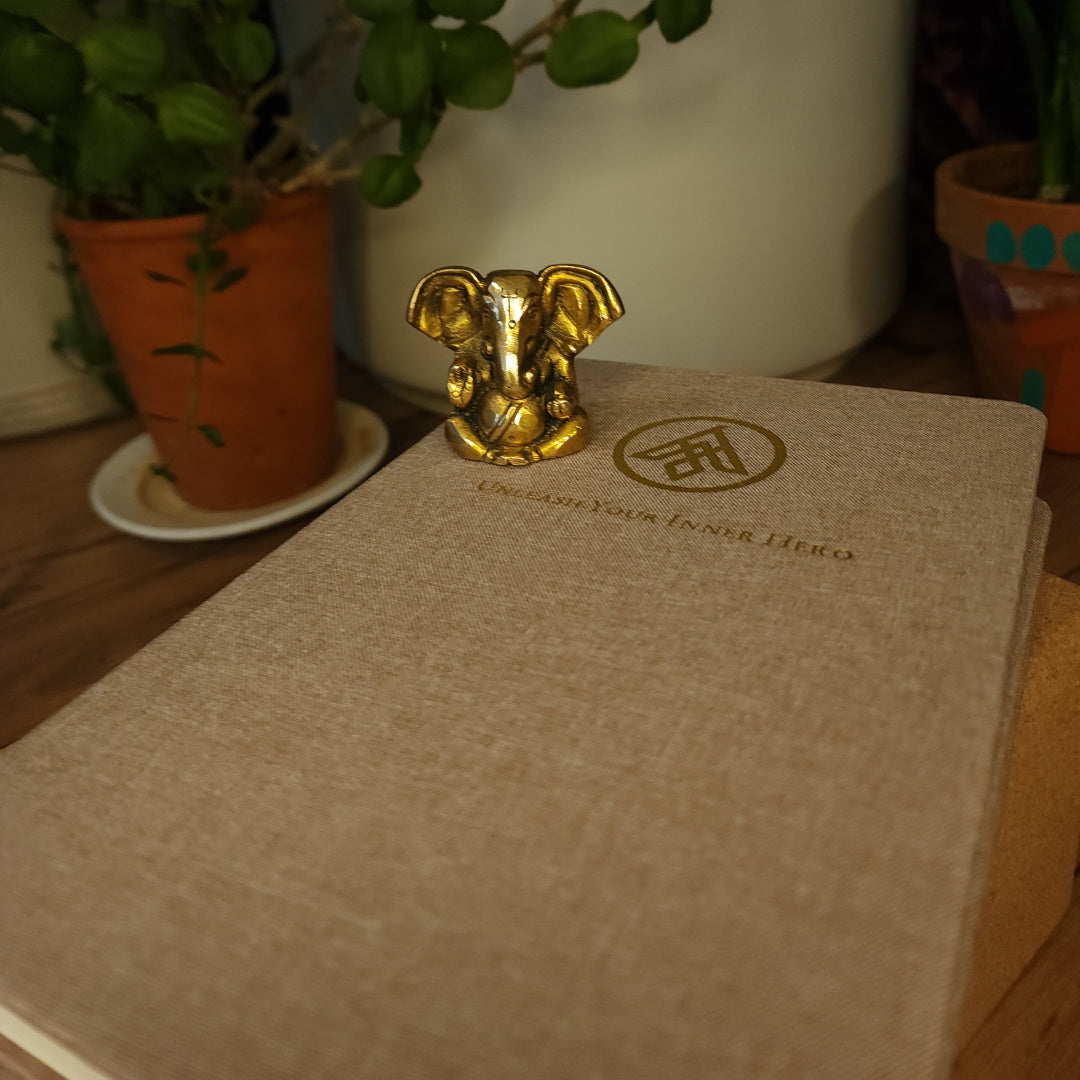
Ganesh (or Ganesha) is the elephant-headed deity in Hindu tradition, revered as the remover of obstacles and the patron of beginnings, wisdom, and intellect. Statues or images of Ganesh are commonly found in yoga studios to invoke blessings at the start of practice.
Learn more
Gaṇeśa (गणेश), also known as Ganapati, literally means “Lord of the Ganas (celestial hosts).”
Yogically, Ganesh symbolizes the principle of overcoming barriers, both external and internal.
He is widely revered as the remover of obstacles and bringer of good luck.
In a yoga training context, one might begin classes or endeavors with a Ganesh mantra (e.g., Om Gaṁ Gaṇapataye Namaḥ) to clear the path of difficulties.
Ganesh’s large head represents wisdom, the elephant strength represents steadfastness, and his small mouse vehicle symbolizes the ability to penetrate even the smallest crevices of the mind.
While devotion to Ganesh can be a personal choice, the iconography and stories serve as rich allegory.
They remind practitioners to cultivate discernment (viveka) and fortitude when faced with challenges on the yogic path.
Garbha (Womb)
Definition
Garbha means “womb” or “embryo.” It denotes an enclosure or seed of potential. In yoga, the term appears in poses like Garbha Pindasana (Embryo in the Womb Pose).
Learn more
Garbha (गर्भ) translates to womb, the nurturing space where growth takes place.
In Hatha yoga, Garbha Pindāsana is a compact, curled pose – garbha = womb, pinda = embryo – where the practitioner threads arms through lotus-positioned legs and balances, resembling a fetus in utero.
Symbolically, garbha represents creativity and the source of life.
This appears in terms like Garbhōpaniṣad, an Upanishad about embryology, or garbhāsana in prenatal yoga contexts.
Some meditative practices advise focusing on the “inner cave of the heart,” occasionally referred to as the hṛdaya-garbha, indicating a spiritual womb from which insight is born.
In Ayurveda, garbhadāna refers to healthy conception.
For yoga teachers, understanding garbha as womb or seed can inspire themes of renewal, potential, and returning inward to the origin of being.
Garuda (Eagle
Definition
Garuda is the mythic eagle in Hindu lore, known as the carrier (vahana) of Lord Vishnu. In yoga, Garuda symbolizes majestic strength and the ability to soar above limitations.
Learn more
Garuḍa (गरुड) is often depicted as a powerful eagle or hawk-like creature, massive enough to carry Vishnu on his back.
The name “Garudasana” (Eagle Pose) is derived from Garuda, a huge, mythical bird with a golden body.
Garuda represents keen sight, speed, and transcendence.
In yoga, Garudāsana requires balance and focus, arms and legs entwined like the coiled posture of an eagle.
The pose compresses and then releases blood flow, inviting renewal.
Stories of Garuda emphasize devotion and courage, as he served Vishnu to free his mother.
Teachers may invoke Garuda to encourage higher perspective (drishti) and strength of purpose in practice.
Garudasana (Eagle Pose)
Definition
Garudasana is Eagle Pose, a standing balance pose where one arm crosses under the other and one leg wraps over the other. The intertwined posture resembles an eagle’s silhouette.
Learn more
Garuḍāsana (गरुडासन) is named after Garuḍa, the mythic eagle.
The Sanskrit name honors the divine bird Garuda rather than a literal animal shape.
The pose challenges balance and concentration while binding the limbs.
Energetically, it opens shoulders, wrists, hips, and ankles while strengthening legs and core.
The binding creates compression followed by a release of circulation.
Symbolically, Garuḍāsana teaches constraint leading to expansion.
A teaching cue is to draw into the midline to find stability before extending outward.
Go (Cow)
Definition
Go means “cow” in Sanskrit. It also carries the broader sense of cattle or, symbolically, the Earth, since cows are sacred and connected to the land in Indian culture.
Learn more
Go (गो) is a simple Sanskrit word meaning cow.
In yoga, go appears in terms like Gomukhāsana (“cow-face pose”).
In Gomukhāsana, go means cow and mukha means face, referring to the shape formed by the limbs.
Cows symbolize gentleness, abundance, and nourishment in Indian tradition.
In broader contexts, go can also mean senses or rays of light, depending on usage.
Krishna is called Gopāla, protector of cows, linking the term to devotion.
Knowing go = cow helps decode pose names and mudras shaped like a cow’s face or ear.
Gomukhasana (Cow Face Pose)
Definition
Gomukhasana is Cow Face Pose. It’s a seated posture where the knees are stacked over each other and the arms are clasped behind the back (one elbow up, one down). The arrangement of limbs is said to resemble the face of a cow.
Learn more
Gomukhāsana (गोमुखासन) breaks down to go (“cow”) + mukha (“face”) + āsana (“pose”).
The name comes from the shape formed: the crossed legs create a shape like a cow’s mouth and the elbows sticking out resemble a cow’s ears or horns.
Traditionally, this pose is used for hip-opening and shoulder mobility.
It provides a deep stretch to the external rotators of the hips (glutes/piriformis) and to the triceps and chest muscles (through the arm bind).
Energetically, it directs awareness to the heart and sacral regions, and sitting upright in Gomukhasana is also suitable for pranayama or meditation once comfortable.
In teaching, one often needs to offer modifications (like using a strap between the hands, or sitting on a blanket if knees are sensitive) because the full pose can be challenging for those with tight shoulders or hips.
As for the “cow” symbolism: cows in Indian culture are calm and steady – one could say Gomukhasana invites a steady, grounded feeling (through the firm base of the pose) combined with openness (through the chest stretch), much like the gentle yet solid presence of a cow.
Goraksa (Cow Protector)
Definition
Goraksa (often spelled Goraksha) refers to the great yogi Guru Gorakhnath, a medieval master who was instrumental in the development of Hatha Yoga. The name “Goraksa” literally means “cow protector.”
Learn more
Gorakṣa (गोरक्ष) is the Sanskrit epithet meaning “cow-protector”.
It’s famously the name of Gorakṣanath (Gorakhnath), a sage who lived around the 10th–11th century CE and is credited with authoring influential texts like the Gorakṣa Śataka and Hatha Yoga manuals.
Under the guidance of his guru Matsyendranath, Gorakhnath spread the teachings of yoga throughout India, and he’s regarded as a founder of the Nath yogi tradition.
Many Hatha Yoga practices (āsanas, prāṇāyāma techniques, bandhas, etc.) are attributed to Goraksa’s lineage.
In modern yoga training, you might learn that Goraksha was a siddha (realized master) who emphasized the yoga of transformation – turning the gross body into a subtle body fit for enlightenment.
There’s even a pose named Gorakṣāsana (Yogi Gorakhnath’s pose), a sort of yogic squat said to be favored by him.
The name itself—protector of cows—indicates a person who tends the “sacred” and humble; metaphorically, it reflects how Gorakhnath protected and nurtured the sacred knowledge of yoga.
Remembering figures like Goraksa links present-day practitioners to the historical lineage (guru-paramparā) of yoga teaching.
Granthi (Knot)
Definition
Granthi means “knot.” In yoga, it often refers to energetic knots or blockages along the spine that prevent the free flow of prana. The three main granthis are Brahma Granthi, Vishnu Granthi, and Rudra Granthi.
Learn more
Granthi (ग्रन्थि) literally is a knot or tie, and in yogic context it denotes a psychic/energetic knot in the subtle body.
These knots symbolically bind consciousness, making it difficult for kundalini energy to rise through the chakras.
The three granthis are: Brahma Granthi – located around the muladhara (root) chakra, associated with the bondage to material desires and survival instincts; Vishnu Granthi – around the anahata (heart) chakra, tied to attachments in the realm of emotions and ego (attachment to duty, tradition, or form); Rudra Granthi – near the ajna (third-eye) chakra (some say throat or between ajna and sahasrara), related to attachment to psychic powers or the subtlest ego identity.
Yoga practices like specific pranayamas (e.g. Kapalabhati), bandhas (energy locks), and meditation on chakras aim to “pierce” or untie these granthis, allowing kundalini (transformative energy) to ascend and consciousness to expand.
In a teaching setting, granthis might be introduced when discussing Kundalini or Tantra Yoga, to help students conceptualize inner obstacles.
Even psychologically, one can think of granthis as deep-seated knots of conditioning that yoga helps release.
Gunas (Constituents of Nature)
Definition
Gunas are the three fundamental qualities or constituents of nature, according to Samkhya/Yoga philosophy. They are sattva (purity, balance), rajas (activity, passion), and tamas (inertia, darkness). Everything in the universe, including our minds, is influenced by a mix of these three gunas.
Learn more
Guṇa (गुण) means “quality” or “attribute.”
In yoga philosophy, particularly Sankhya, the three guṇas (triguṇa) are the forces that compose Prakṛti (material nature).
Sattva guna brings clarity, harmony, light; it is responsible for happiness, wisdom, and tranquility.
Rajas guna brings movement, change, and stimulation; it causes desire, effort, and restlessness.
Tamas guna brings heaviness, resistance, and obscurity; it results in lethargy, confusion, and decay.
These three exist in everything and everyone in varying proportions and constantly fluctuate.
The aim of yoga is to cultivate sattva – for a pure, serene mind – while reducing excess rajas and tamas.
For example, a sattvic diet (pure vegetarian food) and lifestyle (truthfulness, cleanliness) promote sattva; too much screen time or spicy food might increase rajas; oversleeping or junk food can increase tamas.
Ultimately, even sattva is transcended in the state of samadhi, but until then, yoga practice (āsana, prāṇāyāma, meditation) can be seen as a means to bring the guṇas into balance, leading to a clear, sattvic mind fit for enlightenment.
Guru (Teacher)
Definition
Guru means “teacher” or “spiritual mentor.” In the yoga tradition, a guru is someone who imparts wisdom and guides students on the path, often described as one who dispels darkness (ignorance) with light (knowledge).
Learn more
Guru (गुरु) in Sanskrit literally translates to “heavy” or “weighty” – implying profundity.
A popular explanation is that gu means “darkness” and ru means “remover”, so guru is “the remover of darkness (ignorance).”
In guru-disciple relationships (guru-śiṣya paramparā), the guru is not merely a teacher of techniques, but a guide who through their insight and experience awakens the disciple’s inner knowledge.
Traditionally, yoga was transmitted directly from guru to student over years (or a lifetime) of close study.
The concept extends beyond a person – anything or anyone that opens your eyes to truth can be seen as a guru.
In modern yoga settings, guru can simply mean a respected teacher, although many classes use the term “teacher” unless referring to an acknowledged spiritual master.
The guru principle emphasizes humility and trust: the student (śiṣya) approaches with an open heart and the guru guides ethically for the student’s benefit.
It’s often said the true guru is ultimately the inner Self; external gurus are there to point you back inward.
Still, honoring one’s teachers and lineage is a big part of yoga culture (for example, the chant “Gurur Brahma, Gurur Vishnu…” acknowledges the guru as the creative, sustaining, and transforming principle).
Guru Parampara (Succession of Teachers)
Definition
Guru Parampara is the lineage of gurus and disciples – essentially the “teacher to student” chain through which knowledge is passed down. It emphasizes that yoga teaching is part of an ongoing tradition.
Learn more
Guru Paramparā (गुरु परम्परा) means “succession of teachers.”
Paramparā translates to tradition or continuation, and in context it’s the unbroken line of transmission from guru to disciple over generations.
For example, one might trace a yoga style’s paramparā: from Krishnamacharya → B.K.S. Iyengar → next generation teachers, and so on.
This lineage guarantees the authenticity and purity of teachings, as each disciple receives the depth of knowledge from their guru and then becomes a guru for the next generation.
In teacher trainings, acknowledging the guru paramparā fosters respect for the source of the teachings and reminds new instructors that they too are part of this living chain.
Even if one’s “guru” is not a single person but a set of teachings or mentors, the idea is to honor the origin.
Many traditional classes begin with a Guru Mantra to salute the lineage (e.g., “sadāshiva samarambhām…” which names the paramparā).
Remember: being in a guru paramparā means one is a steward of the yoga wisdom, tasked with passing the light on responsibly, so the flame kindled by ancient sages continues to burn bright.