Sanskrit Terms Starting with H
Jack UtermoehlShare
This page is an alphabetical list of Sanskrit terms commonly used for teaching and understanding yoga in Western contexts that begin with the letter H.
Index of Sanskrit Terms
Halasana (Plow Pose)
Definition
Halasana is Plow Pose. In this inverted posture, from a shoulderstand you lower your toes to touch the floor above your head, with legs straight, creating a shape like an old-fashioned plow.
Learn more
Halāsana (हलासन) comes from hala meaning “plow” and āsana meaning “pose.”
The body’s position – folded at the hips with feet extended overhead – resembles a plow used in farming.
Halasana deeply stretches the spine and hamstrings, stimulates the thyroid gland (due to chin pressure on the throat), and calms the nervous system.
It is typically done after Sarvāṅgāsana (Shoulderstand) as a counter-pose, allowing more spinal flexion.
Energetically, halāsana directs awareness inward; with the gaze toward the heart and the body in a contained position, pratyāhāra (sense withdrawal) naturally arises.
In teaching, precautions should be noted: students with neck issues or tight shoulders may need props or modifications (like practicing with knees bent or using a chair).
The plow imagery can be meaningful – just as a plow prepares the soil for new seeds, Halasana can be seen as preparing the body-mind field for deeper practices by uprooting stiffness and tossing aside restless thoughts, leaving a more fertile ground for relaxation or meditation.
Hamsa (Swan)
Definition
Hamsa means “swan.” The hamsa is often used as a symbol of the soul or spiritual grace in Indian and yogic literature.
Learn more
Haṃsa (हंस) is the Sanskrit word for a swan or goose.
In yogic symbolism, the hamsa is revered for its purported ability to separate milk from water – metaphorically representing discernment (sifting truth from illusion).
The term Paramahamsa (“supreme swan”) is an honorific for enlightened sages, implying they dwell in the pure essence.
Additionally, “hamsa” is associated with the breath mantra: it is said each inhalation sounds like “ham” and each exhalation like “sa,” so the soul is continually chanting ham-sa, ham-sa (or so’ham when reversed) with each breath.
This Hamsa mantra means “I am That,” identifying the individual consciousness with the universal consciousness.
Some meditation practices specifically use the Hamsa/Soham mantra to cultivate a natural, effortless concentration on the breath and the idea of unity with the divine Self.
The image of a white swan gliding on a still lake is a beautiful representation of the sattvic (pure) mind a yogi seeks – able to remain unstained by the waters of the world.
Thus, hamsa encapsulates purity, wisdom, and the intrinsic link between breath and spirit in yoga.
Hamsa Mantra (Unspoken Mantra)
Definition
The Hamsa mantra is the spontaneous mantra of the breath, often recognized as “So’ham” (or “Ham-sa”). Inhalation naturally sounds like “so,” exhalation like “ham,” which translates to “I am That.” It is a meditation practice aligning one’s breath with the awareness of unity with the universe.
Learn more
Haṁsa mantra (हंस मंत्र) is a classic ajapa-japa (unspoken mantra) continually reciting itself with each breath.
So’ham (सोऽहम्), meaning “I am That,” is the same mantra read in reverse.
Both forms emphasize the idea that the individual self is one with the supreme Self.
In practice, a meditator will sit quietly and mentally follow the breath, gently hearing “ham” on exhalation and “sa” on inhalation (or “so” on inhale, “ham” on exhale; the sequence is the same cycle).
This trains the mind to merge with the breath’s rhythm and the vibration of the mantra.
Philosophically, That (tat) refers to the ultimate reality or consciousness (Brahman), and I am (asmi or implied in so’ham) asserts one’s identity with it.
Thus, every breath becomes a reminder of divinity within.
Many Upanishads and Tantric texts mention this mantra – sometimes called the ajapa gayatri.
The beauty of the haṁsa mantra is that it’s already happening; the yogi simply becomes aware of it.
In teacher training, you might encounter hamsa in pranayama or meditation modules, highlighting how awareness of breath can lead to awareness of the Self.
By focusing on So’ham during meditation, practitioners often find the mind easily returning to a natural focus, since it is in tune with the very current of life force.
Over time, this mantra can cultivate a deep sense of peace and oneness as the distinction between breather, breath, and sound fades into pure being.
Hanu (Jaw or Chin)
Definition
Hanu means “jaw” or “chin.” It’s not a common standalone term in yoga practice, but it features in the name Hanuman and related lore.
Learn more
Hanu (हनु) is the Sanskrit word for the jawbone or chin.
A notable usage is in Hanumān (हनुमान्), the name of the famous monkey-deity devotee of Rama.
Hanuman is said to derive from hanu (jaw) and mān (perhaps from mant, “prominent” or man, “disfigured”) – essentially meaning “one with a prominent or disfigured jaw”.
According to legend, baby Hanuman’s jaw was struck by Indra’s thunderbolt, giving him a distinct feature and his name.
In yoga poses, we see hanumānāsana (Monkey Pose or forward splits) named after Hanuman, but hanu itself isn’t directly invoked.
Understanding hanu can give insight into subtle alignments – for example, in some pranayama or meditation instructions, you might hear about relaxing the hanusandhi (jaw joint) to release tension.
Also, recognizing that hanu means jaw can clarify translations; e.g., Hanuman as “Jaw-Man” – reminding us of the story behind the character.
While teaching, you probably won’t use “hanu” by itself, but knowing it enriches your appreciation of Hanuman-related practices or Sanskrit anatomy terms (like Jiva Bandha, sometimes defined at the chin lock, involves the jaw/chin position).
And if you ever cue “jalandhara bandha” (throat lock), note it doesn’t involve hanu in name, but the action is tucking the chin – a hanu-related movement.
So indirectly, the concept of the jaw does come into play in pranayama and mudra practice.
Hanuman (God of Devotion and Service)
Definition
Hanuman is the monkey-god from the Indian epic Ramayana, celebrated for his devotion, strength, and selfless service. In yogic culture, Hanuman symbolizes devotion (bhakti) and the power of faith – and the pose Hanumanasana (full front splits) is named after his famous leap across the ocean.
Learn more
Hanumān (हनुमान्) is a deity depicted as a humanoid monkey, revered as the epitome of sevā (service) and bhakti (devotion).
The name Hanuman itself reflects “broken jaw” (from hanu – jaw, and perhaps mān – disfigured/prominent) after an incident in his youth.
In the Ramayana, Hanuman’s unconditional devotion to Lord Rama enables him to perform miraculous feats, like leaping over the sea to Lanka to help rescue Sita – which is commemorated in Hanumanāsana, the forward splits representing that giant leap of faith.
For yogis, Hanuman represents the ideal disciple or yogi: egoless, powerful yet humble, and entirely dedicated to a higher purpose.
His energies are celebrated in mantra (e.g., “Sri Hanumān Chālīsā” or simply chanting Ram as he would) and in stories that impart lessons of strength combined with surrender.
In a yoga class, invoking Hanuman might be done to inspire courage or devotion in the practice.
For instance, when guiding students into a challenging pose or endeavor, one might reference Hanuman’s bravery and say, “Approach this with Hanuman’s spirit – strong in effort, soft in heart.”
Ultimately, Hanuman’s tale is a reminder that through grace (and one-pointed devotion), even the seemingly impossible can be achieved – a beautiful morale for any yogic journey.
Hasta (Hand)
Definition
Hasta means “hand.” Many pose names and terms use hasta to indicate involving the hands (for example, Hasta Utthanasana means Raised Hands Pose).
Learn more
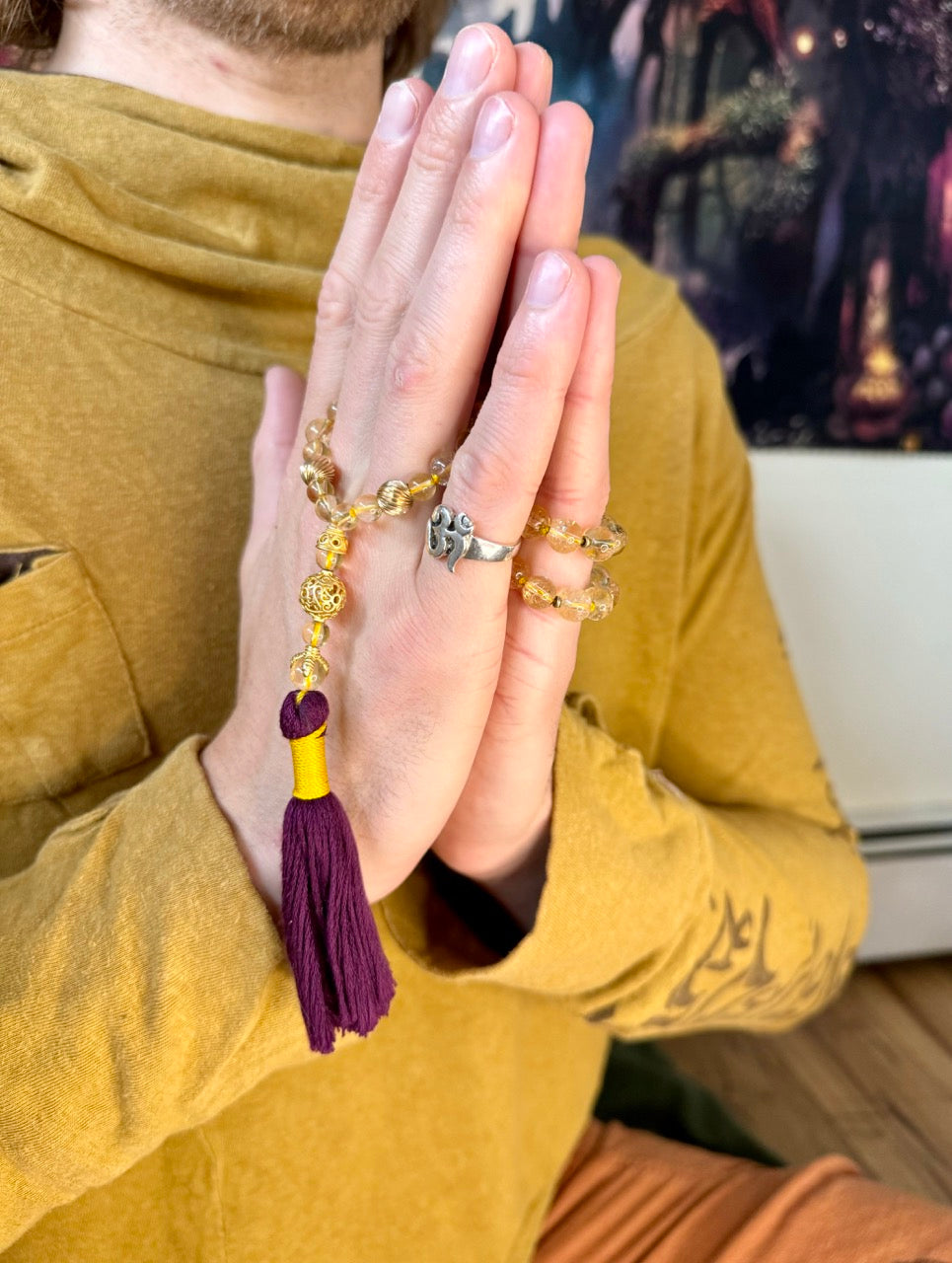
Hasta (हस्त) in Sanskrit denotes the hand, from wrist to fingertips.
You’ll see this term in asana names such as Pādahastāsana (“hand-to-foot pose,” where you place hands under feet in a forward bend) or Urdhva Hastāsana (“upward hand pose,” essentially the arms raised overhead).
It’s also common in descriptions of mudrās (hand gestures) – e.g., Jnana Mudra might be described as joining the index finger and thumb of each hasta.
Understanding the word hasta helps teachers and students alike decode instructions; for instance, “adho mukha svanasana, palms (hasta) firmly pressing down”.
Additionally, yoga anatomy references the term hasta-bandha (hand lock/engagement), which involves distributing weight through the hand evenly (particularly the mound of the index finger and thumb) and creating a subtle lift in the palm.
The hands are considered extensions of the heart in energetic anatomy (the heart chakra’s energy flows out through the arms to the hands), so working with hastas can also influence one’s heart energy.
In teaching cues, you might say “activate your hastas” to mean spread the fingers and engage the hand muscles.
Culturally, hasta appears in classic texts like the Hatha Yoga Pradipika describing gestures, and even in classical dance (hasta mudras).
So, it’s a simple term but highly useful across different yogic disciplines.
Hasta Bandha (Hand Lock)
Definition
Hasta bandha is the “hand lock.” It refers to the technique of engaging the hands by pressing through the fingers and creating a slight vacuum or lift in the palm. This action stabilizes the wrists and shoulders in poses where weight is on the hands.
Learn more
Hasta-bandha (हस्त बन्ध) literally means “hand lock”.
In practice, this is an energetic and muscular activation in the hands.
To perform hasta bandha, you spread the fingers wide and press down through the finger pads, knuckles, and the mound at the base of the thumb and index finger.
Concurrently, you suction the center of the palm upward (imagine drawing energy from the earth up into your hand).
This engagement supports the arches of the hand (yes, your palm has an arch similar to the foot’s arch) and takes strain off the wrist.
By rooting down through the edges of the hand and “lifting” the palm, the weight distributes evenly, preventing collapse into the heel of the hand.
Hasta bandha is essential in poses like Downward-Facing Dog, Plank, Crow, and handstands – it protects the wrist joints and allows for a stable foundation.
For teaching: you can have students practice hasta bandha by pressing their hands on the mat in tabletop and noticing the little dome under their palm.
When done properly, they often feel increased control and strength radiating up through the arms.
It also ties into shoulder girdle engagement (as the forearm muscles activate).
Emphasizing hasta bandha can dramatically improve arm balances and any asana where the hands bear weight, fostering a sense of rootedness and connection to the ground through the hands.
Hastagra (Hand-Tip)
Definition
Hastagra (or Hastagrah) means “hand-tip” – essentially the fingertips or the end of the hand. In yoga, hastāgra drishti is focusing your gaze on the tip of the hand.
Learn more
Hastāgra (हस्ताग्र) comes from hasta (“hand”) and agra (“tip” or “point”).
It’s commonly referenced with drishti, the focused gaze technique.
For example, in Triangle Pose (Trikoṇāsana), the classic drishti is hastāgrai dṛṣṭi – gazing at the upraised hand’s fingertips.
By directing one’s eyes to the hand-tip, the practitioner enhances concentration and alignment (the neck turns and aligns with the spine appropriately).
Hastagra drishti is also used in certain seated twists or any posture where looking at the hand aids balance or twist depth.
Understanding this term is mostly about recognizing cues: if an instructor says “hastagra drishti,” you know to find a steady point at the tip of your finger or thumb to look at.
Additionally, knowing Sanskrit breakdown can help – agra is “tip,” so you’ll see it in other contexts like nāsāgra drishti (nose-tip gaze).
In a broader sense, the concept reminds us how the seemingly small detail of where we place our gaze (dṛṣṭi) can transform the quality of our practice, turning a physical pose into a more meditative, single-pointed experience.
Hastagra, as the object of sight, becomes a tool for training the inner sight.
Hatha (Determined Effort)
Definition
Hatha yoga, often just called “hatha,” refers to the physical practice of yoga – postures (asanas), breathing techniques (pranayama), and cleansing practices. The word Hatha literally means “forceful,” but is commonly explained as the union of “ha” (sun) and “tha” (moon), indicating balance of opposites.
Learn more
Haṭha (हठ) yoga is the branch of yoga emphasizing physical methods to purify and prepare the body and mind.
The term haṭha literally translates as “force” or “determined effort,” highlighting the sometimes rigorous nature of its techniques.
Medieval texts like the Haṭha Yoga Pradīpikā outline practices such as āsanas, prāṇāyāmas, bandhas (energy locks), mudrās, and śatkarmas (cleansings) – all under the umbrella of Hatha Yoga – whose purpose is to awaken subtle energies and ultimately lead to rāja yoga (the state of meditation and samadhi).
In popular interpretation, ha is said to signify the sun (heating, active energy) and ṭha the moon (cooling, receptive energy), and Hatha Yoga thus seeks to harmonize these solar and lunar energies within us.
While scholars note this sun-moon meaning is a later esoteric explanation, it’s a useful metaphor taught in many yoga trainings to illustrate balance: “ha” (sun) + “tha” (moon) = Hatha, the yoga of balance.
A class labeled “Hatha Yoga” today typically means a combination of physical postures and breath, paced moderately – as opposed to a specific series like Ashtanga or the flowing nature of Vinyasa.
Essentially, most modern yoga as practiced in the West (if not explicitly Kundalini, Mantra, etc.) is Hatha-based.
For teacher trainees, it’s important to know Hatha Yoga as the foundation from which various styles emerged, and historically, as a set of practices aiming at the “haṭha” or forceful breakthrough of the body’s limitations to reach a higher consciousness.
Hetu (Cause or Reason)
Definition
Hetu means “cause” or “reason.” It’s used philosophically to talk about the underlying cause of something (like the cause of suffering), or in logic as the middle term in reasoning.
Learn more
Hetu (हेतु) is Sanskrit for cause – the factor that gives rise to an effect.
In Patanjali’s Yoga Sutras, one example is avidyā (ignorance) being described as the hetu (root cause) of all the five kleśas (II.4).
In Buddhism and Yoga philosophy, understanding the hetu of suffering (duḥkha) is key to eliminating it – e.g., ignorance is the hetu of egoism, attachment, aversion, etc., so by removing ignorance through wisdom (jñāna), the chain of suffering is broken.
The term also shows up in Ayurveda (finding the hetu of a disease) and in Indian logic (Nyaya), where hetu is the reason in a syllogism (for instance, “there is fire on the hill because there is smoke” – smoke is the hetu, the cause/evidence indicating fire).
For yoga teachers, hetu might come into play when discussing the why behind practices: the cause of imbalance and how yoga addresses it.
For instance, you could say excessive rajas is a hetu (cause) of restlessness, and thus forward bends and cooling pranayamas are employed to counteract that cause.
In summary, understanding hetu encourages a mindset of inquiry – not just experiencing what is happening in one’s body-mind, but asking why it’s happening (and thus empowering the practitioner to make changes at the causal level).
Yoga is, in a way, the science of addressing root causes of suffering rather than just symptoms.
Hrdaya (Heart)
Definition
Hrdaya means “heart.” In Sanskrit, it refers both to the physical heart and the spiritual heart center.
Learn more
Hṛdaya (हृदय) – often spelled hridaya – is the term for heart, the core of one’s being.
It is not just the anatomical organ, but in yogic and tantric philosophy it signifies the seat of consciousness and love within – sometimes called the spiritual heart.
In fact, certain traditions speak of the hṛd akasha (heart space) as a special cave where one can meditate on the Self.
Adi Shankaracharya and other sages have used hridaya to denote the innermost Self (for example, in the Brahma Gita: “in the middle of the heart cave, Brahman shines”).
The word itself can be etymologically broken as hri (to take away) + da (to give) + ya (that which), implying that which gives and takes – perhaps hinting at the heart’s role in circulation or in emotional exchange.
In yoga practice, anāhata chakra (the heart chakra) is the energetic hrdaya-sthana (heart place).
Techniques like Hridaya Mudra (heart gesture) or meditations focusing on loving-kindness (metta) target this heart center.
From a training perspective, understanding hrdaya reminds teachers and students that yoga is ultimately a heart-centered practice – beyond just alignment of bones and muscles, it’s about aligning with compassion, empathy, and one’s inner truth found in the heart.
As an example, many pranayama sessions advise “keeping your awareness in the heart center (hridaya)” to cultivate a sense of peace.
Hridaya is truly the spiritual dimension of the heart: the place of deep trust, connection, and the abode of the soul.
Hridaya Akasha (Heart Space)
Definition
“Heart space.” Hridaya Akasha refers to the inner spiritual space of the heart. It is considered an internal sky or subtle cavity within the heart where one’s consciousness or true Self can be realized.
In meditation or yoga practice, focusing on this heart space can evoke a sense of expansive peace and deep inner presence.
Learn more
Hṛdayākāśa – literally “heart-ether” or “space of the heart.” Classical Vedantic texts describe hṛdayākāśa as the luminous space in the heart where Brahman (ultimate reality) is immediately perceptible to the contemplative mind.
It is sometimes called the “mental canvas” or inner sky in which the entire universe is held in potential.
In yogic and tantric systems, this concept underpins heart-centered meditations: by turning awareness to the spiritual heart (not the physical organ, but the heart akasha), a practitioner aims to transcend mental noise and experience the Hridaya Akasha as a gateway to pure consciousness and unity with the universal Self.
This heart-space is thus both a meditative focal point and a symbol of the infinite presence of the divine within.